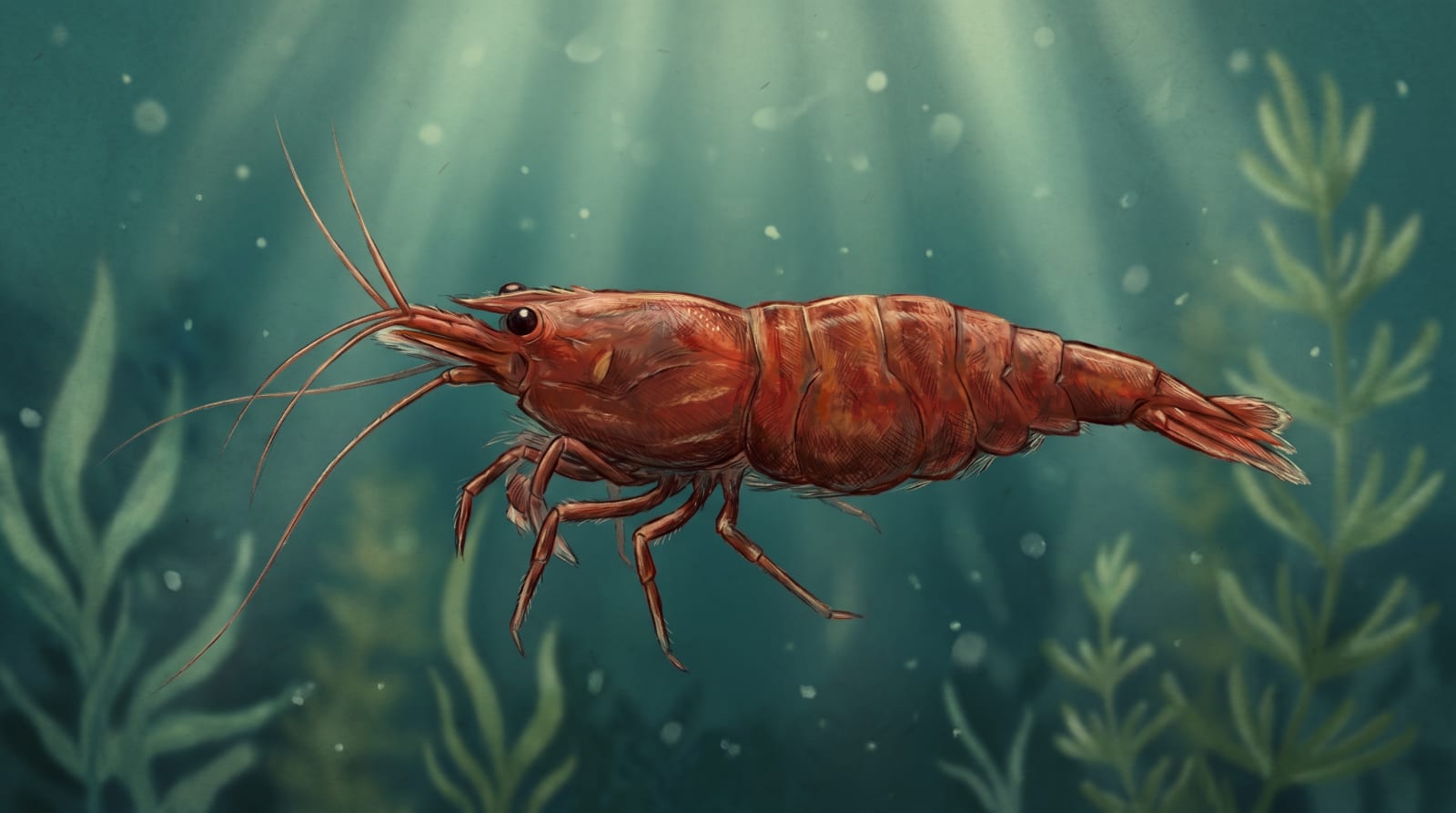
Every hobby has its jargon, and shrimp keeping has plenty. This shrimp keeping glossary gathers the terms we use most on this site and in the breeding room, in plain English, grouped by what they describe. Where a term has a full guide of its own, we've linked it. Skim the lot, or use your browser's find to jump to the word that sent you here.
The parts of a shrimp (anatomy)
You don't need to be an anatomist to keep shrimp, but a handful of body-part names come up again and again — in care guides, in sexing, in disease ID. Here's the map.

Antennae
Two pairs of feelers on the head, one long pair and one short. A shrimp tastes and touches its way around the tank almost entirely through them, waving them constantly as it grazes. Healthy shrimp keep both pairs intact and active; missing or stubby antennae usually point to an old injury, a rough moult, or a nip from a tank mate. On the chart above they're the long lines sweeping back from the front of the face.
Carapace
The single hard shield covering the head and thorax — the front half of the shell. It's the canvas colour grading is judged on, since depth and evenness read most clearly across the carapace. It matters at moulting too: the shell splits at the back edge of the carapace so the shrimp can arch out backwards, which is why moulting trouble tends to show up right there.
Exoskeleton
The whole external shell that gives a shrimp its shape and its armour. Because it can't stretch, a shrimp has to shed and regrow the lot to get any bigger — see Moulting. The exoskeleton is built largely from minerals pulled straight from the water, which is why general hardness matters so much: too little dissolved mineral and the new shell sets soft and incomplete.
Pleopods
The swimmerets — the paired, feathery limbs under the abdomen that beat constantly to push water and oxygen over the body. In females they take on a second job: holding and fanning eggs. When a female is carrying a clutch beneath these limbs she's described as berried, and her steady fanning keeps the eggs clean and oxygenated right up until they hatch.
Rostrum
The pointed, saw-toothed spike projecting forward between the eyes — think of it as the shrimp's nose in profile, though it's really a forward extension of the carapace. It's a favourite perch for a couple of harmless-looking hitchhikers, so it's worth knowing: tiny white stalks sprouting from the rostrum are usually scutariella, a treatable commensal worm rather than part of the shrimp itself.
Telson
The pointed central plate at the very end of the tail. Together with the fan-shaped uropods either side of it, the telson forms the tail fan a shrimp uses to backflip away from danger — and out of its old shell when it moults. A quick, snappy tail-flick when startled is a reassuring sign of a strong, well-minerated shrimp.
Uropods
The pair of flat, fan-like plates flanking the telson at the tail end. Telson and uropods together make up the "tail fan" that powers a shrimp's escape backflip. They're also one of the spots keepers check colour on high grades, since the strongest lines carry pigment right out to the tail rather than fading to clear at the very edges.
Breeding and life-cycle terms
Berried
A female carrying fertilised eggs under her tail, held and fanned by the swimmerets — named for the berry-like cluster they form. She'll usually become berried within days of a moult, carry 20–30 eggs for 14–21 days, and fan them constantly until they hatch. The best thing you can do for a berried female is nothing dramatic: keep the water stable and leave her to it.
Direct development
The reason cherry shrimp are so easy to breed. There's no free-swimming larval stage — a Neocaridina egg hatches straight into a 1–2mm fully formed miniature of the adult, able to graze biofilm from day one. It needs no special foods and no brackish water, unlike some larger shrimp. Direct development is exactly why a colony renews itself with essentially zero intervention from you.
Moulting
Shedding the old exoskeleton in order to grow. Adults moult every three to six weeks, juveniles more often, and for 24–48 hours afterwards the new shell is soft, so the shrimp hides. The cast-off shell is translucent and complete — leave it in, and the colony grazes it back. When a moult fails, you get the white ring of death, a stall usually tied to hardness problems and sudden swings.
Saddle
A patch of developing eggs visible in the ovaries behind the head, sitting roughly where a saddle would on a horse — hence the name. It's the earliest sign a female is maturing and getting ready to breed, and one of the clearest tells when you're sexing your shrimp. When she next moults, a saddled female will often mate and become berried within a day or two.
Shrimplet
A baby shrimp. Thanks to direct development, shrimplets emerge as 1–2mm replicas of the adults and fend for themselves immediately, grazing biofilm off surfaces around the tank. They're too small to travel far for food, so a mature, biofilm-rich tank with plenty of moss cover raises far more of them than a spotless new one. Most reach breeding size in three to five months.
Colour, grading and genetics terms
Cull
A shrimp removed from the breeding line for weak or off colour — and, as a verb, the act of removing it. Culling doesn't have to mean killing: most keepers keep a separate tank, or sell and give away culls as standard-grade pets. It's how a line is kept sharp over generations. Our guide to culling covers the humane options and why you never release surplus to the wild.
Fire Red
The grade above Sakura on the red ladder: near-complete, deep red coverage across the whole body, legs included, with little to no clear patching. Fire Reds fetch more than plain cherries because holding the grade takes constant selection. They are exactly the same species as a standard red cherry — just many generations of choosing the reddest, most fully covered parents.
Grade
A ranking of how good an individual's colour is — its depth, its coverage, and how far it extends onto the legs and tail. For red cherries the ladder runs Cull, Cherry, Sakura, Fire Red, Painted Fire Red, and the price climbs with each rung. Grading is partly subjective and completely unregulated, so one seller's "Fire Red" can be another's "Sakura" — our grades guide shows what each should actually look like.
Line-breeding
Breeding selectively within a single colour line — keeping the best-coloured shrimp back to parent the next generation and culling the rest — to deepen and fix colour over time. It's how the high grades are made and held. The flip side is that mixing two different lines does the opposite, scattering the offspring back towards dull wild-type. One line per tank is the rule that follows from it.
Painted Fire Red
The top of the red grading ladder: solid, opaque, brush-on red with no translucency anywhere, right down to the legs. "Painted" captures the look — as though the shrimp has been coated rather than merely coloured. These are the priciest red Neocaridina, because only a fraction of any brood makes the grade and keeping a line at this level takes relentless selection generation after generation.
Sakura
The middle grade on the red ladder, a step up from a plain Cherry: fuller red coverage with only small clear patches, but not the near-solid colour of a Fire Red. Sakura is where a lot of hobby stock sits, and good value if you want a rich-looking colony without top-grade prices. The term gets used loosely, so judge the shrimp in front of you, not the label on the tank.
Wild-type reversion
The way mixed or poorly selected lines drift back to the dull brown-green of wild Neocaridina. All the bright colours are selected forms of one species, so when different lines interbreed, their offspring trend back to that wild-type camouflage within a couple of generations. It isn't a disease or a fault — just genetics reasserting itself, and the reason keepers don't mix colour lines in a breeding tank.
Water and tank terms
Biofilm
The thin, living layer of bacteria, algae and microorganisms that coats every surface in a mature tank — invisible, faintly slimy, and the primary food cherry shrimp graze all day long. It's why shrimp constantly pick at glass, wood and leaves, and why shrimplets thrive in an older, settled tank. You don't buy biofilm; you grow it, with light, surfaces and a few weeks of patience.
Cycling
Establishing the colony of beneficial bacteria that convert toxic ammonia to nitrite and then to far less harmful nitrate — the "nitrogen cycle". A tank has to be cycled for four to six weeks or more before any shrimp go in, because ammonia and nitrite are lethal to them at any measurable level. Skipping the cycle is the single most common cause of first-week losses.
Dechlorinator
A water conditioner that neutralises the chlorine — and, just as importantly, the chloramine — that UK water companies add to tap water. Chlorine gasses off if water is left standing overnight, but chloramine doesn't, so a conditioner rated for chloramine is essential at every water change. Untreated tap water is a common and entirely avoidable shrimp killer. Use it every single time you add new water.
GH (general hardness)
The concentration of dissolved calcium and magnesium in the water — the very minerals a shrimp builds its new shell from. Cherry shrimp want GH 6–12, a touch higher for breeding. Too low and shells set soft, causing failed moults; the fix in soft-water regions is to remineralise. GH is measured in degrees (dGH) or ppm, and it's a separate reading from KH.
KH (carbonate hardness)
The water's buffering capacity — how well it resists sudden pH swings. Cherry shrimp are content at KH 2–8. Some KH is genuinely useful, because it stops pH crashing overnight; with too little, readings turn unstable. KH is often confused with GH, but they measure different things: GH is the shell minerals, KH is pH stability. Both come up whenever you're getting water right.
Remineralising
Adding minerals back into soft or near-mineral-free water — RO water, rainwater, or naturally soft tap — to bring GH and TDS up into the shrimp's range. Soft-water keepers dose a GH+ (or GH/KH+) remineraliser to a target reading rather than by guesswork. It's the standard step across much of Scotland, Wales, Cornwall and the North West, where tap water is simply too soft as it comes.
Sponge filter
An air-driven filter — a foam block on a lift tube, run off a small air pump — that's the standard for shrimp tanks. It has no intake to draw in shrimplets, it runs gently, and the foam itself becomes a huge grazing surface as biofilm builds across it. Cheap, quiet and completely shrimp-safe, it's what runs on every tank in our breeding room.
TDS (total dissolved solids)
A single meter reading, in ppm, of everything dissolved in the water — minerals, salts, the lot. Cherry shrimp sit happily at TDS 150–250, a little higher for breeding. On its own the figure matters less than its trend: a slow creep upward flags evaporation or overfeeding, while a sudden jump means something changed. A cheap TDS pen is the most useful test tool you'll own.