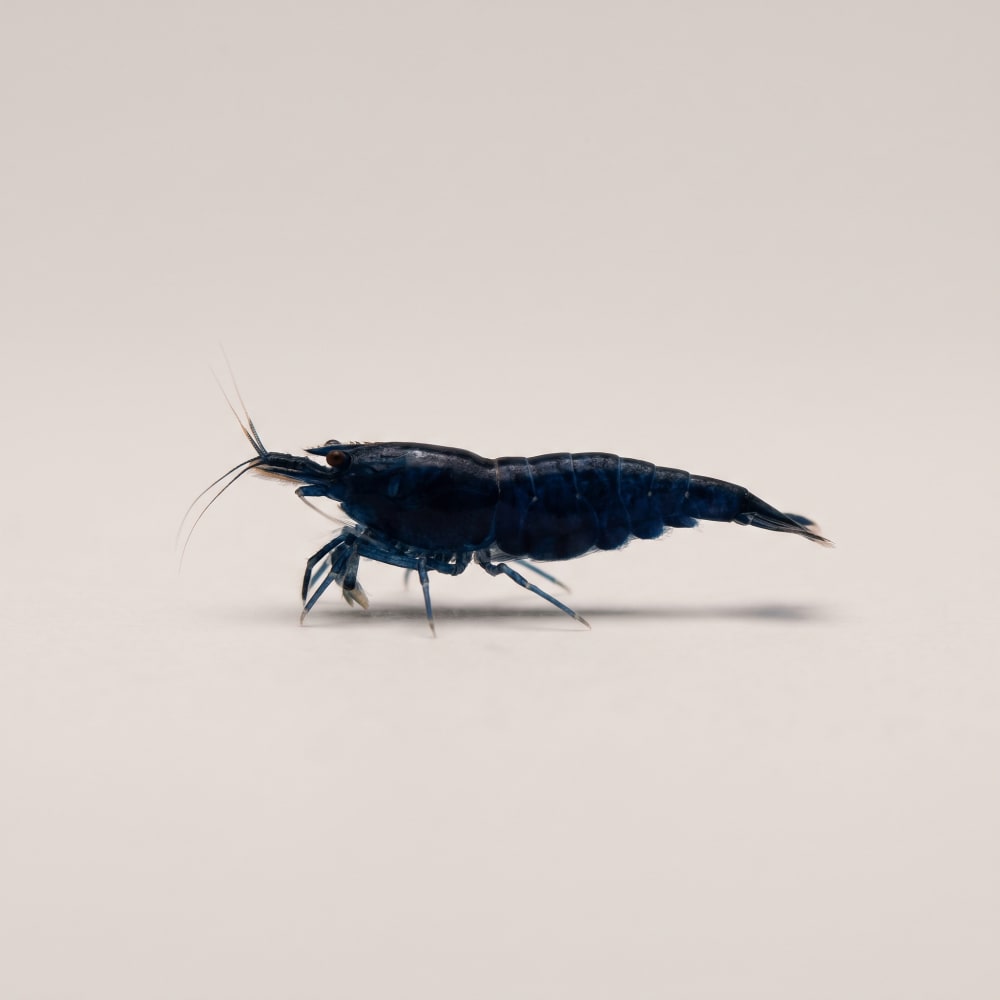
Blue Diamond is the darkest blue in the Neocaridina hobby: a deep sapphire that shades toward navy-black, closer to ink than sky. It's also the blue you're least likely to find in a UK shop, which is half the appeal. Under the colour it's a cherry shrimp, as easy to keep as they come.
Blue Diamond at a glance
| Difficulty | Easy |
| Adult size | 2.5–3cm |
| Lifespan | 1–2 years |
| Temperature | 18–26°C |
| pH | 6.8–7.6 |
| GH | 6–12 |
| TDS | 150–250 |
| Breeding | Prolific |
What is a Blue Diamond shrimp?
Blue Diamond is a colour line of Neocaridina davidi selected for the deepest blue the species will give: a saturated sapphire-to-navy that can read nearly black until the light hits it and the blue flares through. Origins get argued over, as Neocaridina origins always do, but most breeders credit the line to chocolate and black stock rather than to the other blues — and the shrimp themselves back that version up, because Blue Diamond broods routinely throw chocolate or blackish shrimplets. Put one next to a chocolate shrimp and the family resemblance is hard to miss.
That ancestry is the practical difference between a Diamond and a dark Blue Dream. The two can overlap in shade at the extremes, but most breeders treat them as separate lines with different typical throwbacks, which matters the moment you start breeding.
The three blues, side by side
UK keepers meet three blue Neocaridina lines, and they're easiest to hold apart as a scale from light to dark.
| Blue Velvet | Blue Dream | Blue Diamond | |
|---|---|---|---|
| Shade | Light sky blue | Deep navy | Deepest sapphire to near-black |
| Opacity | Semi-translucent, glassy | Opaque | Dense and dark |
| Usual lineage (as breeders tell it) | Blue rili | Velvet and chocolate lines | Chocolate and black lines |
| UK availability | Common | Common | The rarest of the three |
Blue Velvet is the glassy light blue, Blue Dream the solid navy, and Blue Diamond the one that makes visitors ask whether the shrimp is blue or black. In poor light, the honest answer is both.
Colour and grading
Diamonds are graded on depth and evenness, and specifically on how well the blue holds under light: a top shrimp stays saturated blue-black from every angle, while lesser grades grey out or show brownish undertones — the chocolate ancestry showing through the blue. Females are larger, darker and more opaque, males run slimmer and lighter, and juveniles darken considerably as they mature, so never judge or cull young stock. The grading framework that runs through every line is in the Neocaridina grades guide.
Care
Nothing new to learn: it's a cherry shrimp, and the cherry shrimp care guide covers it wholesale. A cycled tank of 19L or more, a sponge filter, inert substrate and stable water at 18–26°C, pH 6.8–7.6, GH 6–12, TDS 150–250. Stability matters more than any single number, and an unheated UK room is fine — breeding just runs slower at the cool end.
One display note peculiar to this line: a near-black shrimp disappears over dark substrate, the opposite problem to most Neocaridina. We keep our Diamonds over mid-tone substrate with paler hardscape so the blue actually reads. On water, most hard-water UK areas suit them straight from the dechlorinated tap, while soft-water regions should check the UK tap water guide and remineralise to GH 6–12 if needed. And no copper anywhere near the tank, ever.
Breeding true
Kept as a single line, Blue Diamond holds its colour well — with one caveat every buyer should hear before their first brood: expect some chocolate or blackish shrimplets. That's the lineage talking, not a mixed tank, and the fix is ordinary selection. Breed forward your deepest blues, rehome the brown throwbacks before they mature at 3–5 months, and the ratio drops over generations. Everything else is standard Neocaridina — berried females carrying 20–30 eggs for 14–21 days, shrimplets grazing biofilm from day one — and it's all in how to breed cherry shrimp.
Then the rule that applies to every line we keep: one colour per tank. Mix Diamonds with any other Neocaridina colour and the offspring drift back to brownish wild-type shrimp within a couple of generations — the mechanics are in mixing Neocaridina colours.
Buying Blue Diamond shrimp in the UK
Blue Diamonds are genuinely harder to find than Dreams or Velvets in the UK. Few shops carry them, and the good lines mostly move breeder to keeper. Price them accordingly: standard-grade blues sit at the usual £2–4 per shrimp, but proper high-grade Diamonds sit at the top of the £30–50 per 10 range, and at that money you should see photos of the actual colony showing deep, even blue-black across the whole group, not two show females. It's also worth asking what proportion of recent broods threw chocolate — an honest breeder will have a rough number rather than a blank look. Our own Diamond colony is rebuilding and sales are paused while it restocks; join the waitlist and you'll get first refusal when the next batch is graded.
FAQ
What is the difference between blue diamond and blue dream shrimp?
Shade and, most breeders would say, ancestry. Blue Dream is a deep opaque navy; Blue Diamond is darker again — sapphire into near-black — and is usually credited to chocolate and black lineage, which is why its broods throw brownish shrimplets. Dark Dreams and lighter Diamonds can overlap, so judge stock by photos rather than names.
Why did my blue diamond shrimp have brown babies?
Almost certainly the line's ancestry rather than anything you did. Most Blue Diamond lines are credited to chocolate and black stock, and that heritage resurfaces as chocolate or blackish shrimplets in perfectly normal broods. Select your bluest offspring forward and the proportion falls. If browns dominate over several generations, suspect mixed colour lines instead.
Are blue diamond shrimp rare?
In the UK, fairly — you'll see Dreams and Velvets in shops far more often. Rare doesn't mean difficult, though: care is identical to any cherry shrimp. In practice it means fewer sellers, prices at the top of the range and more reason to vet stock photos before you buy.
How much do blue diamond shrimp cost UK?
Expect the top of the usual range: £30–50 per 10 for high-grade lines, closer to the £50 end for the deepest blue-blacks, with standard-grade blues at £2–4 each. If a listing offers "blue diamond" at bargain prices, look hard at the photos — it's often lower-grade or loosely named blue stock.