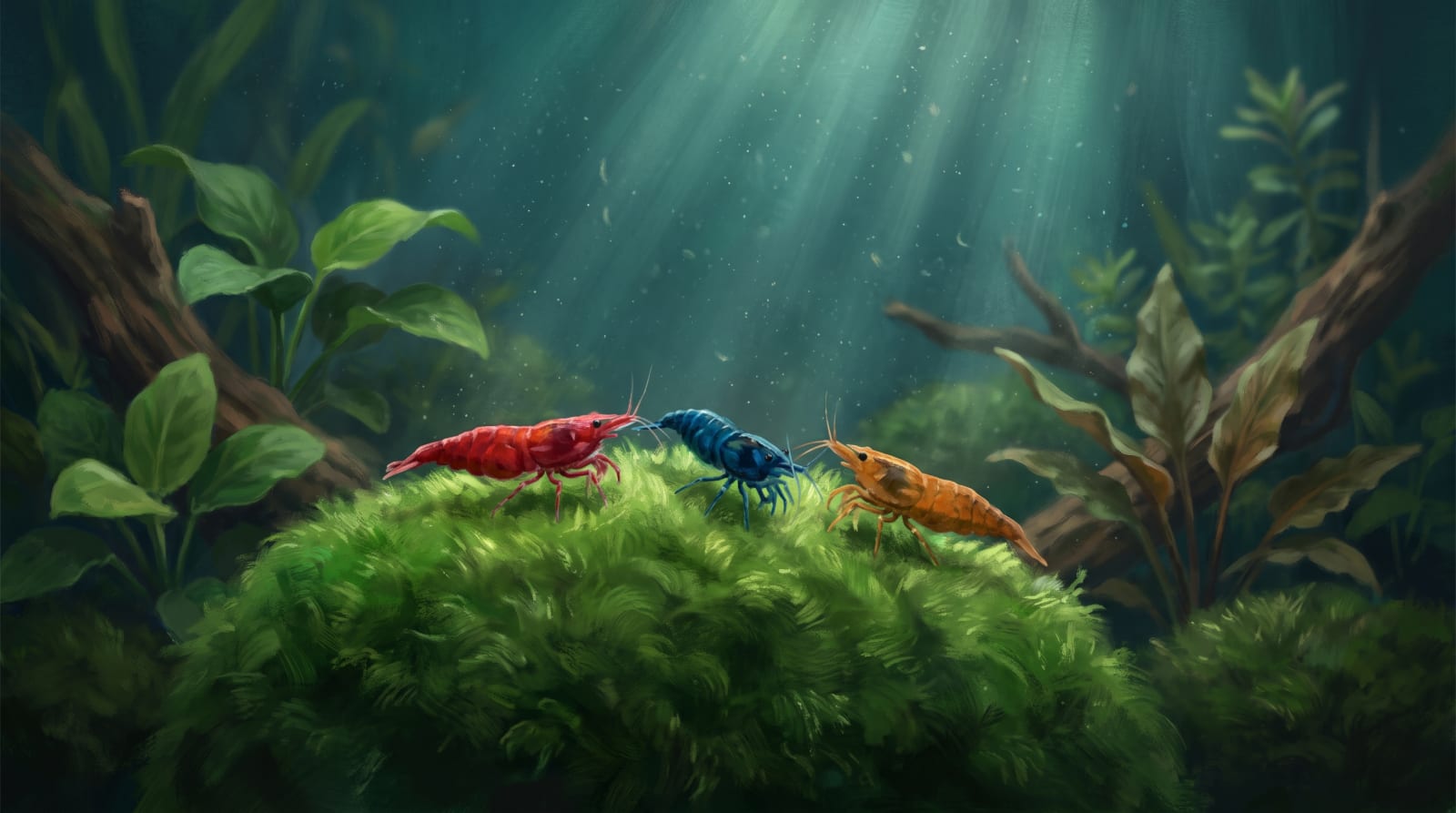
It's the question every keeper asks the moment they see a tank of reds, blues and yellows together: can you mix Neocaridina colours? The answer has two halves that pull in opposite directions. Yes — different colour shrimp live together perfectly happily, because they're all one species with identical needs. And no — you can't mix them and keep the colours, because they interbreed freely and their offspring slide back to muddy wild-type brown. Which half matters depends entirely on whether you want a colony that breeds true.
The short answer: fine to house, ruinous to breed
Put a blue and a red cherry shrimp in the same tank and nothing bad happens on the surface. They don't fight, they don't stress each other, they don't need different water. Every Neocaridina colour is the same animal — the same 2.5–3cm shrimp on the same 18–26°C, GH 6–12, stable parameters — so keeping different colour shrimp together is no harder than keeping one colour. As a display of adults, a mixed tank is genuinely lovely.
The trouble is invisible at first and lives entirely in the next generation. Because they're one species, red cherry and blue dream shrimp interbreed as readily as two reds would, and their babies don't come out purple, or half-and-half, or a fetching new shade. They come out brown. Within a couple of generations a mixed tank left to breed turns into a tank of drab wild-type shrimp, the exact camouflage colour their bright ancestors were bred away from.
So the honest one-line answer is: you can mix them to look at, but not to breed. If you never want babies, or don't care what colour they are, mix away. If you want your colours to last, don't.
Why mixed colours breed back to brown
The reversion isn't bad luck or poor keeping — it's baked into what these colours are. Every hobby colour is a selected trait sitting on top of a wild-type background, and wild-type — that mottled brown-green — is the species' genetic default. Breeders spend generations holding the bright colour in place by only breeding matching shrimp. Cross two different lines and you stop holding it: the selected colour genes separate out, the ancestral brown pattern reasserts itself, and the tank drifts back to where the whole hobby started. We map the full genetic picture in Neocaridina colour genetics.
It helps to picture the colours as lids pressed down on a wild-type spring. A pure line keeps the lid shut. Mixing lines lets the spring back up, and it doesn't take long — this is exactly the wild-type reversion that makes crossbreeding a dead end for colour, covered in detail in our guide to crossbreeding and wild-type reversion. The key thing to understand is that brown isn't a new colour the shrimp are turning into. It's the old one coming back.
"But my mixed tank still looks colourful"
Plenty of keepers will tell you their mixed tank looks great, and for a while they're right — which is where the confusion comes from. The reversion runs on a timeline, and it's slower than a single brood.
The shrimp you bought keep their colours for life; buy ten bright reds and ten bright blues and those twenty stay bright until they die of old age. The first generation of mixed babies is where it starts, and even they can carry enough colour to look passable at a glance. It's the second and third generations, the babies of the babies, where the wild-type brown really floods in and the tank visibly muddies. So a "skittles" tank often looks fine for its first few months and only reveals the problem once the mixed offspring have themselves grown up and bred.
There's a second reason mixed tanks in shops and community setups can look better than they should: shrimplet survival. In a busy community tank with fish, most baby shrimp get eaten before they mature, so the brown offspring never grow up to spoil the view — the display stays colourful because it's continuously restocked by the adults, not because the colours are breeding true. Take that same mix into a safe, planted, species-only tank where shrimplets thrive, and the browning arrives right on schedule.
The exceptions worth knowing
The "everything reverts to brown" rule is the one to plan around, but a few wrinkles are worth understanding honestly.
Colours that share recent ancestry drift less predictably than opposites. Blue Velvet, Blue Dream and Blue Diamond, for instance, all sit on the blue branch of the family and were bred from overlapping stock, so crossing them doesn't always crash straight to brown the way red-on-blue does — you might get intermediate blues for a while. "Less predictable" is the operative phrase, though, not "safe": you still lose the clean, fixed colour you started with, and the further generations still trend towards wild-type. Breeders chasing a specific line treat even same-branch mixing as contamination.
Patterns behave differently again. Rili shrimp carry a broken pattern rather than a solid colour, and mixing a rili into a solid line tends to scatter that pattern rather than blend it cleanly. And one popular "colour" isn't even the same species: Snowball shrimp often trace to Neocaridina cf. zhangjiajiensis rather than davidi, so mixing them with cherries muddies the genetics on a second axis. Their care is identical, but keep them separate if you want predictable offspring.
How to keep a mixed tank honestly
None of this means a mixed tank is forbidden — it means going in with open eyes. There are three honest ways to enjoy one.
The first is to simply accept the brown. Stock whatever colours you like, let them breed, and treat the eventual wild-type colony as the natural end point — some keepers enjoy watching the genetics play out, and wild-type shrimp are hardy, active and quietly handsome in their own right. It's a legitimate choice as long as it's a choice and not a surprise.
The second is to run a display that doesn't breed on. A single-sex group — all males, say — gives you a mix of colours with no babies to revert, though sexing well enough to guarantee it takes practice. Alternatively a mixed shrimp display in a community tank, where fish keep shrimplet numbers down, holds its look because few mixed offspring survive to muddy it. Neither grows a colony, which for a display tank is the point.
The third, and the one we'd actually recommend, is to skip the compromise entirely: keep several tanks, one clean colour line in each. You get all the colours you want across the shelf, every line breeds true, and nothing reverts. It's more glass but far less heartbreak, and it's how we run every colour in our breeding room.
If you want your colours to breed true
For anyone who wants a growing colony that stays the colour they paid for, the rule is short and non-negotiable: one line per tank. A single colour, kept closed to other lines, breeds true indefinitely and can even be improved over time — that's the whole basis of selective breeding for colour. The moment a second line shares the water, the clock starts on reversion.
That's also why guarding a line matters when you add stock. Even "the same" colour from another source can carry hidden variation, so quarantine and eyeball new shrimp before they join a project. Keeping colours pure is genuinely the easier path, not the harder one — the care is identical across every line, as our cherry shrimp care guide lays out, so the only real difference between a bright colony and a brown one is whether you kept the lines apart.
FAQ
Can you keep different colour cherry shrimp together?
Yes, without any problem — every Neocaridina colour is the same species with identical needs, so they cohabit happily and need no special arrangement. The only catch is breeding: because they interbreed freely, a mixed tank left to reproduce produces wild-type brown offspring within a couple of generations. Mix them if you want a display and don't mind losing the colours; keep them apart if you want a colony that breeds true.
Can you put blue and red cherry shrimp together?
You can house them together fine, but they'll interbreed, and their babies won't be blue, red or purple — they'll be brown. Blue and red are just two selected lines of one species, so crossing them lets the ancestral wild-type colour re-emerge, and within a couple of generations the tank muddies. The adults you bought keep their colours for life; it's the offspring that revert.
What happens if you mix cherry shrimp colours?
Short term, nothing — the shrimp live together happily and keep their own colours. Long term, they interbreed and their offspring drift back to wild-type brown over two or three generations, because every colour is a selected trait sitting on a brown genetic default. A mixed tank can look colourful for months, especially if shrimplets are being eaten, then browns out once the mixed babies grow up and breed.
Do mixed colour shrimp babies breed true?
No. The offspring of mixed colour lines carry a jumble of colour genes with no consistent target, so they don't breed true to any colour and trend towards wild-type brown with each generation. Only a single, unmixed line breeds true. If you want reliable colour in the next generation, keep one colour per tank and never let a second line share the water.
Can you mix snowball shrimp with cherry shrimp?
They live together perfectly well, since care is identical, but don't breed them together if colour matters to you. Snowball shrimp often belong to a different species, Neocaridina cf. zhangjiajiensis, rather than Neocaridina davidi, so mixing them muddies the genetics on top of the usual reversion to brown. For a stable white line or a stable cherry line, keep the two in separate tanks.