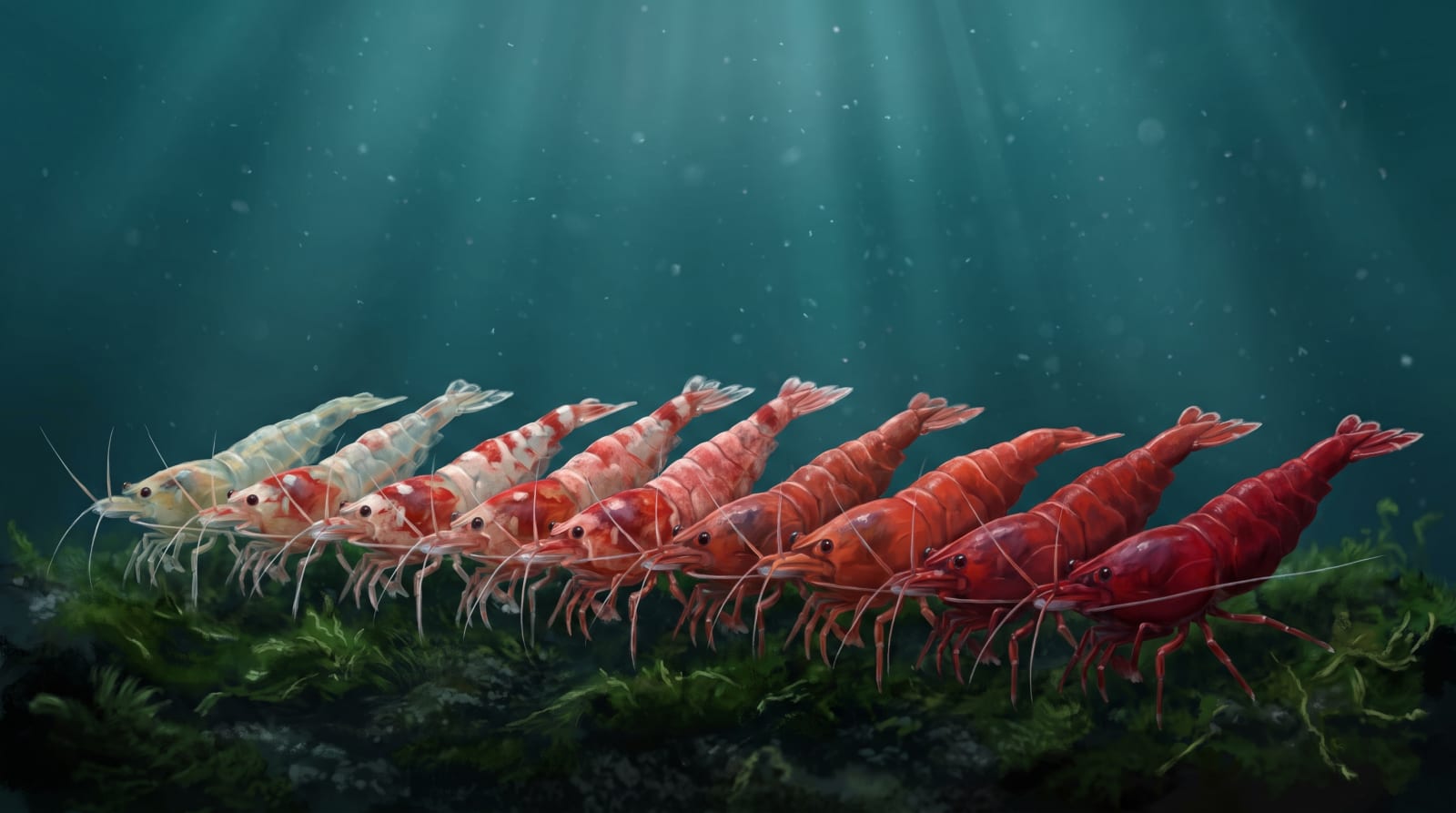
Every Neocaridina in the hobby is one species, so a Painted Fire Red and a cull-grade cherry are the same animal with the same needs. Grade is a colour judgement and nothing more: how much of the shrimp the pigment covers, how deep it runs, and how far it reaches down the legs. It changes the price and it changes nothing else. This guide walks the red ladder rung by rung, then does the same for the blue, yellow, green and dark lines, with a chart for each.
What a grade actually measures
Graders look at three things, and once you know them you can grade a shrimp yourself through the glass. The first is coverage: how much of the body carries colour rather than showing clear or translucent. The second is depth, meaning how saturated and opaque that colour is — a deep, solid red against a thin, washed one. The third is the extremities. Colour reaches the legs, rostrum and tail fan last, so a shrimp with coloured legs is carrying pigment further than one with clear legs, and that is usually the tell that separates one grade from the next.
None of this is about health or hardiness. A cull cherry grazes algae, breeds and lives just as long as the best Painted Fire Red in the tank; the care never changes across grades. What grade actually reflects is genetics plus environment. The parent stock sets the ceiling — you cannot feed a standard-grade shrimp up to extra grade — while dark substrate, a varied diet and stable water decide how much of that ceiling you get to see. One species carrying many selected colour lines is the whole story, and we've drawn the family tree in our guide to Neocaridina colour genetics.
The red grading ladder
Red is the only Neocaridina colour with a proper, widely used ladder, and it's the one every other line gets measured against in conversation. It runs Cull → Cherry → Sakura → Fire Red → Painted Fire Red, and each step means more coverage, deeper colour and more pigment reaching the legs.

| Grade | What you see | Legs |
|---|---|---|
| Cull | Mostly clear or patchy, red thin and confined to the back | Clear |
| Cherry | Red over much of the body but translucent, with a see-through underside | Clear |
| Sakura | Solider red, fewer gaps, colour starting to creep onto the legs | Part-coloured |
| Fire Red | Opaque, near-complete red with little to no clear | Red |
| Painted Fire Red | Solid, even, opaque red everywhere, no translucency at all | Fully red |
A Cull is the reject of a red brood: red confined to a stripe along the back, the rest of the body clear or barely tinted. It isn't an insult and it isn't a sick shrimp — a cull is simply a shrimp pulled from the breeding line rather than killed, and what culling actually means surprises a lot of new keepers.
Cherry is the base graded red, the classic red cherry shrimp that gave the whole species its common name: good red over the body, but translucent in patches and clear underneath and on the legs. Sakura is the middle rung, where the red goes solider, the clear patches shrink and colour begins to reach the legs. Fire Red is opaque red across effectively the whole shrimp, legs included, with the translucency gone. Painted Fire Red — often just "Painted" or "PFR" — is the top: solid, even, deeply opaque red from rostrum to tail fan, so complete the shrimp looks dipped rather than grown.
Why one seller's "Fire Red" is another's "Sakura"
Here's the catch that trips up every buyer eventually: none of these grades is standardised. There is no governing body, no ruler you hold against the shell. Two sellers looking at the same shrimp will grade it differently, one honestly optimistic and one conservative, and a "Fire Red" bought cheaply from one shop can sit a clear rung below a "Sakura" from a careful breeder. The grade word in a listing title is a claim, not a measurement.
The fix is the one we give for every colour line on this site: judge the shrimp in the photo, not the name on the listing. Look for even colour across a whole group shot rather than one show female fronting the ad, and treat "high grade" priced like standard stock as a question rather than a bargain.
The blue lines: velvet, dream and diamond
Blue doesn't run on a single ladder the way red does. Instead the hobby recognises three named blue lines, and the easiest way to hold them apart is as a scale from light to dark: Blue Velvet, Blue Dream, Blue Diamond.

Blue Velvet is the lightest: a glassy, semi-translucent sky-to-powder blue you can partly see through, traced back to blue rili breeding. Blue Dream is the deep opaque navy most shops mean by "blue cherry shrimp". Blue Diamond is darker again, a sapphire that shades to near-black, usually credited to chocolate and black lineage. Neither of the darker two is a "higher grade" of velvet — they're different targets, and which you prefer is taste.
Within each line, though, there is still grading, and it works on depth and evenness rather than coverage. Standard-grade blues show lighter or translucent patching; high grade is a deep, even colour from nose to tail. Blue Dream grades in particular climb to "extra blue" at the top, meaning no clear windows anywhere on the body. The mistake to avoid is judging blues by name alone, because sellers swap "velvet" and "dream" freely — a dark velvet and a pale dream can meet in the middle, so the photo settles it, never the title.
Yellow and orange lines
Yellow and orange sit together because both are graded on depth and evenness, and both have a warm, high-visibility colour that shows best over dark substrate.

The yellow line runs from plain "yellow shrimp" with translucent patches up to solid, opaque "Yellow Fire", and at the very top sits the feature the "neon yellow" name comes from: a golden, paler stripe running the length of the back, rostrum to tail. That stripe shows strongest on well-fed, mature, high-grade females, and it's the main tell of a top-grade yellow. Grade the body colour first, though — a crisp stripe over a washed-out body is still a washed-out shrimp.
Orange is where the naming turns genuinely confusing. On the orange side, "Orange Sakura" is the name of the line, graded on depth from patchy standard stock up to solid pumpkin-orange (sometimes listed "orange fire" at the deepest). But on the red side, "Sakura" is a grade — the middle rung of the red ladder. So a listing that just says "sakura" might be a mid-grade red cherry or a pumpkin-orange line, and neither seller is technically wrong. Read the photo: red shrimp means a graded red, orange shrimp means the orange line.
The green lines: emerald and jade
Green came late to the hobby and never got common, so its two lines are younger and more variable than the fixed reds. They're graded on depth and evenness like the blues.

Emerald Green is the brighter of the two, a lit-up green that reads emerald and glows over dark substrate; its background stock is genuinely debated among breeders. Green Jade is the darker sister line, a deep forest green most often credited to chocolate ancestry, which is why jade broods throw brownish and olive shrimplets more readily. In both lines a high-grade shrimp is saturated, even green from rostrum to tail with no translucent windows, while standard grade shows lighter patching and, in jade especially, an olive cast over the shoulders. Because the lines are young, expect more variation within a brood than you'd see from a long-fixed red — which is exactly why buying from a breeder who culls hard matters more here than anywhere.
The dark lines: chocolate, black rose and carbon rili
The dark end of the family is where grading gets most interesting, because one of these three isn't graded on coverage at all.

Chocolate is the foundation of this end of the hobby: a deep, glossy cocoa-brown graded on depth, evenness and that characteristic gloss. It's worth knowing that several celebrated lines are bred out of chocolate stock, which is why a warm reddish cast in strong light is a mark of quality rather than a fault. Black Rose is black taken as far as selection reaches — graded on coverage, with a high-grade shrimp reading even, opaque black and only giving up a deep maroon undertone when you light it hard. Black is the one line where our usual advice reverses: dark shrimp vanish over dark substrate, so a Black Rose colony shows best over pale sand.
Carbon Rili breaks the pattern entirely. "Rili" is a pattern, not a colour — solid pigment at the head and tail with a clear, unpigmented midsection — so a carbon is graded on contrast and edges rather than how much black covers the shrimp. A top carbon shows dense, truly opaque black sections, a clean bright window in the middle, and sharp cut lines between the two, with the head and tail roughly balanced. Lower grades smudge: grey blacks, a fogged window, pigment freckling into the clear zone. Grading your own carbon broods actually means something, because the pattern never fully breeds true.
What grade is worth paying for
Prices in the UK anchor to two numbers, and we hold to them across every line on the site. Standard-grade cherry shrimp cost £2–4 per shrimp — honest value and a perfectly good starting colony. Genuine high-grade stock, of any colour, runs £30–50 per 10, with the rarer lines and the deepest grades sitting at the top of that range.
That premium is honest work rather than a markup. Holding a line at Fire Red or extra blue takes constant selective breeding, because every brood throws variation and someone has to keep moving the best colour forward and the weakest out. Buy a high grade and you're paying for years of that selection baked into the parent stock — which also means the shrimp will hold its grade only if you keep the line unmixed. Cross any two Neocaridina colours and the offspring slide back to wild-type brown within a couple of generations, however good the parents were, and mixing Neocaridina colours explains exactly why. For a fuller breakdown of what moves price within those bands, see our guide to cherry shrimp prices in the UK.
We grade every brood before it's offered, so our lines are sold by grade rather than by hope. They're rebuilding at the moment — join the waitlist and we'll email you when the next graded groups are ready.
FAQ
What is the best grade of cherry shrimp?
For red, Painted Fire Red is the top grade: solid, opaque, even red across the whole shrimp including the legs, with no translucency. It's the priciest because it's the hardest to breed consistently. "Best" only means deepest colour, though — a Painted Fire Red is no healthier, hardier or longer-lived than a standard cherry, so buy the grade your eye and budget agree on.
What is the difference between Sakura and Fire Red shrimp?
Coverage and depth. A Sakura is the middle grade of the red ladder — solid red over most of the body but with some clear patches and only partly coloured legs. A Fire Red is a step up: opaque red across effectively the whole shrimp, legs included, with the translucency gone. Because grading isn't standardised, one seller's Fire Red can be another's Sakura, so judge the photo.
How are blue dream shrimp graded?
On depth and evenness of the blue, not on a red-style ladder. Standard grade shows lighter or translucent patches; high grade is a deep, even navy across the whole body; and "extra blue" — the top — has no clear windows anywhere. Genetics set that ceiling, so parent stock matters more than anything you do, though dark substrate and stable water help the blue show its best.
Do high grade cherry shrimp breed true?
Kept as a single, unmixed line, yes — high grade begets mostly high grade, but every brood still throws a spread of grades. Holding quality means selecting your best each generation and rehoming the rest. Mix the line with any other colour, though, and the offspring drift back to wild-type brown within a couple of generations, whatever grade the parents were.
What is a cull shrimp?
A cull is a shrimp removed from the breeding line for weak colour, not a dead or defective one. It's the bottom of the grading ladder — thin, patchy colour confined to the back — but it grazes, breeds and lives exactly like any other cherry. Culling in this hobby means separating and rehoming, not destroying, and a cull-grade shrimp makes a perfectly good display animal.