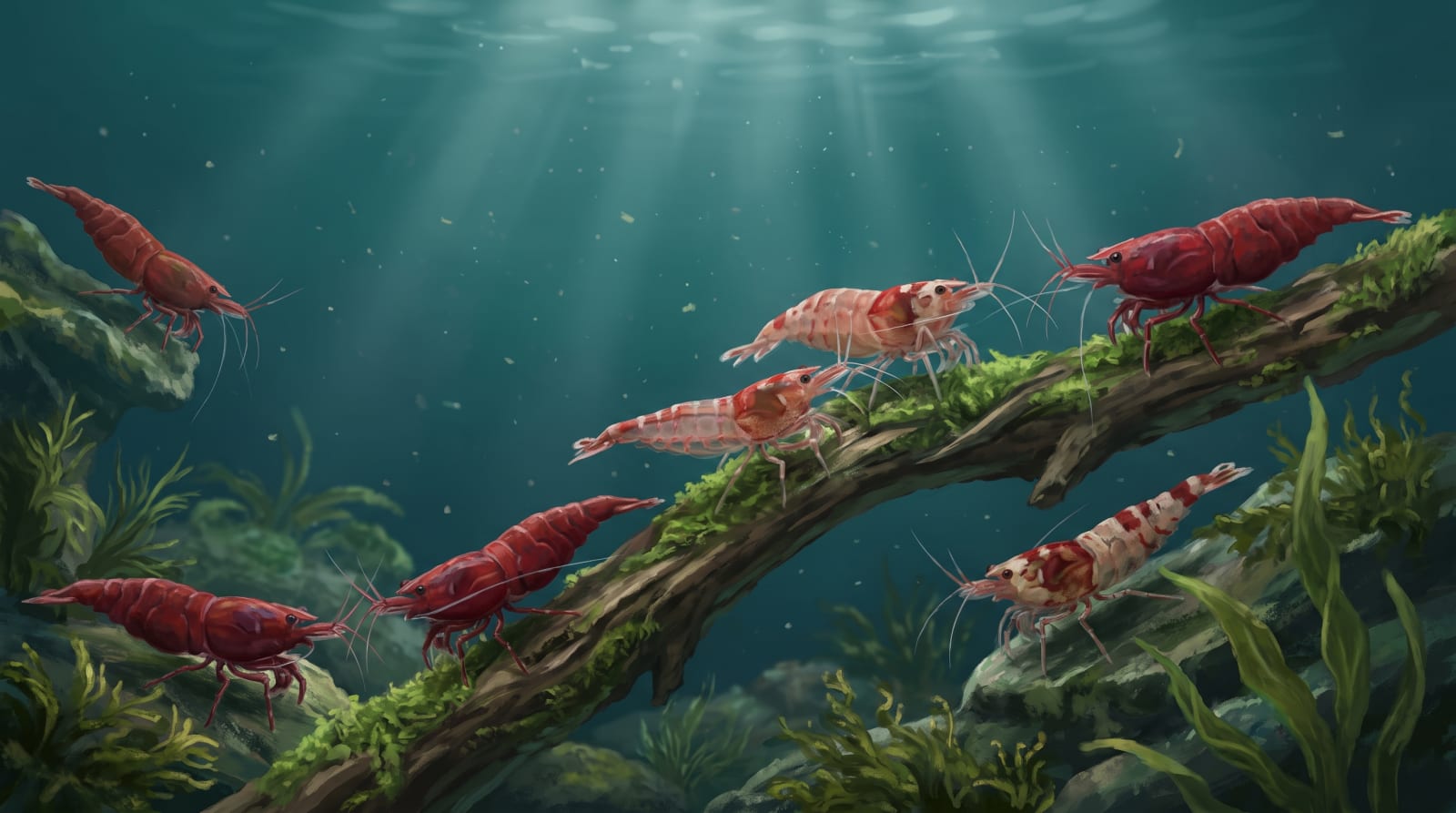
The word "culling" does a lot of damage to newcomers, because in most contexts it means killing and in shrimp keeping it usually doesn't. When a breeder talks about culling shrimp, they almost always mean taking the off-colour ones out of the breeding line — not putting them down. A culled cherry shrimp is a perfectly healthy animal that simply won't be allowed to pass on its washed-out colour, and it has plenty of good homes ahead of it. Get that distinction straight and the whole subject stops being grim.
What culling actually means
In a breeding project, to cull is to remove a shrimp from the gene pool so it can't breed on. That's the entire meaning. It says nothing about the shrimp's health and nothing, by itself, about its fate — a cull is a shrimp you've decided not to breed from, and everything after that is a choice about where it goes.
The confusion is understandable, because in farming and wildlife management culling does mean killing. The hobby borrowed the word for the act of selecting-out and kept the sense of "removing from the group" while mostly dropping the lethal part. You'll see the term defined the same way in our shrimp keeper's glossary: a cull is a low-grade or off-type shrimp pulled from a line, not a dead one.
So when a keeper says they "culled hard this generation", picture them netting out every shrimp that didn't hit the colour standard and moving it elsewhere. The line gets tighter; the culls carry on living. That's the normal, everyday meaning, and it's the one this guide is built around.
Why breeders cull at all
If culling sounds like a lot of bother for a tank of tiny shrimp, the reason comes down to a single stubborn fact of Neocaridina genetics: colour only holds if you keep selecting for it. Every colour line sits on top of a drab wild-type background that's always trying to reassert itself, which we unpack in Neocaridina colour genetics. Left alone, even a good line drifts. Weak-coloured shrimp breed with strong ones, the average slips, and within a few generations a bright colony fades toward muddy brown.
Culling is simply the selection half of selective breeding. You keep the best-coloured 10–20% to breed the next generation and take the rest out of the equation, and you do it again each generation. That constant weeding is what holds a line at Sakura, Fire Red or Painted Fire Red instead of letting it sag back down the ladder. Stop culling and the reversion pressure wins — the same drift that turns a mixed tank brown, described in crossbreeding and wild-type reversion, happens slowly even within a single line if you never remove the poor colour.
There's an economic edge to it too. Standard-grade cherries sell for around £2–4 each, while genuinely high-grade groups fetch £30–50 per 10, and the only thing standing between the two is generations of patient selection. A breeder who culls is protecting the work that puts a line in the upper bracket. A keeper who just wants a pretty pet colony has no such pressure, which we'll come back to.
The humane options for culls
Here's the part that should put the newcomer's mind at rest: a culled cherry shrimp is a healthy shrimp, and healthy shrimp are easy to rehome. You almost never need to kill one. In order of what we'd actually reach for, these are the honest options.
Keep a cull tank. The simplest and kindest solution is a second tank — often just a bare box with a sponge filter and a clump of moss — where culls live out their natural 1–2 years. Many breeders run one as a matter of course. It becomes a low-effort colony of mixed and lower-grade shrimp that quietly does its own thing, and because their care is identical to any cherry, as laid out in the care guide, it costs almost nothing to run. Some keepers let their cull tanks revert to wild-type entirely and rather enjoy the result: hardy, active, unpretentious brown shrimp.
Sell or give them away as standard grade. This is the real answer to "what do I do with culled shrimp". A shrimp that's a cull to a high-grade breeder is still a lovely animal to someone starting out. Sell them honestly as standard or lower-grade stock at standard-grade money, pass them to friends setting up first tanks, offer them to a local aquarist group, or trade them in for shop credit. The one rule is honesty about what they are: never a "Fire Red" if it's a Cherry, never sold up a grade it doesn't hold. If you're moving numbers regularly, it's worth knowing where the line sits between a hobbyist selling surplus and running a business, which we cover in selling your surplus.
The feeder route, discussed honestly. Some keepers use culls as live food for predatory fish — pufferfish, larger community fish, or a betta in another tank. It's worth being straight about this rather than pretending it doesn't happen. Plenty of the hobby finds it distasteful and would never do it; others see it as no different from any other food chain, and a cull that would otherwise be killed does at least serve a purpose. It's a personal line, and where you draw it is up to you. We'd only add that a cull tank is easy enough that most keepers never need to reach for this at all.
Or simply don't cull. The lowest-effort option is not to select at all — let the colony be whatever mix of grades it produces and enjoy it as a living tank. You lose the tight colour of a bred line, but for a pet colony that's often no loss worth minding.
Notice what's missing from that list: routinely killing healthy shrimp. Because colour-culling produces animals that are only "wrong" in their looks, there's essentially always a non-lethal home for them. Euthanasia belongs to a different situation — a shrimp that's suffering from disease or a failed moult — not to a shrimp whose only fault is being a paler shade of red than its tank-mates.
The one rule you can't break
Whatever you do with surplus or culled shrimp, there is a hard limit: never release them into the wild. Do not tip unwanted shrimp into a pond, stream, canal, ditch or any natural waterway. In the UK it is illegal to release non-native species like Neocaridina into the wild, and beyond the law it's ecologically reckless — a hardy, fast-breeding shrimp let loose in the wrong place is exactly the kind of introduction that causes real damage.
This holds even though a British winter would probably see most of them off. "Probably" isn't good enough where invasive species are concerned, and the legal position doesn't care about your intentions. If you have shrimp you genuinely can't rehome through any of the routes above, the responsible fallback is to keep them in a cull tank or to ask a local fish shop or aquarist group to take them. The waterway is never an option. Rehome them, don't release them.
Do you even need to cull?
For most keepers, honestly, no. Culling is a breeder's tool, and if you're keeping a colony for the pleasure of it rather than to improve or sell a line, you can skip the whole business. A mixed-grade tank of red cherries is a happy, healthy, colourful thing, and letting nature take its course is a perfectly legitimate way to keep shrimp.
Culling earns its place when you have a goal: holding a line at a high grade, selling graded stock, or working a colour up over generations. Then the discipline of removing the weak colour each generation is what separates a project from a tank. If that's you, keep a cull tank from the start — it turns culling from a hard decision into a simple sorting job, and it means every shrimp you breed has somewhere good to go.
The takeaway is the one we opened with. Culling in shrimp keeping is a sorting exercise, not an execution. Removed from the breeding line, given a tank or a new owner, a cull lives out its life the same as any other cherry — which is exactly why the word deserves to lose its sting.
FAQ
Does culling shrimp mean killing them?
Usually not. In shrimp keeping, culling means removing a shrimp from the breeding line so it can't pass on poor colour — not putting it down. Culled shrimp are healthy animals, and the standard options are to keep them in a separate cull tank or rehome them as standard-grade stock. Killing healthy culls is neither necessary nor common, because there's almost always a home for a perfectly good shrimp whose only flaw is its shade.
What do you do with culled cherry shrimp?
The usual routes, best first: keep them in a cull tank where they live out their lives, or sell and give them away honestly as standard-grade shrimp to beginners, local groups or a shop for credit. Some keepers use culls as feeders for predatory fish, which is a personal choice. The one thing you must never do is release them into a pond or waterway — that's illegal in the UK and ecologically harmful.
What is a cull shrimp?
A cull is a shrimp a breeder has decided not to breed from, usually because its colour is too pale, patchy or off-type to meet the line's standard. It's a judgement about looks, not health — a cull grazes, moults and lives exactly like a top-grade shrimp. The term is borrowed from farming, where it means killing, but in the shrimp hobby it almost always just means "removed from the breeding group".
Why do breeders cull shrimp?
Because colour only holds if you keep selecting for it. Every Neocaridina colour sits on a wild-type brown background that slowly returns if weak-coloured shrimp are allowed to breed on. By culling — keeping the best 10–20% and removing the rest each generation — a breeder holds a line at a high grade instead of letting it fade. It's the selection half of selective breeding, and it's what keeps the difference between a £2–4 shrimp and a high-grade one.
Do I have to cull my cherry shrimp?
No. Culling is only needed if you want to improve or sell a colour line. If you keep shrimp for enjoyment, a mixed-grade colony is healthy, colourful and perfectly fine left to breed as it likes. You'll lose the tight, uniform colour of a selected line over the generations, but for a pet tank that's rarely a problem worth the effort of sorting shrimp every few weeks.