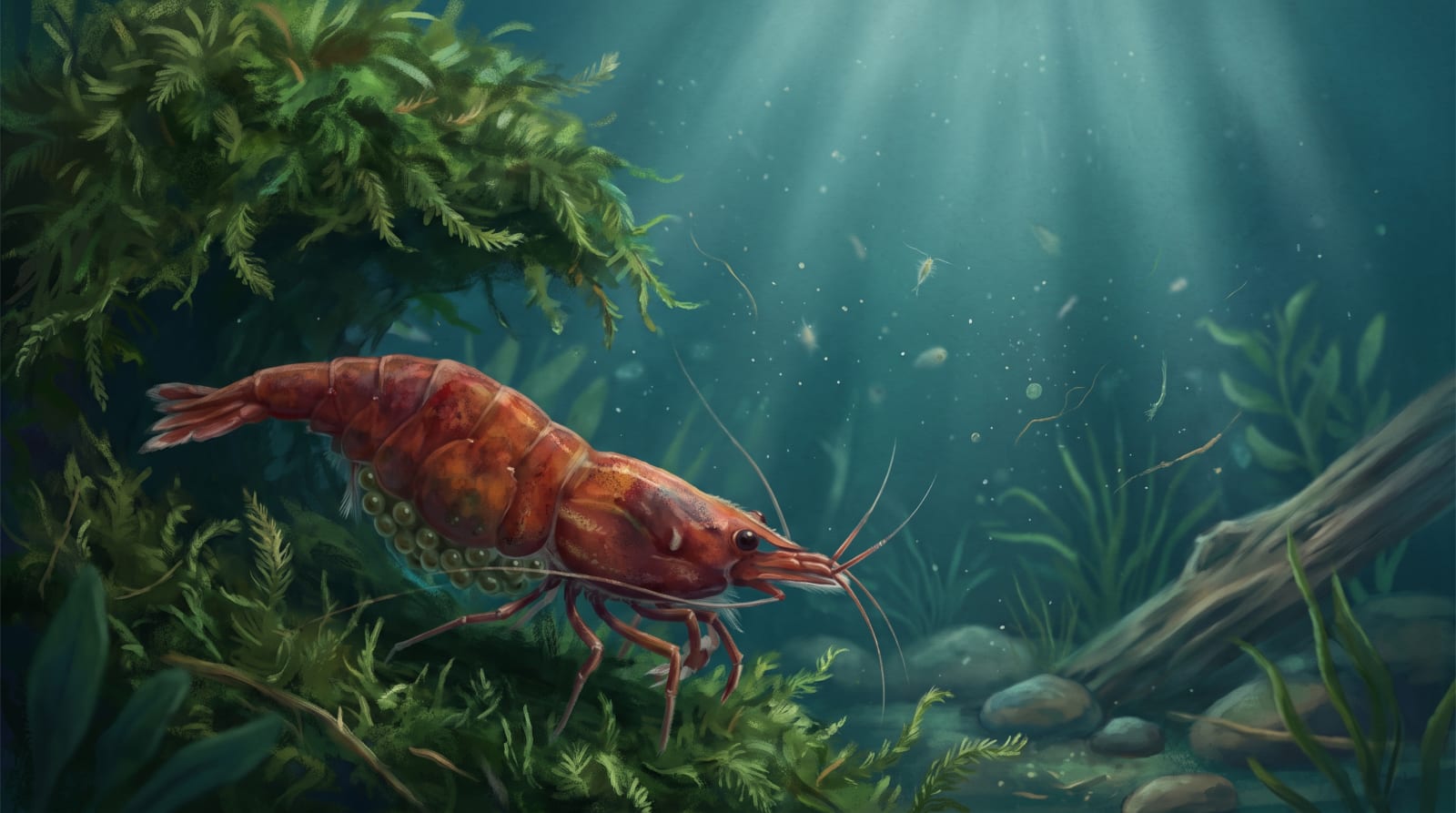
Cherry shrimp will breed on their own: leave a mixed group in decent water and sooner or later you'll spot a female carrying eggs. Building a colony that grows every month and holds its colour is a different job, made of a dozen small decisions taken in the right order. This is the whole process as we run it in our own breeding room, from first moult to your first hundred shrimp.
Why cherry shrimp are the easiest shrimp to breed
Neocaridina davidi is the beginner breeding project of the aquarium hobby, and it deserves the reputation. Cherries breed across a wide temperature band, tolerate a spread of pH values, and need no special trigger, no brackish phase and no live-food cultures. Hatchlings arrive as fully formed miniature shrimp around 1–2mm long and graze biofilm from their first day. There is no fragile larval stage to lose.
That's the easy half. The honest half is that a colony is a process, not luck. One berried female is a nice moment; a tank where every mature female produces a brood roughly every 5–6 weeks, and where most of those shrimplets live to adulthood, is the product of stable water, sensible stocking and patience. Everything below is aimed at that second outcome.
It also helps to know what you're working towards. Adults reach 2.5–3cm and live 1–2 years, so a colony is always turning over. You're not keeping ten shrimp; you're keeping a population.
Breeding parameters: the numbers we run
Cherry shrimp survive across a wide range and breed reliably in a narrower one. These are the figures we hold our racks to, and why each earns its place.
| Parameter | Safe range | Breeding sweet spot | Why it matters |
|---|---|---|---|
| Temperature | 18–26°C | 21–24°C (we run 22–23°C) | Warmth speeds metabolism and egg development; cool tanks breed slowly |
| pH | 6.8–7.6 | Same; they tolerate 6.5–8.0 if it's stable | Swings stress shrimp far more than any particular value |
| GH | 6–12 | 8–12 | GH supplies the minerals for egg development and clean moults |
| KH | 2–8 | 2–8 | Buffers pH so it can't crash between water changes |
| TDS | 150–250 | 180–250 | Overall mineral load; breeding females do best in the upper band |
| Ammonia and nitrite | 0 | 0 | Any reading at all harms adults and kills shrimplets |
| Nitrate | Under 20ppm | Under 20ppm | Creeping nitrate quietly suppresses breeding in neglected tanks |
If you take one line from that table, make it this: stability beats perfect numbers. A tank sitting rock-steady at pH 7.8 will out-breed one swinging between 6.9 and 7.5, because shrimp treat swings as danger and moults go wrong when minerals lurch about. Chasing textbook figures with constant corrections is the most common way keepers talk themselves out of a colony. Every parameter gets a fuller treatment in our Neocaridina water parameters guide.
Breeding tank or display tank?
You can breed cherry shrimp in a community display. Whether you keep any of the babies is another question. In a species-only tank that's mature and planted, the majority of shrimplets survive to adulthood. In a community tank with fish, most shrimplets get eaten; without dense cover you're looking at single-digit survival. A 2mm shrimplet is food to almost anything with a mouth, including fish sold to you as shrimp-safe.
So if the goal is a colony, give the shrimp their own tank. Ours are deliberately boring: anything from a 20-litre cube to a 45-litre breeder does the job, with a cycled sponge filter, a thin layer of substrate, and plenty of moss and leaf litter. The sponge filter earns its place twice over. It can't suck up shrimplets the way a filter intake can, and its surface grows a permanent lawn of biofilm that doubles as a feeding station.
Mature matters as much as species-only. A tank that's been running for a few months carries biofilm on every leaf, stone and pane of glass, and biofilm is what shrimplets actually live on. A brand-new setup can pass every water test and still starve a hatchling, so if you're starting fresh, plant the tank and let it ripen before the shrimp arrive.
Keep two quiet killers out of any shrimp tank while you're at it: copper-based fish medications and pesticide residue on freshly bought plants. Both are lethal to shrimp.
If the display tank is all you have, stack the odds. Pile in moss, keep floating plants with long roots, and make peace with small numbers; a handful of survivors per brood still compounds over a year.
Sexing your shrimp: have you actually got both?
A surprising share of the "why won't they breed" messages we get end with someone discovering a tank of one sex. Rule it out first.
Females are the bigger, bolder shrimp: closer to 3cm, deeper and more opaque in colour, with a visibly deeper curve to the underbelly where the flared side plates (the pleura) will later shelter eggs. Look just behind the head for the saddle, a paler patch showing through the shell. That's undeveloped eggs waiting their turn, and a saddled female is a female preparing to breed. A berried one removes all doubt.
Males run smaller, nearer the 2.5cm end, slimmer through the body, and usually paler or more translucent in most colour lines. They're also the busy ones. If a shrimp spends its day swimming laps rather than grazing, the odds say male.
Juveniles are genuinely hard to call, and shrimp only reach sexual maturity at roughly 3–5 months, so a young group may simply need time. Our male vs female cherry shrimp photo guide shows every marker side by side on real shrimp.
Stocking is simpler than the forums make it. Ignore "breeding pairs" — cherry shrimp breed as a colony, and pairs are a fish concept. Start with 10 or more shrimp for a near-certain mix of sexes and enough genetic spread to keep the line vigorous. A roughly balanced or slightly female-heavy group is ideal, but you don't need to engineer it.
The breeding cycle, step by step
Once you know the sequence, you can read a tank at a glance.
It starts with a moult. Adults moult every 3–6 weeks, and when a mature, saddled female moults she releases pheromones into the water. The response is unmistakable: every male in the tank abandons his patch of biofilm and swims, fast and restless, criss-crossing the tank in search of her. Keepers call it the shrimp dance. The first time you see it, you'll know.
Mating itself is brief and easily missed. Afterwards the female hides while her new shell hardens, as every shrimp does for 24–48 hours after a moult, and within days her eggs move under her swimmerets. She's now berried.
| Stage | What you'll see | Timing |
|---|---|---|
| Pre-breeding moult | An empty white shell; the saddled female tucked away | Adults moult every 3–6 weeks |
| Pheromones and the "dance" | Males swimming hard all over the tank | Straight after her moult |
| Mating | Brief contact, easy to miss | During the dance |
| Berried | 20–30 eggs held under her swimmerets | Within days of the moult |
| Carrying | Constant fanning of the clutch | 14–21 days; warmer runs faster within the safe range |
| Hatch | Fully formed shrimplets, about 1–2mm | Direct development, no larval stage |
Two reassurances while you wait. A shrimp that vanishes for a day or two is almost always lying low after a moult, not dead; give it 48 hours before you go digging. And a dance with no berried female at the end of it does happen. If it happens every time, work through the troubleshooting section further down.
The berried female
A berried female carries 20–30 eggs in a tight cluster under her tail, and for the next 14–21 days her main job is oxygen. She fans the clutch constantly with her pleopods, the small swimming legs under the abdomen, and you'll see the eggs ripple as she works. New keepers sometimes read the fanning as distress. It's the opposite: a fanning female is doing everything right. Warmer water within the safe range shortens the carry, which is one reason we hold our breeding racks at 22–23°C.
Egg colour is your progress bar. Clutches start deep, anywhere from yellow to green depending on the line, and pale as the embryos develop, until dark eye-spots show through shortly before hatching. Spot the eyes and you're days away. We've photographed the whole sequence in our cherry shrimp eggs guide.
Two rules for the fortnight. First, don't move her unless you truly must: stress is the main reason females drop their eggs, and first-time mothers carry smaller clutches and drop them more readily anyway. Second, if you do have to move her — say she's berried in a fish tank where the brood stands no chance — do it underwater. Guide her into a cup so she never leaves the water, match temperature and parameters at the other end, and move her early in the carry rather than days before the hatch.
The odd egg turning white or woolly is normal. It's infertile or fungused, and she'll usually groom it out of the clutch herself. Losing a whole clutch is different; that points to water quality or a sudden swing, so test before you blame the shrimp.
Hatching and the first weeks
Nobody sees the hatch. One evening a fleck of moss will move, and that's your first shrimplet: 1–2mm, glassy, and a perfect miniature of its parents. Direct development means there's no larval stage and nothing special to do, but the first weeks are still where colonies are won and lost.
Shrimplets eat biofilm from day one and graze more or less constantly, which is why the mature tank keeps coming up: the biofilm lawn is the food supply. In a seasoned, planted tank a brood can raise itself. We still dust in a pinch of finely powdered food a few times a week once shrimplets are loose, and our feeding shrimplets guide covers what, how much and how often without wrecking the water.
Beyond food they need cover and calm. Moss, leaf litter and plant thickets let them graze without being exposed, and a sponge filter (or a prefilter sponge over an intake) stops the filter eating the brood. Hold your nerve on maintenance too. Shrimplets handle swings far worse than adults, so the first weeks are the time for small, gentle water changes rather than big corrections. The full rearing walkthrough is in raising shrimplets.
Growing the colony: cadence and compounding
Shrimplets reach maturity at roughly 3–5 months, and a healthy female can be berried again within days or weeks of releasing a brood. In practice that means a brood roughly every 5–6 weeks per female in good conditions, and at colony level the compounding takes over: a stable colony roughly doubles every 2–3 months.
| Time from a 10-shrimp start | Rough colony size |
|---|---|
| Start | 10 |
| 2–3 months | 20 |
| 4–6 months | 40 |
| 6–9 months | 80 |
| 8–12 months | 160 |
Real colonies are lumpier than the table. Expect a quiet first quarter while juveniles mature, then a surge that catches you off guard. And since adults live 1–2 years, by the second year you're managing overlapping generations rather than individuals; the limit becomes tank space and your willingness to rehome.
Somewhere past the first hundred shrimp, selection becomes worth doing. Broods vary in colour depth and coverage, so move your best into the breeding tank and shift the rest — the culls — into a display or community tank. Culling in shrimp keeping means separating, not killing; a cull-grade cherry is still a lovely shrimp doing honest work on algae. What you must never do is release surplus into ponds or waterways. It's illegal in the UK and ecologically harmful, and there's always a keeper nearby who'll take spares. For red lines the ladder runs Cull → Cherry → Sakura → Fire Red → Painted Fire Red, and our Neocaridina grades guide shows exactly where the boundaries fall.
Why won't my cherry shrimp breed?
When a healthy-looking tank refuses to produce, it's nearly always one of these, listed roughly in the order we see them.
They're too young. Maturity takes 3–5 months and most shop stock is sold as juveniles. Count forward from the purchase date before you worry.
They're all one sex. Saddles that never turn into berries usually mean no mature males in the tank; a female can sit saddled indefinitely without one. Recheck the sexing markers above.
It's too cold. Cherries live happily at 18°C, but breeding slows right down at the cool end of the range. Nudging a room-temperature tank into the 21–24°C band is the single most reliable fix we know.
The water's unstable. Swinging parameters suppress breeding, cause dropped eggs and sit behind most failed moults — the notorious white ring of death links to GH and mineral imbalance plus sudden swings. Boring water breeds shrimp.
The water's too soft. Below GH 6, egg development and moulting both struggle; we want 8–12 for breeding. This is the classic hidden cause in Britain's soft-water regions, and there's more on that below.
They're underfed for the job. Egg production takes resources. A quality, varied diet with a protein component supports it; thin biofilm in a new, sparse tank may not be enough on its own.
One more, filed as our observation rather than settled fact, because breeders genuinely disagree: a larger water change with slightly cooler water can trigger a round of moulting, and moults are when mating happens. We've watched it wake up a quiet tank. We've also watched colonies breed like clockwork on nothing but small, consistent changes. Stability first, tricks second.
A note on UK tap water
UK water varies hugely by region, and it decides how much work breeding takes. Across the South East and much of eastern England the tap runs hard, often GH 12–18 or higher. That reads high against the textbook range but is generally fine for Neocaridina; ours breed well in hard water, and stability covers the difference. In soft-water regions — much of the North West, Scotland, Wales and Cornwall — tap GH can sit too low for reliable egg development and moulting, and remineralising is often the difference between a colony and a mystery.
Wherever you live, dechlorinate every drop of new water; chlorine and chloramine both harm shrimp. Our UK tap water guide breaks down regions, remineralisers and what to test before your first water change.
Selling your surplus
A doubling colony outgrows any tank eventually, and UK demand for home-bred Neocaridina is steady. Standard cherry shrimp sell for £2–4 each, while high-grade stock brings £3.50–5 per shrimp, or £30–50 per 10 at the top end. Be honest with yourself about the scale: that money covers food, remineraliser and the next tank rather than replacing a wage, and anyone telling you otherwise is usually selling a course. If you want to do it properly — pricing, photographing stock, where UK buyers actually are — we've laid the whole thing out in breeding shrimp for profit in the UK.
FAQ
How often do cherry shrimp breed?
In good conditions, each mature female produces a brood roughly every 5–6 weeks; she can be berried again within days or weeks of releasing the last one. At colony level that compounds into a rough doubling every 2–3 months.
What temperature do cherry shrimp breed at?
Cherry shrimp live at 18–26°C, but breeding accelerates between 21 and 24°C. We run our breeding racks at 22–23°C year round. At the cool end of the range colonies tick over rather than grow, so temperature is the first thing to check when breeding stalls.
How long are cherry shrimp pregnant for?
Strictly, they're never pregnant: the female carries fertilised eggs externally under her tail, which is why keepers say "berried". She carries them for 14–21 days, quicker at the warmer end of the safe range. But everyone knows what you mean, and the practical answer is two to three weeks.
Will cherry shrimp breed in a community tank?
They'll mate and carry eggs in a community tank without any trouble. The problem comes at hatching: most shrimplets are eaten by fish, and without dense cover survival drops to single digits. In a species-only, mature, planted tank the majority survive, which is why serious breeders always run a dedicated tank.
How many babies do cherry shrimp have?
A female carries 20–30 eggs per brood, and first broods are often smaller. Not every egg becomes an adult, but in a species-only tank most shrimplets make it through, so one good female adds a couple of dozen shrimp to the colony every six weeks or so.
How fast do cherry shrimp grow?
Shrimplets hatch at 1–2mm and reach sexual maturity at roughly 3–5 months, topping out at 2.5–3cm as adults. Lifespan is 1–2 years, which is why a healthy colony always has every size of shrimp on show: the population is constantly replacing itself.