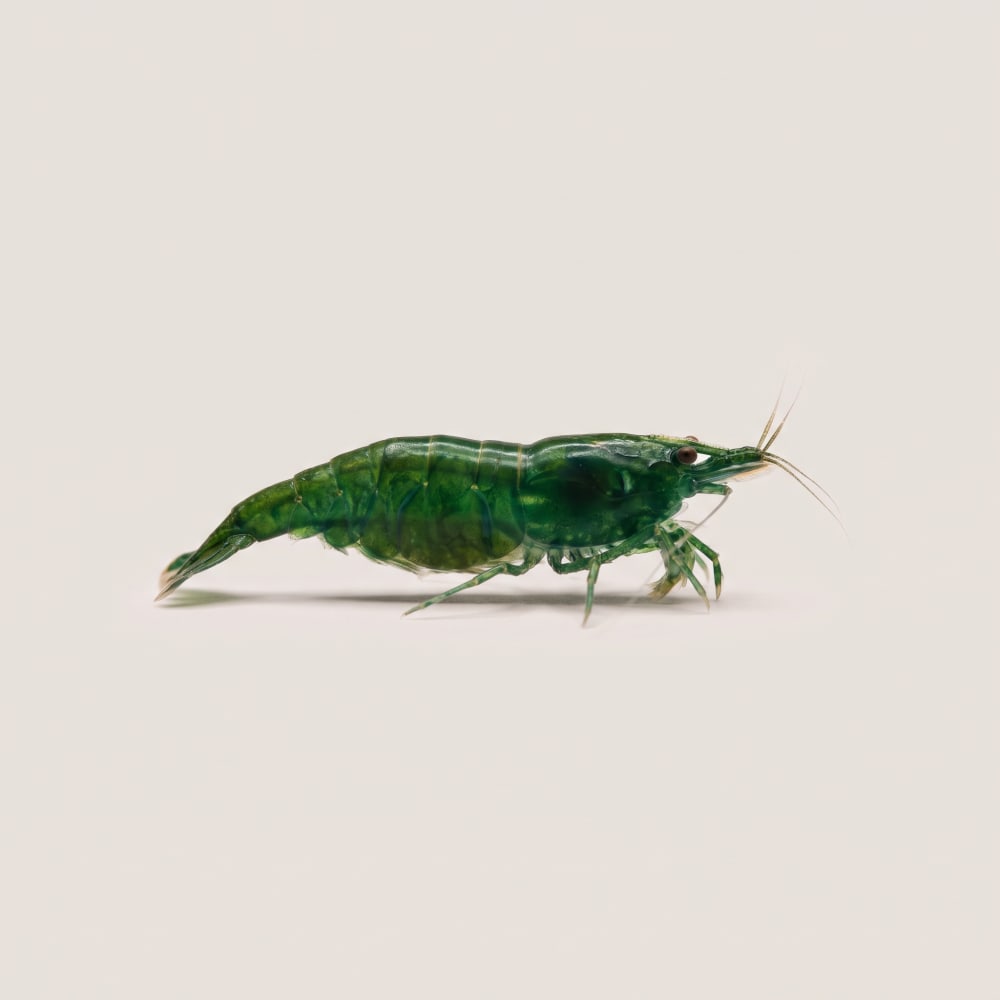
Cherry shrimp have been bred into nearly every colour going, but green came late and never got common. A proper emerald green shrimp — rich, saturated, somewhere between grass and bottle glass — is still an animal most UK keepers have only seen in photos. We bred and sold this line for years as one of our signature strains, and of everything that's passed through our racks it's the colour people trusted least in pictures and stared at longest in person.
Emerald Green shrimp at a glance
| Difficulty | Easy |
| Adult size | 2.5–3cm |
| Lifespan | 1–2 years |
| Temperature | 18–26°C |
| pH | 6.8–7.6 |
| GH | 6–12 |
| TDS | 150–250 |
| Breeding | Prolific |
What is an Emerald Green shrimp?
Emerald green is a colour line of Neocaridina davidi — the same species as the red cherry shrimp, selectively bred towards deep green instead of red. "Emerald shrimp", "green emerald shrimp" and "emerald green shrimp" all mean the same animal; sellers shuffle the words, the shrimp doesn't change. Because it's a cherry shrimp underneath, it's hardy, prolific and easy — the least demanding way to put a genuinely unusual colour in a tank.
Green is also one of the youngest directions in the genus. The hobby had red, yellow and blue long before it had a convincing green, and where the green actually came from is still argued over. Most lines seem to trace back to Far East breeding projects, but ask three breeders what stock those started from and you'll get three answers — yellow ancestry, blue, chocolate somewhere in the mix. Nobody can produce a pedigree. It changes nothing about the care, but it does explain why greens vary more between sellers than the long-fixed reds: the line is young, and quality depends on who's been selecting it.
Emerald Green vs Green Jade
It's the comparison people actually search for, and worth settling before you buy. Green Jade is the sister line: a deeper, darker forest green, most often credited to chocolate lineage, and a little more prone to throwing brownish or olive offspring because of it. Emerald green is the brighter of the two — a lit-up green that reads emerald rather than jade — and in our tanks it held its shade more evenly across a colony.
| Emerald Green | Green Jade | |
|---|---|---|
| The green | Bright, rich emerald | Deep forest jade, darker |
| Lineage | Debated; no agreed pedigree | Most often credited to the chocolate line |
| Broods | Normal grade variation | More brownish or olive throwbacks |
| In the tank | Glows over dark substrate | Reads near-black in low light |
Neither is better; they're two different greens. If you want the colour to announce itself across the room, emerald. If you want something darker and moodier, jade.
Colour and grading
Emerald greens are graded on depth and evenness. Standard grade shows good green with lighter or translucent patches, usually low on the sides and legs. High grade is saturated, even green from nose to tail with no clear windows. Females run larger, deeper and more opaque than males, and juveniles darken as they mature, so judge young stock by its females and give the rest time. Grading logic across all the lines is in our grades guide.
You'd think a green shrimp would vanish in a planted tank. In practice the opposite happens: a good emerald is a deeper, bluer green than most aquarium plants, so the shrimp read as solid shapes against the leaves instead of disappearing into them. Over dark substrate the effect doubles; over pale sand the same animals wash out. Plant heavily and keep the floor dark.
Care
Nothing about the colour changes the keeping. The full cherry shrimp care guide applies unchanged: a cycled tank of 19L or more, a sponge filter, inert substrate and stable water inside the table's ranges — and stability matters more than any single number. An unheated UK room at 18–21°C is fine — broods simply arrive slower than they would at 22–24°C.
Most hard-water areas of the UK can run emeralds straight from the dechlorinated tap; soft-water areas need to remineralise to GH 6–12 for clean moults. Look your region up in the UK tap water guide. And the standard Neocaridina rule applies in full: no copper, whether from medications or pesticide-carrying plants.
Breeding true
Kept as a single, unmixed line, emerald green breeds green. Because the line is younger than the classic reds, broods throw a wider spread — expect paler and patchier shrimplets alongside the good ones, and the occasional olive surprise. That's not failure; it's the raw material of selection. Move your deepest, most even greens into the breeding tank before they mature at 3–5 months, rehome the rest, and the line tightens visibly within a few generations. The mechanics are ordinary cherry breeding — 20–30 eggs carried for 14–21 days — and it's all in how to breed cherry shrimp.
The rule protecting all of it: one colour line per tank. Emeralds interbreed freely with every other Neocaridina colour, and mixed offspring drift back towards brownish wild-type within a couple of generations. Mixing Neocaridina colours covers the genetics.
Buying Emerald Green shrimp in the UK
Green remains genuinely uncommon in UK shops. Chains almost never stock it, and most good greens change hands through private breeders and waitlists rather than shelves. Where lower-grade greens do turn up, expect the standard £2–4 per shrimp; high-grade emerald green runs £30–50 per 10, and greens sit at the top of that range simply because so few UK breeders work the line.
Judge a listing the way you'd judge a blue: the seller's actual stock in the photos, even green across the whole group rather than one show female, and no olive or brownish animals in the group shots — those point to a loose or mixed line. Ask what the seller culls; a breeder with an answer is a breeder who's actually selecting.
Emerald green is one of our signature lines and demand has always outrun the broods, so while our own colony restocks there's a waitlist on this page — join it and you get first refusal when the next batch is graded.
FAQ
What are emerald green shrimp?
A colour line of Neocaridina davidi — the same species as the red cherry shrimp, selectively bred for rich green instead of red. "Emerald shrimp" and "green emerald shrimp" are the same animal under shuffled names. Care, size, lifespan and breeding are identical to any other cherry shrimp: easy, hardy and prolific.
What is the difference between emerald green and green jade shrimp?
Shade and background. Emerald green is the brighter, lit-up green and its lineage is genuinely debated; green jade is a deeper forest green most often credited to the chocolate line, which is why jade broods throw brownish or olive shrimplets more readily. Care is identical — choose on the green you want to look at.
Are green shrimp rare in the UK?
Uncommon rather than rare. The shrimp themselves are as easy to keep and breed as any cherry; what's scarce is UK-bred stock, because very few breeders work green lines. You'll hardly ever see them in chain shops — most good greens are sold by private breeders, often through waitlists.
How much do emerald green shrimp cost?
Standard-grade greens, where you find them, run the usual £2–4 per shrimp. High-grade emerald green typically sells at £30–50 per 10 in the UK, sitting at the top of that range because supply is so thin. Treat much cheaper "high grade" listings with suspicion and ask for photos of the actual stock.