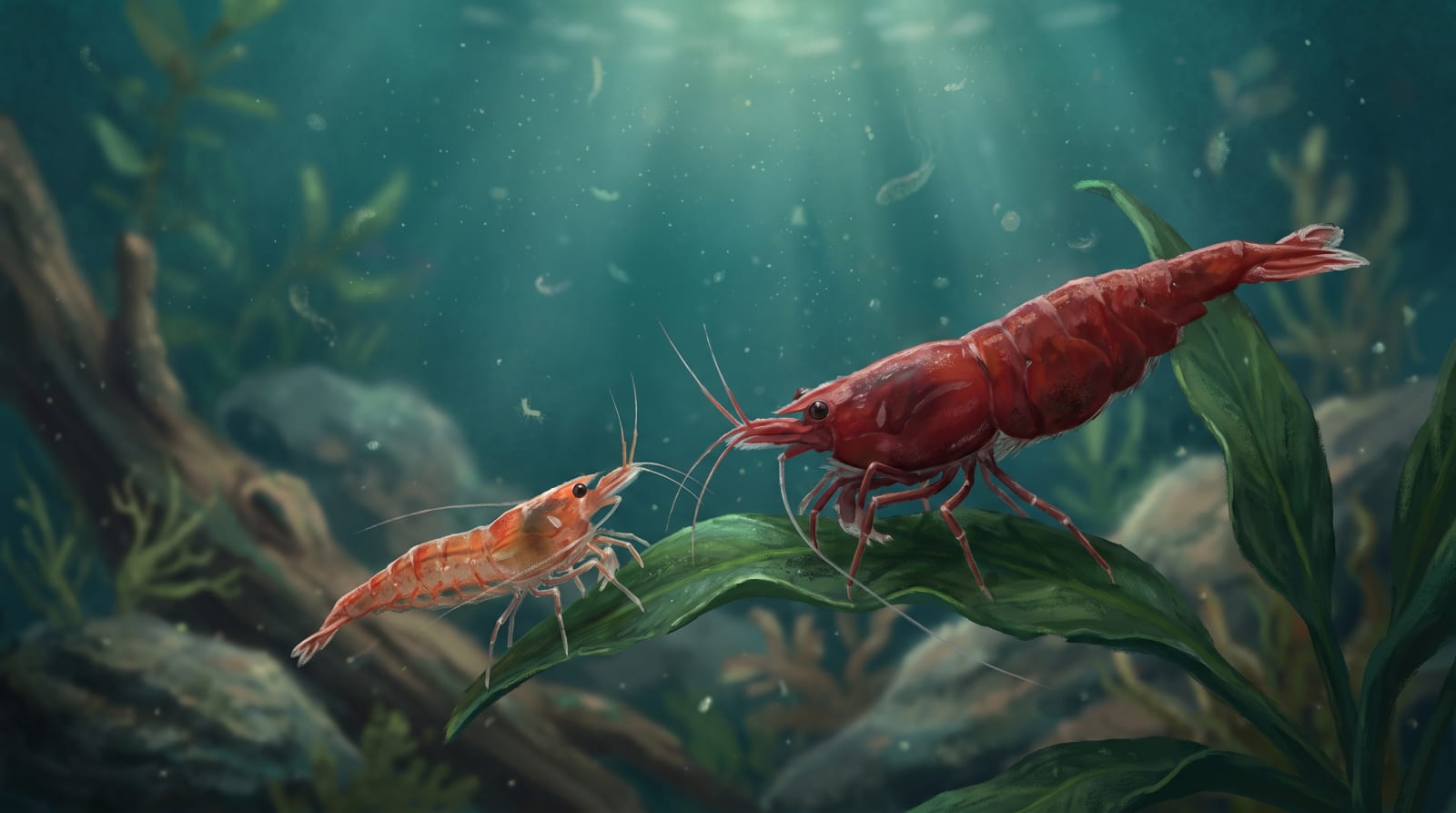
Telling male and female cherry shrimp apart is easy once they're adult and close to impossible while they're young. On a mature shrimp, four tells do the whole job: size, the depth of the colour, the curve of the underbelly, and the saddle behind the head. Learn those and you can sex a settled colony at a glance through the front glass. This guide walks through each one, then covers the part most guides skip — why you shouldn't bother trying to sex juveniles at all.
Why sex your shrimp at all?
Most keepers never need to hand-pick a single shrimp, because buying a group of ten all but guarantees a mix of both sexes and a colony grows itself from there. Sexing earns its keep in three situations: when you're setting up a breeding project and want to check you actually have females, when you're selling or trading surplus and a buyer asks for a known ratio, and when a colony isn't breeding and you're working out whether you've somehow ended up with all one sex. For everyday keeping it's a party trick; for anyone breeding on purpose it's a basic skill.
How to sex a cherry shrimp: the four tells
Take your reading off adult shrimp only, and off ones that have settled in — a stressed or freshly moved shrimp washes out and hides its colour. With that in mind, here are the four things to look at, strongest tell last.

Size and build. Females are the bigger, bulkier shrimp. Adults of the species reach 2.5–3cm, and the females sit at the top of that range with a noticeably deeper, heavier body, while males stay smaller and slighter. Once you've got a few adults side by side, the size difference is often the first thing that leaps out.
Colour depth. Females carry deeper, more saturated colour than males of the same line and grade. A female red cherry reads as a solid, opaque red; the males alongside her look paler and more translucent, sometimes almost see-through in patches. This is genuinely useful, but it's also the tell that catches people out, which is why it isn't the one to trust on its own — more on that below.
The curve of the underbelly. Look at the shrimp side-on. A female's underside, beneath the abdomen, curves outward in a deeper, rounder line, because that's the space she needs to tuck a clutch of eggs into. A male's underline is straighter and slimmer, following the body without that broadening. On a mature female the curve is obvious once you know to look for it.
The saddle. This is the one that settles the question, and it only appears on females. It's a patch of colour behind the head, sitting on top of the body, and it's a batch of developing eggs held in her ovaries and showing through the shell. No male ever has one. See a saddle and you're looking at a female, full stop — the other three tells just help you read the shrimp that aren't showing one yet.
The saddle, in detail
The saddle gets its name from where it sits: draped over the back just behind the head, roughly where a saddle would go, often as a curved or triangular smudge. Its colour varies by line and by how developed the eggs are — commonly a yellowish, greenish or pale cream tone, which is the colour of the egg mass rather than the shrimp's own body colour, so it can stand out against a red or blue female quite clearly once your eye is in.
A saddled female is one preparing to breed. Within days of her next moult, those ovary eggs are fertilised and moved down under her tail, and she goes from saddled to "berried" — carrying 20–30 eggs among her swimming legs. So the saddle is the early warning and the berried clutch is the event itself. What the eggs then do over the following two to three weeks is covered in cherry shrimp eggs: colours, timeline and what can go wrong, and how to look after her while she carries is in berried female care: protecting the brood.
Reading the males: smaller, paler, slimmer
Males are the shrimp people overlook, because everything that makes a female easy to spot is muted in them. They're smaller, slimmer, straighter-bellied and paler, and they never show a saddle. They also tend to be the more restless swimmers, zipping about the tank while the heavier females graze — during a moult, when females release scent, you'll sometimes see the males dashing around the glass hunting for her.
One point worth making plainly, because it trips up a lot of keepers: a pale male is not a low-grade shrimp. Males of even a top-grade line run paler and thinner than their sisters, so don't cull a washed-out male thinking his colour has failed — that's just what male colour looks like. Grade is read off the females, where the depth and coverage actually show, and how that grading works is set out in Neocaridina grades explained. If your reds look uniformly weak across both sexes, that's a stock or genetics question rather than a sexing one.
Sexing across the colour lines
The four tells work the same on every Neocaridina colour, because they're all one species wearing different coats. Size, belly curve and the saddle read identically on a red cherry, a blue or a yellow — what changes is how easy the colour-depth tell is to use. On a very dark or a very pale line the male-versus-female difference in saturation is harder to call by eye, so lean more on size and the saddle there and treat colour depth as a supporting clue rather than the decider. On a strong red line the depth difference is stark; on a subtle line it's almost useless. The saddle never lies, whatever the colour.
Sexing juveniles: don't bother
Here's the honest part. You cannot reliably sex a young cherry shrimp, and anyone who tells you they can spot males and females in a batch of juveniles is mostly guessing. Females mature at around three to five months, and the saddle — the only truly reliable tell — doesn't appear until she's approaching that maturity. Before then the size and colour differences haven't developed either, so a tank of juveniles is a tank of shrimp you simply can't sort yet.
This is exactly why we always tell beginners to buy at least ten rather than trying to hand-pick a breeding pair. A group of ten all but guarantees both sexes and enough of each, whereas buying two or three "to get a male and a female" is a coin toss you'll usually lose. Let them grow out, and the colony sorts its own ratio.
Getting the ratio right
You need far fewer males than people assume. One male can fertilise several females, so a handful of males in a group of ten is plenty, and a colony naturally settles into a workable mix without any management from you. The failure case is the rare one where you've ended up with no mature males at all, or the shrimp are simply too young — both of which show up as saddled females who never become berried. If your females are saddling but never carrying, run through why won't my shrimp breed, and for the bigger picture of how quickly a mixed group turns into a colony, see how fast do cherry shrimp breed. The whole process front to back sits in our cornerstone, how to breed cherry shrimp.
FAQ
How do you tell if a cherry shrimp is male or female?
Look at adult shrimp for four things: females are bigger and bulkier, deeper and more saturated in colour, and have a rounded, curved underbelly, while males are smaller, paler, slimmer and straighter underneath. The clincher is the saddle — a patch of colour behind the head, on top of the body — which only females carry. See a saddle and it's a female; the other tells help you read the ones not showing one yet.
What is the saddle on a cherry shrimp?
The saddle is a patch of colour sitting on a female's back just behind the head, and it's a batch of developing eggs held in her ovaries, showing through the shell. It's named for looking like a saddle draped over the shrimp. Only females have one, so it's the most reliable way to sex them. A saddled female is preparing to breed and will usually become berried within days of her next moult.
Are female cherry shrimp bigger than males?
Yes. Females are the larger, heavier-bodied sex, sitting at the top of the 2.5–3cm adult range, with deeper colour and a rounded underbelly for carrying eggs. Males stay smaller, slimmer and paler. The size gap is one of the quickest ways to sex a settled group at a glance, though it only becomes clear once the shrimp are adult — juveniles of both sexes look much the same.
Can you sex baby cherry shrimp?
Not reliably. The saddle, which is the only dependable tell, doesn't appear until a female nears maturity at three to five months, and the size and colour differences haven't developed in juveniles either. Trying to sex a batch of young shrimp is mostly guesswork. This is why buying ten or more, rather than hand-picking a "pair", is the sensible way to guarantee both sexes in a new colony.
Why are my male cherry shrimp so pale?
Because that's simply what males look like. Even in a top-grade line the males run paler, thinner and more translucent than the deeply coloured females, so a washed-out male isn't a low-grade one — don't cull him on colour. Grade is judged on females, where the depth and coverage actually show. If both sexes look weak across the whole tank, that points to stock genetics or stress rather than the shrimp being male.