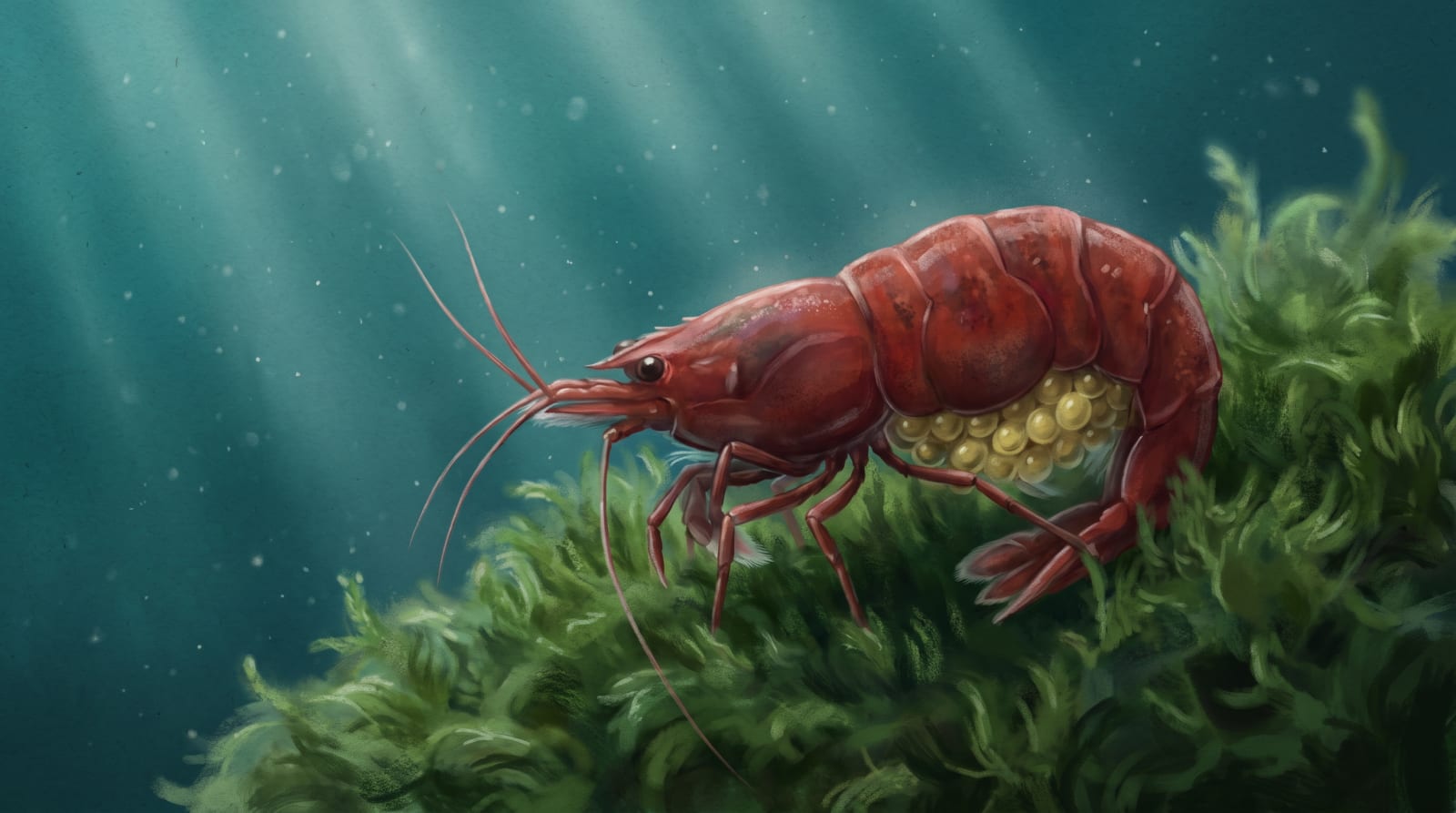
You've spotted a female tucked under the moss with a clutch of eggs held beneath her tail, and the instinct is to do something: feed her up, move her somewhere safe, freshen the water to keep it clean. Resist all three. The entire care plan for a berried cherry shrimp is stability, and most of it is things you deliberately don't do. This guide is the fortnight of leaving well alone that turns a clutch into a brood.
What "berried" actually means
A berried female is carrying fertilised eggs on the outside of her body, clustered under her abdomen among the small swimming legs called pleopods. The bundle looks like a little clump of berries, which is where the term comes from, and a female carrying one is the clearest sign there is that your water is right and your colony is settled.
She reaches that point in a set sequence. First she develops a "saddle": a patch of colour behind the head, on top of the body, which is a batch of undeveloped eggs sitting in her ovaries and showing through the shell. Within days of her next moult those eggs are fertilised and moved down under her tail, and she goes from saddled to berried, carrying 20–30 eggs. If you're still learning to read those markers, our male vs female cherry shrimp guide walks through the saddle and the rest, and the full story of what the eggs do over the next two to three weeks is in cherry shrimp eggs: colours, timeline and what can go wrong.
Stability is the care plan
Here is the whole of it, and everything below is just detail: keep the tank steady and let her get on with it. Sudden swings in temperature, TDS or pH are what make a female jettison her clutch, and a big mismatched water change is the classic trigger. A berried female wants the tank she was in yesterday, unchanged.
That means no rescaping, no rearranging the hardscape, no deep clean, and above all no moving her while she's carrying unless you genuinely have to. In our breeding room a berried female gets nothing special at all — the same steady water, the same light hand on maintenance, the same tank. The temptation to intervene is the single biggest risk to the brood, because almost every intervention registers with her as a shock. Holding your ordinary parameters steady matters far more here than chasing any perfect number.
What's normal berried behaviour
Three things throw new keepers, and all three are healthy.
She hides. A berried female spends more time tucked into moss or under wood than she used to. That's partly instinct and partly timing: she berries within days of a moult, so for the first day or two she's also sitting out the soft-shell window every shrimp hides through. A female you can't find is usually doing exactly what she should.
She fans constantly. You'll see the eggs ripple as she sweeps her pleopods back and forth around the clock. This keeps the clutch clean and oxygenated, and it's the busiest a shrimp ever looks. People read that frantic fanning as distress; it's the opposite, and a female who stops fanning is the one to worry about.
She eats less visibly. A carrying female grazes quietly rather than piling onto food with the rest of the colony, so she can look off her feed. She isn't. She's picking at biofilm on her own schedule and staying out of the scrum.
One point of language, because it's the term everyone searches: a "pregnant cherry shrimp" isn't pregnant in any internal sense. She carries the eggs externally, in full view, and there is nothing developing inside her to protect. That's genuinely good news, because it means there's nothing you need to do differently for her comfort.
Feeding: keep the routine, don't feed her up
The urge to feed a berried female more, to "keep her strong", is a good way to lose the brood. Overfeeding is the number-one killer of cherry shrimp, and uneaten food fouling the water is exactly the kind of instability that ends a clutch. Keep your normal rhythm of feeding two or three times a week, portions gone within a couple of hours, and anything fresh removed the same day.
A little variety across the colony does no harm and a small weekly protein feed supports egg development, but the tank feeds her more than you do. In a mature setup biofilm is the primary diet, and a carrying female works her way through it steadily without your help. Feed the colony as you always would and let her graze.
Water changes while she's carrying
Don't stop water changes altogether, but shrink them and soften them. We drop to small changes — around 10% — while a female is berried, always temperature-matched, dechlorinated and added slowly rather than tipped in. The goal is to keep the water fresh without ever giving her the temperature or TDS jolt that triggers a drop. The safe way to run changes, and why small-and-often beats large-and-occasional, is in water changes: how much, how often, how safely.
Between changes, keep the tank topped up for evaporation. A tank left to drop concentrates its minerals, so TDS creeps upward, and a top-up of dechlorinated water holds it level. Steady is the whole game.
Should you move her to a breeding box or separate tank?
For most keepers the answer is a firm no, and the myth that a berried female needs isolating costs a lot of broods. Netting her into a breeding box, or moving her to another tank, is precisely the stress that makes a female dump her eggs. She doesn't need it. Shrimplets are born fully formed and self-sufficient, they graze biofilm from their first hour, and they're perfectly safe among the adult colony — cherry shrimp don't eat their own young. Left in a species-only tank, mother and babies need no separating at all.
The one real exception is a female berried in a community tank with fish. There the newborn shrimplets stand almost no chance, because nearly anything with a mouth treats a 1–2mm baby as food, and moving her can be worth the risk. If you do it, do it gently: scoop her up underwater in a cup so she never leaves the water, move her early in the carry rather than days before hatch, and settle her into an established species-only tank rather than a bare box. Which tank mates make that move necessary in the first place is graded honestly in cherry shrimp tank mates.
How long is a shrimp berried?
A cherry shrimp carries her eggs for 14–21 days. Where a clutch lands in that window is mostly down to temperature: warmer water within the safe range speeds the embryos along and shortens the carry, which is one reason we hold our breeding tanks at 22–23°C, while a cool room-temperature tank sits at the longer end. Don't crank the heater mid-carry to hurry things — a temperature swing is exactly what you're trying to avoid.
You'll get a few days' warning of the hatch. In the final stretch, two dark dots appear in each egg — the developing eyes of the shrimplet inside — and once you can see eye-spots you're close. Then it happens quietly: one morning she's carrying nothing and a fleck of moss turns out to be a miniature shrimp. There's no larval stage and no metamorphosis, just direct development into a perfect small copy of the adult.
After the hatch: hands off, and she'll likely go again
When the shrimplets arrive, carry on doing nothing. They need mature biofilm, cover to graze in and steady water, all of which a settled tank already provides, and the full playbook for pushing survival from a trickle to the majority of each brood is in raising shrimplets. Your job is still mostly to stay out of the way.
The mother, meanwhile, is often straight back to it. A female can be berried again within days of her next moult, and in a settled tank each mature female produces a brood roughly every five to six weeks for much of her adult life. A first clutch isn't a one-off to fuss over; it's the start of a rhythm, and how that rhythm compounds into a full colony is worked through in how fast do cherry shrimp breed.
If she drops the clutch
Sometimes a female sheds her eggs before they hatch, and it's disheartening the first time. The usual causes are inexperience, stress and a water swing. Young, first-time mothers drop clutches more readily as they learn to carry; handling, a house move or aggressive tank mates will make any female jettison her brood to save herself; and a sudden shift in temperature or TDS does the same. Once the eggs are off her body they can't be rescued, because they need her constant fanning to survive — there's no incubating them in a cup.
One dropped clutch from a young or newly berried female is not a crisis, so give her the next cycle. A female who keeps dropping is telling you something about stress or stability, and the wider reasons a colony stalls are in why won't my shrimp breed. The whole breeding arc, from first saddle to a full colony, sits in our cornerstone guide, how to breed cherry shrimp.
FAQ
What should I do when my cherry shrimp is berried?
As little as possible. The best care for a berried female is a steady tank: no big or cold water changes, no rescaping, no moving her. Keep your normal feeding and shrink water changes to small, temperature-matched top-ups. She'll hide more, fan the eggs constantly and eat less visibly, all of which are normal. In a species-only tank you don't need to separate her — just keep everything boring for two to three weeks.
How long is a cherry shrimp berried for?
Between 14 and 21 days, with temperature setting the pace. Warmer water in the safe range — around 22–24°C — speeds embryo development and brings the hatch towards the 14-day end, while a cooler room-temperature tank stretches it towards 21 days or a little beyond. You'll get a few days' notice when dark eye-spots appear in the eggs, and then she releases fully formed miniature shrimp.
Why is my berried shrimp hiding?
Because that's what carrying females do, and because she's likely just moulted — shrimp berry within days of a moult and hide through the soft-shell window afterwards. Tucking into moss or under wood is instinct, keeping the clutch out of sight and out of the current. A hidden berried female is a healthy one; the time to worry is when a shrimp sits motionless in the open rather than grazing.
Should I move a berried cherry shrimp to a separate tank?
Usually no. In a species-only tank the shrimplets are born fully formed and safe among the adults, so moving her just adds the stress that makes females drop eggs. The exception is a community tank with fish that will eat the babies — there, gently moving her to an established shrimp tank, underwater and early in the carry, can be worth it. Breeding boxes and nets do more harm than good.
Do berried cherry shrimp stop eating?
No, they just eat more discreetly. A carrying female grazes biofilm quietly on her own schedule instead of joining the scramble at feeding time, so she can look off her food when she isn't. Keep feeding the colony as normal without ramping it up to "help her" — overfeeding fouls the water and threatens the clutch far more than a quiet appetite ever will.