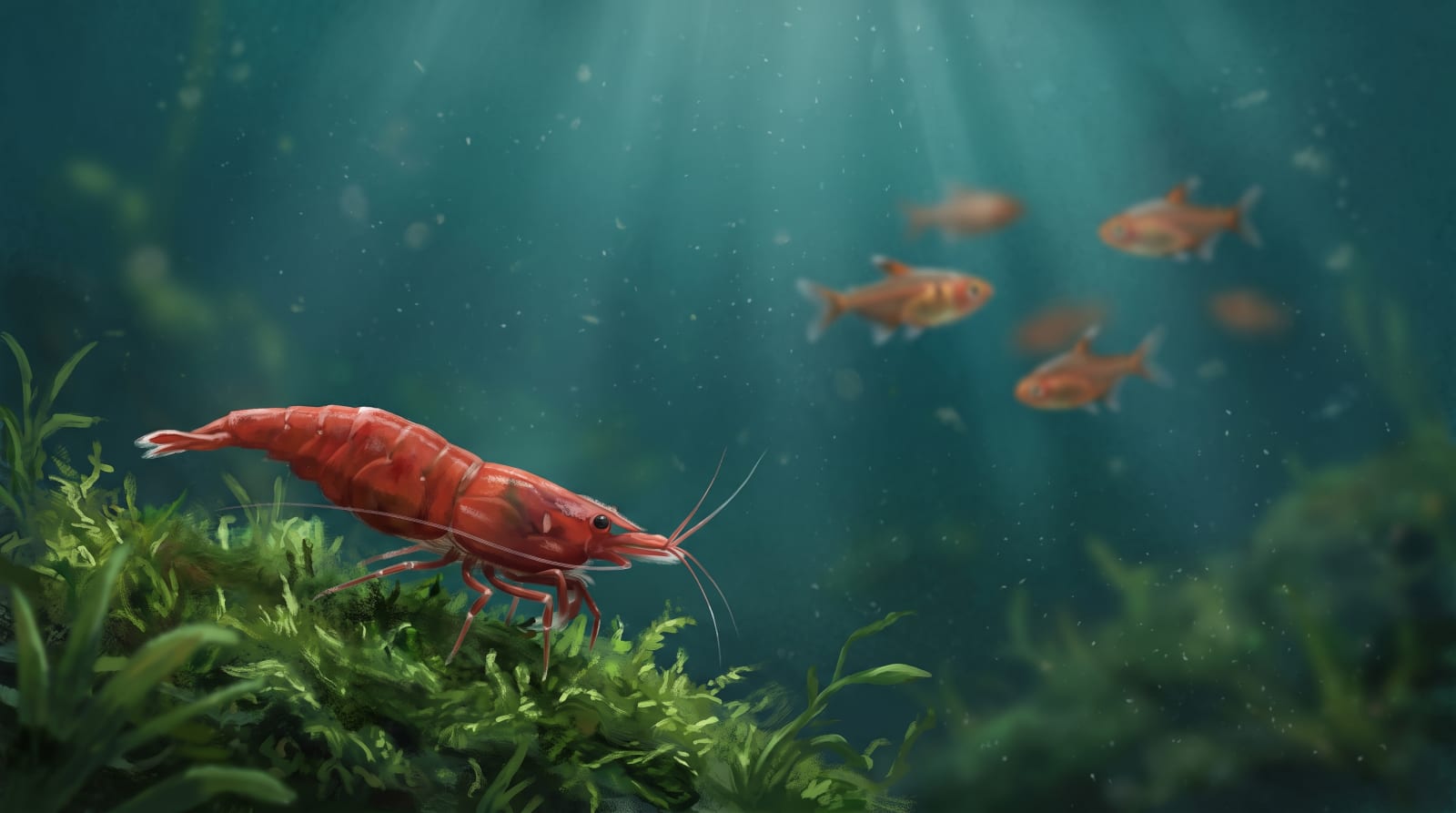
The honest answer first: the safest cherry shrimp tank is a cherry shrimp tank, and every breeding colony in our room is species-only. But cherries also live perfectly well alongside the right neighbours — the trick is knowing what "right" means before you buy, not three weeks after. Here's every common candidate rated on one simple, unsentimental rule.
The rule that decides everything
If it fits in the mouth, it's food. No fish leaves shrimp alone out of good manners; the ones that leave them alone are the ones physically incapable of eating them, or genuinely uninterested in hunting. Everything in this guide is that rule applied to specific animals.
It splits into two separate questions, because cherry shrimp come in two sizes. Adults are 2.5–3cm — too big a mouthful for genuinely tiny fish, and armoured enough to shrug off casual curiosity. Shrimplets hatch at 1–2mm and are food to almost everything that swims. Plenty of "shrimp-safe" fish are really adults-safe fish, and the difference decides whether your colony has a future.
There's a third question most compatibility lists skip: what happens to the colony over time. Cherries live 1–2 years, so a colony only persists by replacing itself. A tank where every shrimplet gets eaten doesn't look like a disaster — it looks fine, right up until the adults age out and you realise nothing ever grew up behind them.
One more wrinkle: moulting. Adults shed their exoskeleton every 3–6 weeks and spend 24–48 hours soft and hiding afterwards. Fish that can't touch an armoured adult will happily take a freshly moulted one, which is why "risky" fish often seem fine for months — until the day they don't.
The compatibility table
| Tier | Tank mates | Adult shrimp | Shrimplets | Colony outlook |
|---|---|---|---|---|
| Safe | Snails (ramshorns, nerites, Malaysian trumpets), otocinclus, pygmy corydoras | Safe | Safe, or as near as it gets | Grows normally |
| Mostly safe — adults only | Ember tetras, chili rasboras, endler livebearers and similar nano fish | Safe | Eaten in the open | Holds, or grows slowly under heavy cover |
| Risky | Bettas, most tetras from neon size up, gouramis | An individual lottery; moulting shrimp get picked off | Eaten | Shrinks |
| Never | Goldfish, cichlids of any size, loaches | Eaten | Eaten | It's a feeding event, not a tank |
Read it as two columns, not one. The "adult shrimp" column tells you whether the shrimp you buy on Saturday are still there on Sunday; the "shrimplets" column tells you whether the tank has a future as a colony. Most compatibility advice online quietly answers only the first question, which is how people end up with a "successful" community tank whose shrimp population has been ageing towards zero for a year.
Print that table and you have the whole article. The rest is the reasoning, tier by tier, plus how to stack the odds if you mix anyway.
Safe: snails, otocinclus and pygmy corys
Snails are the only tank mates we trust without a single caveat, and we keep them in nearly every tank we run — pearl blue ramshorns, mostly, alongside nerites and Malaysian trumpet snails. They work a different shift entirely: film algae and leftovers rather than the biofilm grazing shrimp prefer, no interest in anything that moves, and no mouth built for catching it anyway. If you see a snail on a dead shrimp, it's doing the undertaking, not the murder. The pairing is so good it gets its own guide: shrimp and snails, the perfect cleanup crew.
Otocinclus are the closest thing to a genuinely shrimp-safe fish. Their mouth is a rasping disc evolved for scraping algae film off surfaces — the wrong tool for catching anything, even a shrimplet. Two honest caveats: they need a mature, algae-filmed tank or they slowly starve, and they want the company of their own kind. Give them both and they'll share a colony for years without incident.
Pygmy corydoras stay tiny, live in sociable little groups and spend their day sifting the substrate for scraps. They're not hunters, and a colony carries on breeding around them. Being fish, they won't turn down a newborn shrimplet that lands directly in front of them — but that's opportunism at the margins, not predation that changes the colony's maths. Their full-size corydoras cousins are nearly as trustworthy on the same logic, just with slightly bigger margins.
Mostly safe: nano fish, adults only
This tier is the honest home of the classic "shrimp-safe fish" list: ember tetras, chili rasboras, endler livebearers, and the other true nano species (common guppies behave the same way as their endler relatives, with slightly bigger mouths). Adult cherries are simply too big for them, so the shrimp you bought are safe. The shrimp they produce are not.
Every shrimplet that crosses open ground in daylight is a coin toss, and these fish flip a lot of coins. What tilts the odds is cover: dense moss thickets are nursery habitat the fish can't work through, and a well-mossed tank absorbs those losses without the colony going backwards. The moss guide covers the best species for exactly this job, and the wider survival levers are in raising shrimplets.
Keep the fish properly fed, too — a hungry shoal hunts harder than a full one, though never assume "well fed" means "retired". Expect a planted tank in this tier to hold its shrimp numbers or creep slowly upward. What you won't get is the population boom a species-only tank produces, so if the plan is breeding for numbers or grade, this tier is already a compromise.
Risky: bettas, bigger tetras and gouramis
Bettas are the most-asked question in shrimp keeping, and the truthful answer is that it depends entirely on the individual fish. Some ignore shrimp for their whole lives; some clear a tank methodically within weeks; most sit somewhere between, tolerating adults and eating every shrimplet they find. We've written up the honest odds on keeping shrimp with a betta separately — the short version is: never with shrimp you'd mind losing.
Most tetras from neon size upward get waved through as community classics, and for adult shrimp they're mostly — mostly — tolerable. The problem is the moult cycle. Every adult in your colony goes soft for a day or two every 3–6 weeks, and a curious shoal finds them. Combine steady adult attrition with total shrimplet predation and the colony arithmetic only runs one way: down.
Gouramis are deliberate, patient invertebrate-pickers — a dwarf gourami working a shrimp tank is a heron in miniature. Of everything in this tier they're the ones we'd rule out soonest; the interest isn't curiosity, it's professional.
Never: goldfish, cichlids and loaches
Goldfish fit an adult cherry shrimp in whole, and what they can't fit they'll spend the afternoon trying. Cichlids — and that includes the angelfish people forget are cichlids — are capable, motivated predators of exactly shrimp-sized animals. Loaches are specialist invertebrate eaters; the same skill set that makes them famous snail-control makes them shrimp-removal. Kuhli loaches are the gentlest of the family and the exception people hope for, but we still wouldn't put them with a colony we cared about.
There's no husbandry fix here — no amount of moss changes what these fish are. If any of them are in the tank, it isn't a shrimp tank; it's an expensive way to feed fish.
What about other shrimp and snails?
The most compatible tank mate for a cherry shrimp is another cherry shrimp, but there's a catch worth knowing before you build a rainbow tank. Every Neocaridina colour line — red, blue, yellow, orange, the lot — is the same species, so they coexist perfectly and interbreed just as readily. Within a couple of generations the mixed offspring drift back towards wild-type brown, which is why we keep one line per tank. The full picture is in can you mix Neocaridina colours? — the short answer is that they're safe together and your colours won't survive it.
Amano shrimp sit in a different genus (Caridina), so they can't produce viable offspring with your cherries — no reversion risk. They're peaceful, tireless algae workers, just noticeably bigger and pushier at feeding time; a cherry that wants the courgette slice will simply wait its turn. No threat to shrimplets, and a sensible addition to a display tank.
Snail-wise, everything in the safe tier stands, with one warning in the other direction: skip anything sold to eat other snails. Predatory species that hunt snails will treat small shrimp as the same job.
Want a growing colony? Go species-only
Every serious breeder ends up in the same place, and it's worth explaining why rather than just asserting it. Remove fish and shrimplet survival transforms — that single change is the difference between a colony that doubles and a colony that treads water. The full breeding guide runs the numbers, but predation is the tax that eats colony growth, and species-only sets it to zero.
Behaviour changes too. A colony under constant patrol lives cautiously: more hiding, less open grazing, and stress that mutes the very colours you bought the shrimp for — even a deep blue dream line looks grey when it spends its life scared. Take the fish out and within days the whole colony is out on the glass at midday, feeding like it's being paid to.
Species-only doesn't mean empty, either — snails slot in without cost, and a snail-plus-shrimp tank is a complete, self-cleaning little system. If you're torn, our species-only vs community guide is the decision framework: colony first or display first, because you genuinely can't optimise for both.
Mixing anyway? How to stack the odds
If the plan is a community tank with shrimp in it, go in with open eyes and rig the game:
Establish the shrimp first. A colony that's been breeding for a few months before any fish arrive has population momentum and a settled network of hides. Shrimp added to an existing community, by contrast, get inspected by everything with fins on day one.
Build for cover. Moss thickets, botanicals, leaf litter, tangled wood — cover is the single biggest lever on shrimplet survival, and it needs planting before the fish exist, not after the losses start.
Stock from the top two tiers only, and stock lightly. One small shoal of nano fish, not a menagerie. Every extra mouth is another coin flipped against each shrimplet.
Spend accordingly. Put £2–4 standard-grade cherries in a community tank. High-grade shrimp at £30–50 per 10 belong in a species-only tank where their offspring survive to justify the price.
Have an exit plan. A cheap tub and a spare sponge filter mean any fish that turns out to be a shrimp-eater can be separated the day you catch it in the act, rather than three weeks and half a colony later.
The shrimp's own requirements don't change in company — stable parameters, real cover, restrained feeding. Get those right and a top-two-tiers community can tick along for years; get them wrong and the fish will only be finishing what the water started.
FAQ
What fish can live with cherry shrimp?
Otocinclus and pygmy corydoras are the safest fish choices — neither has the mouth nor the inclination to hunt shrimp. True nano fish like ember tetras, chili rasboras and endlers are safe with adult shrimp but will eat shrimplets in the open. Snails beat all of them for pure compatibility. For a colony you want to grow quickly, no fish at all is still the best answer.
Will neon tetras eat cherry shrimp?
Armoured adults are usually too much work for a neon, but freshly moulted shrimp — soft for 24–48 hours every few weeks — get picked off, and shrimplets are eaten on sight. A cherry colony alongside neons typically declines slowly rather than dramatically, which is why the combination looks fine for months before the numbers tell the truth.
Can cherry shrimp live with a betta?
Sometimes. It depends entirely on the individual betta: some ignore shrimp completely, others hunt them methodically, and almost all of them eat shrimplets. Dense moss cover improves the odds for adults, but the colony won't grow. Only try it with standard-grade shrimp you can afford to lose — never with expensive stock.
Do snails eat cherry shrimp?
No. Aquarium snails like ramshorns, nerites and Malaysian trumpets are grazers and scavengers with no ability or appetite for hunting; they're the safest tank mates a shrimp colony can have. If you spot a snail on a dead shrimp it's cleaning up a body, not responsible for it — snails reach shrimp only after something else has gone wrong.
Can you keep cherry shrimp with guppies?
Treat guppies exactly like their endler relatives: adult shrimp are generally left alone, shrimplets are eaten whenever they're caught in the open. In a heavily planted, moss-dense tank a colony can hold its numbers alongside them; in a sparse one it will quietly shrink. Fine for a display tank, a poor choice for a breeding project.