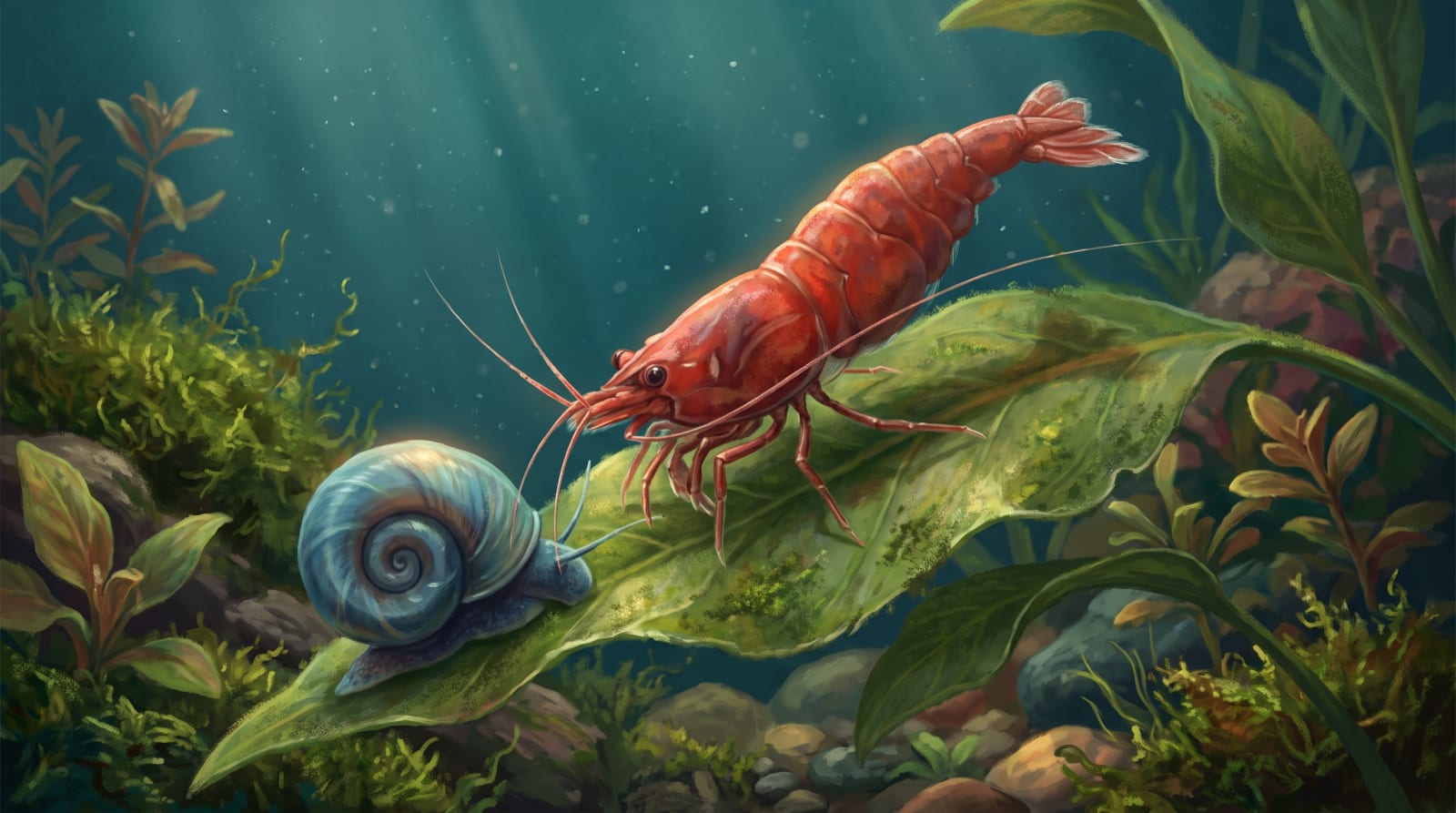
Snails are the only tank mates we trust in a shrimp colony without a single caveat, and there's a snail in nearly every tank we run. Shrimp and snails don't just tolerate each other — they split the cleanup work between them, cover ground neither manages alone, and give you a living readout of whether you're feeding too much. If you're building a cherry shrimp tank, a few snails aren't a risk to weigh up. They're the first thing to add.
Why shrimp and snails work together
The pairing works because the two animals do different jobs. Cherry shrimp are fine grazers: they pick biofilm off every surface, work leftover food into nothing, and comb through moss and substrate for particles too small to see. What they don't do is shift the tougher stuff — the film algae welded to the glass, a dying leaf, a lump of waste tucked behind the wood.
Snails cover exactly that ground. They rasp algae off hard surfaces, graze the film a shrimp's mouthparts can't lift, break down decaying plant matter, and burrow into the leftovers that settle where nothing else reaches. Put the two together and the tank gets worked top to bottom by two crews on different shifts, with almost no overlap and no competition worth the name. It's the closest thing to a self-cleaning aquarium the hobby offers.
None of this replaces your own maintenance — a cleanup crew is staff, not a reset button — but a shrimp-and-snail tank stays visibly cleaner between water changes than a shrimp-only one, and does it for the price of a few snails.
Do snails harm shrimp?
No. This is the worry we're asked about most, and it rests on a misunderstanding of what a snail is. Aquarium snails are grazers and scavengers with no ability, and no appetite, for hunting. They have no way to catch a shrimp, no interest in trying, and no equipment for the job even if the urge struck them. A shrimp and a snail sharing a leaf are two grazers at the same salad bar.
The image that spooks people is a snail sitting on a dead or dying shrimp, and it's a case of mistaken identity. The snail is doing the undertaking, not the murder — it's cleaning up a body that something else, almost always a water-quality problem, already produced. A snail reaches a shrimp only after the shrimp is beyond help. If you see it happen, test your water; the snail is the messenger.
There's one genuine exception, and it runs the other way. Anything sold specifically to eat other snails — assassin snails and the like — will treat small shrimp and shrimplets as the same job. Skip predatory snails in a shrimp tank. Every peaceful grazing snail in this guide is safe; the ones to avoid are the ones marketed as pest control. The wider question of who else belongs in the tank is covered in our cherry shrimp tank mates guide.
The cleanup crew: ramshorns, trumpets and nerites
Three snails do the bulk of the work in shrimp tanks, and they suit different keepers. Here's how they compare on the things that actually matter.
| Snail | What it cleans | Breeds in a freshwater tank? | Keep an eye on |
|---|---|---|---|
| Ramshorn | Film algae, leftovers, dead plant matter | Yes, readily | Population tracks feeding; eggs on everything |
| Malaysian trumpet (MTS) | Detritus in and under the substrate | Yes — livebearer, no eggs to spot | Booms if you overfeed; near-impossible to remove |
| Nerite | Film and spot algae, the best glass-cleaner | No — eggs never hatch in freshwater | Harmless white eggs on hardscape; wants firm GH for its shell |
Ramshorn snails are our default, and the ones you'll see in most of our tanks. They're tireless on algae and leftovers, come in a range of colours, and breed to match the food available — which, as we'll come to, is a feature rather than a fault. They lay jelly-like egg clutches on any surface, so you never quite run out of them. Everything about keeping and colouring them up is in our dedicated ramshorn snails guide.
Malaysian trumpet snails work the shift nobody else will: down in the substrate. They burrow through it by day, surface at night, and in doing so keep the bed turned over and stop waste going anaerobic in the corners. They're livebearers, so there are no egg clutches to see — which also means the first sign you have a lot of them is a lot of them. They're the hardest snail to remove once established, so add them deliberately, not by accident.
Nerite snails are the best pure algae-eaters of the three and the tidiest citizens, because they can't breed in freshwater. They'll lay little white eggs on wood and rock that never hatch — cosmetic, nothing more — so their numbers never run away from you. The trade-off is that a nerite needs firm water to build its shell and rasps through algae fast enough that a small tank can leave it short of food. In hard UK water they're an excellent, controllable choice.
Your snails are an overfeeding gauge
This is the part most guides miss, and it's the best reason to keep breeding snails rather than resent them. A snail population is a direct readout of surplus food. Snails breed to match what's available, so a tank drifting towards a snail explosion is a tank being overfed — the extra food that's growing the snails is the same extra food fouling your water and stressing your shrimp.
So when the ramshorns suddenly seem to be everywhere, don't reach for a treatment. Read the signal and cut the feeding. Scrape off the visible egg clutches if you like, take out any snails you don't want by hand, and above all feed less — portions the tank clears in a couple of hours, no leftovers sitting overnight. Bring the food down and the snail numbers settle within a few weeks, all on their own. The full argument for why surplus food is the root of so many tank problems is in overfeeding: signs, dangers and recovery.
A steady, modest snail population is a sign of a tank fed about right. Treat the count as a dial on your dashboard, not a pest to be beaten.
Same water, same shells — and the copper trap
Snails are as easy to keep as the shrimp, because they want the same conditions. Run the tank to standard Neocaridina numbers — 18–26°C, GH 6–12, stable and dechlorinated — and your snails are sorted too. That GH matters as much to them as to the shrimp: it's the mineral their shells are built from, and a snail in soft, low-GH water grows a pitted, eroded shell the same way a shrimp fails its moults. The reasoning behind every parameter is in our Neocaridina water parameters guide.
There is one thing that will kill your whole cleanup crew at a stroke, and it's the same thing that kills shrimp: copper. Copper-based snail treatments and many fish medications are lethal to invertebrates across the board, so never dose one in a shrimp tank — not to knock back a snail bloom, not for anything. If snails are multiplying, the fix is less food, never poison; if you medicate for a fish problem, move the fish out first. We keep the whole story in copper and shrimp, and it applies to the snails word for word.
Beyond that, snails ask nothing special. They fold straight into the fifteen-minute-a-week routine of any cherry shrimp care setup — which is to say, they ask for nothing at all.
The snail we keep
If we had to pick one snail for a shrimp tank, it's the ramshorn, and specifically the pearl blue ramshorn we breed alongside our colonies — a soft blue-grey line that shows beautifully against dark substrate and does the same honest algae work as any other. When we've a surplus they go up on the shop; our stock is rebuilding at the moment, so join the waitlist and you'll hear the moment the next batch is ready. Whichever colour you land on, the care is identical, and it's all laid out in the ramshorn snails guide.
FAQ
Do snails harm cherry shrimp?
No. Aquarium snails like ramshorns, nerites and Malaysian trumpets are grazers and scavengers with no ability or appetite to hunt — they're the safest tank mates a shrimp colony can have. If you spot a snail on a dead shrimp, it's cleaning up a body, not responsible for it; snails only reach a shrimp after something else has already gone wrong. The one exception is predatory "assassin" snails, which you should keep out.
What snails are best for a shrimp tank?
Ramshorns are the all-round default: hardy, colourful, and great on algae and leftovers. Nerites are the best glass-cleaners and can't breed in freshwater, so their numbers stay put. Malaysian trumpet snails keep the substrate turned over from below. All three are fully shrimp-safe and want the same water as your cherries, so the choice comes down to the job you most want doing.
Why do my snails keep multiplying?
Because you're feeding more than the tank needs. Snails breed to match the food available, so a rising snail count is a direct sign of surplus food — the same surplus that fouls water and stresses shrimp. Cut your feeding to portions cleared within a couple of hours, remove a few snails by hand, and the population settles within weeks. Never treat a snail bloom with copper-based products: they kill shrimp too.
Do nerite snails breed in a shrimp tank?
Not in a way you'll ever have to manage. Nerites need brackish water for their larvae to develop, so in a freshwater shrimp tank their eggs simply never hatch. You'll see small white egg capsules stuck to wood and rock — purely cosmetic, and easily scraped off if they bother you. That's exactly why nerites are popular: all the algae-eating, none of the population explosion.