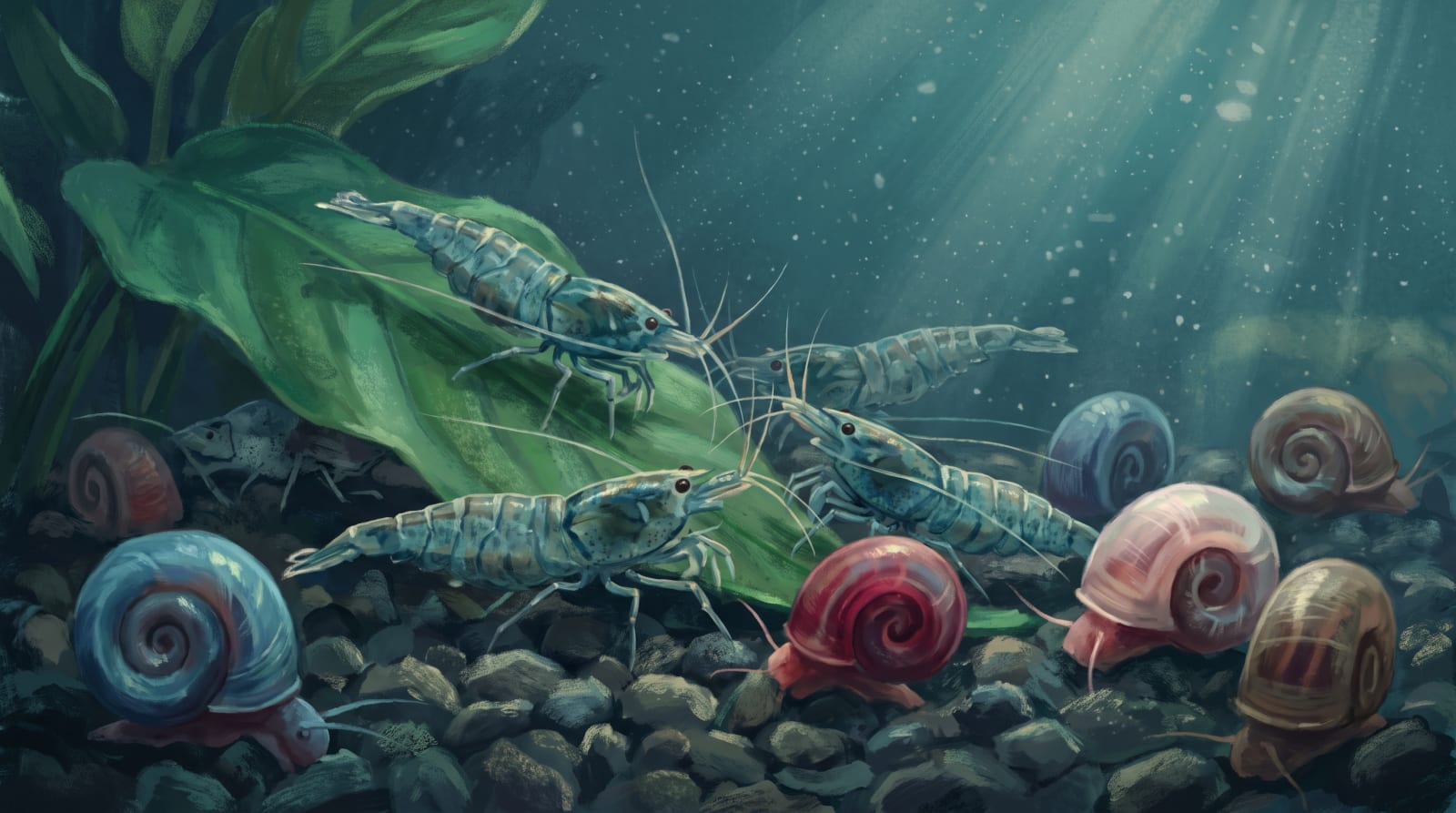
Ramshorn snails divide opinion in UK fishkeeping more than almost any other animal: one keeper's pest is another's favourite cleanup snail. In a shrimp tank, they land firmly on the favourite side. They're hardy, they come in genuinely lovely colours, they do real work on algae and leftovers, and their numbers tell you something useful about how you're feeding. Most people meet their first ramshorn as a hitchhiker on a plant; here's why you might want to keep it on purpose.
What ramshorn snails are
A ramshorn is a small freshwater snail named for its shell, which coils flat in a single plane like a coiled horn rather than spiralling up into a point. That flat coil is the quick way to tell it apart from the pointed bladder and pond snails that hitchhike into tanks the same way — both are common, and both arrive uninvited on new plants, but only the ramshorn wears the neat spiral. Most stay under about 2cm across, though the odd well-fed individual grows larger, and they live around a year, sometimes a fair bit longer in a settled tank.
Two quirks are worth knowing. Ramshorns breathe air: they carry a simple lung and will glide up to the surface for a gulp now and then, which is normal behaviour and not a sign of bad water. And unlike most snails, they carry haemoglobin — the same red oxygen-carrying pigment we do — which is exactly why the red and pink ones look the way they do, their blood showing through a pale body and a translucent shell.
They're peaceful to the point of being oblivious, spend their days rasping quietly over every surface, and bother nothing. In a shrimp tank that makes them a natural fit, which is the subject of our wider shrimp and snails guide.
Ramshorn colours
The colour range is the reason a lot of keepers go from tolerating ramshorns to collecting them. It comes down to two things: the pigment in the snail's body, and how clear or dark its shell is. Here's the range you'll meet in the UK.
| Colour | How it looks | Roughly how it arises |
|---|---|---|
| Brown | Brownish body, tan-to-brown shell | The wild type — full dark pigment |
| Red / pink | Bright red to soft pink body, clear shell | Leucistic: no dark pigment, so the red blood shows through |
| Blue | Cool blue-grey body under a translucent shell | Muted body pigment reading as blue through clear shell |
| Leopard | Pale base with darker spots and speckles | Patchy dark pigment over a lighter ground |
The colours interbreed freely, so a mixed group throws mixed and often muddier offspring over a few generations — the same wild-type pull you get with shrimp lines. If you want a tank of one clean colour, start with stock from a single line rather than a scoop of assorted hitchhikers.
The blues are the ones we've put the most work into. Our own pearl blue ramshorns are a soft, pearlescent blue-grey line that looks superb against dark substrate, and they do exactly the same honest algae work as any brown hitchhiker. When we've surplus they go up on the shop; the colony's rebuilding just now, so join the waitlist and you'll be first to know when the next batch is ready.
Care: the same water as your shrimp
The happy news for shrimp keepers is that a ramshorn wants precisely the conditions your cherries already have. There's no separate regime to learn — a cycled, planted tank run to standard Neocaridina numbers suits them completely.
| Parameter | Range | Why it matters to a snail |
|---|---|---|
| Temperature | 18–26°C | Comfortable across the normal room range |
| pH | 6.8–7.6 | Happy in the same slightly-hard-to-neutral water as Neos |
| GH | 6–12 | The minerals the shell is built and repaired from |
| KH | 2–8 | Buffers pH steady, which shell-building needs |
| TDS | 150–250 | Same target as your shrimp |
| Ammonia / nitrite | 0 | Snails are hardier than shrimp here, but zero is the aim |
The line to underline is GH. A snail's shell is calcium, drawn from the water just as a shrimp's new exoskeleton is, and a ramshorn kept in soft, low-GH water grows a thin, pitted, eroded shell — sometimes with the tip worn back to raw white. In the hard water of London and the South East that's never a worry; in the soft-water regions of Scotland, Wales, Cornwall and the North West you remineralise for the snails for the very same reason you do it for the shrimp. Our UK tap water guide breaks the regions down, and the full reasoning behind each number is in the Neocaridina water parameters guide.
Beyond water, they ask for nothing. No heater they don't share with the shrimp, no special food, no kit. They slot straight into the ordinary routine of any cherry shrimp care setup and get on with it.
What they eat, and the numbers question
Ramshorns are grazers and scavengers. They work over film algae, biofilm, leftover shrimp food, dead and dying plant matter, and the occasional deceased tank inhabitant — the useful, unglamorous cleanup a tank always needs. On healthy live plants they're largely trustworthy: a well-fed ramshorn grazes the soft algae off a leaf and leaves the leaf itself alone, and they don't wreck plants the way apple and mystery snails can. A genuinely starving one may rasp at a very soft or already-dying plant, but that's a symptom of an underfed tank, not a habit of the snail.
Which brings us to the thing everyone asks: why do ramshorns multiply so fast? The honest answer is that they don't, exactly — they breed to match the food you provide. A population that's exploding is a tank that's being overfed, and the surplus food growing the snails is the same surplus fouling your water. So the snail count is a genuinely useful gauge. A steady, modest number means you're feeding about right; a sudden boom means cut back. Reduce the food to portions cleared in a couple of hours, remove a few by hand, and the numbers settle within weeks — no treatment, no drama. The wider case for why surplus food is behind so many tank troubles is in overfeeding: signs, dangers and recovery.
Eggs on everything: the honest bit
Here's the part the pest camp is right about. Ramshorns lay their eggs in small, clear, jelly-like domes stuck to any surface going: the glass, the plants, the wood, the heater, the underside of the lid. They're hermaphrodites, so it only takes two — and often functionally one — to get a colony started, and once they're in, they're in. There is no realistic way to have ramshorns and not have eggs.
What you can do is manage the pace, and it's the same lever every time: feeding. Keep the food tight and the population self-limits at a level the tank can support. Scrape the visible clutches off the glass at water-change time if the look bothers you, thin the adults by hand when you fancy, and accept that a background trickle of new snails is simply part of the deal. In a shrimp tank that trickle is doing you a favour — more grazers, more cleanup, and a live readout on your feeding. It's only a problem in a tank that's overfed, and the snails are telling you so.
Ramshorns with shrimp
For a cherry shrimp colony, ramshorns are as close to a perfect companion as the hobby has. They can't harm a shrimp — no equipment for it, no interest in it — and if you ever see one on a dead shrimp it's scavenging a body, not the cause of it. They compete for food only at the margins, and in exchange they clean surfaces the shrimp can't and flag your overfeeding before it becomes a water problem. Snails sit in the "fully safe" tier of our cherry shrimp tank mates guide, and ramshorns are the reason that tier exists.
The one thing that will kill them is the one thing that kills shrimp: copper. Copper-based snail treatments and many fish medications wipe out invertebrates across the board, so if a ramshorn population needs reining in, the answer is always less food, never poison — a copper dose would take your shrimp with the snails. If you must medicate a fish, move the fish to a separate tank first. The whole story is in copper and shrimp, and every word of it applies to the snails as well.
FAQ
Are ramshorn snails good or bad for a shrimp tank?
Good, on balance — genuinely so. In a shrimp tank they clean algae and leftovers, do no harm to shrimp of any size, and their numbers act as a handy gauge of whether you're overfeeding. The only real downside is that they breed freely and lay eggs on every surface, which some keepers dislike. Control the population by feeding less rather than by dosing anything, since snail treatments contain copper and copper kills shrimp.
What do ramshorn snails eat?
Film algae, biofilm, leftover food, and decaying or dying plant matter, plus the occasional dead tank inhabitant — they're grazers and scavengers rather than hunters. Healthy live plants are usually safe, because a well-fed ramshorn takes the algae off a leaf and leaves the leaf. In a shrimp tank they need no dedicated feeding at all; the leftovers and biofilm the colony generates keep them going.
Do ramshorn snails eat plants?
Rarely, if the tank is fed properly. Unlike apple or mystery snails, ramshorns prefer algae, biofilm and decaying leaves to healthy plant tissue, and a colony with enough of that on offer leaves growing plants alone. Damage to healthy plants is almost always a sign of an underfed tank pushing hungry snails onto soft leaves — the fix is more grazing surface and steady feeding, not removing the snails.
How do I control ramshorn snails in a shrimp tank?
By feeding less, not by treating the tank. Ramshorns breed to match available food, so cutting portions to what the tank clears in a couple of hours brings the numbers down within weeks. Scrape egg clutches off the glass, remove surplus adults by hand, and drop in a blanched courgette slice as a lure you can lift out covered in snails. Never use copper-based snail killers — they're lethal to your shrimp too.