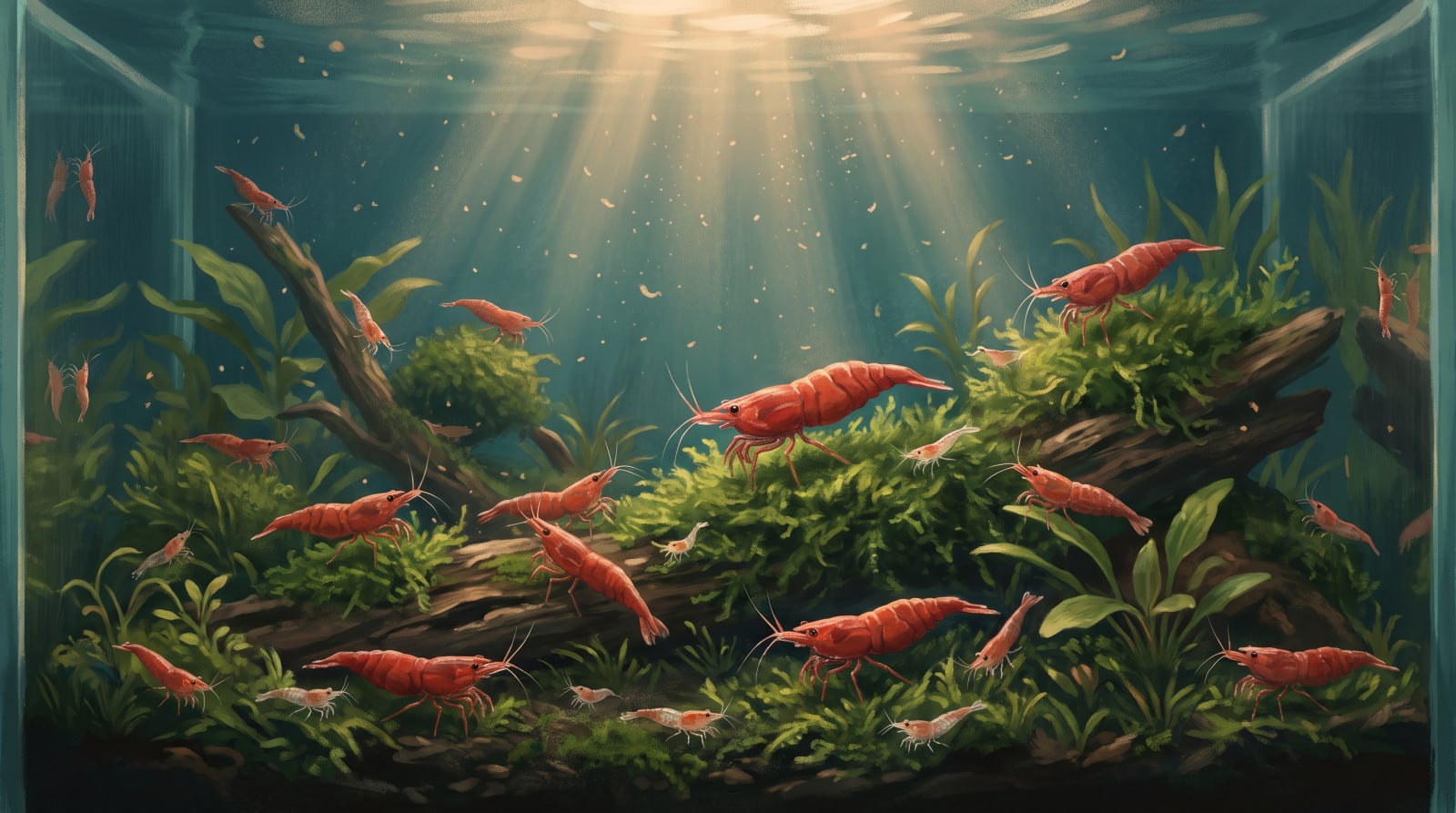
The honest answer is: slowly at first, then faster than you expect, then it stops. Cherry shrimp breeding compounds like interest, so a group of ten sits there doing very little for a few months and then, seemingly overnight, the tank is full of shrimp. This guide lays out the numbers that drive that curve, works a twelve-month model from ten starters, and — just as importantly — explains why your tank won't actually hit the top of the table.
The numbers that drive it
Everything about colony growth comes down to a handful of figures, all of them from how Neocaridina reproduce:
- A mature female carries 20–30 eggs per clutch, detailed in cherry shrimp eggs: colours, timeline and what can go wrong.
- She carries them for 14–21 days, then releases fully formed miniature shrimp — there's no larval stage to survive, so every hatchling is a potential breeder from day one.
- She can be berried again within days of her next moult, producing a fresh brood roughly every five to six weeks.
- A shrimplet reaches breeding age at three to five months, at which point it starts the cycle over.
- Put together, a healthy colony roughly doubles every two to three months.
That last figure is the headline, but it hides the interesting part: the doubling isn't steady. It lags while your starters and their first babies grow up, then accelerates hard once several generations are breeding at once.
How often do cherry shrimp breed?
Per female, a brood every five to six weeks for much of her adult life. She'll moult, mate, carry for two to three weeks, release, and often re-berry within days of the next moult, back to back. One female alone is a slow drip of twenty-odd shrimplets a month or so.
The pace comes from stacking. In a colony, the females aren't synchronised — they moult and berry on their own schedules — so at any given moment several are carrying and others are between clutches. The result is that a settled tank almost always has berried females in it, and shrimplets arrive in a near-continuous trickle rather than in distinct batches. That staggering is what makes the growth feel smooth rather than lumpy.
How many babies do cherry shrimp have?
Twenty to thirty per brood, and in theory a single female can produce several hundred eggs across a year — eight to ten broods, each of a couple of dozen. If every egg became an adult, one female would swamp a tank on her own.
They don't, and that gap is the whole story of colony growth. Not every egg is fertile, not every clutch is carried to term, and above all not every shrimplet survives its first weeks. In a bare community tank with fish and an open filter intake you might see a couple of survivors per brood; in a mature, planted, species-only tank the majority live. Survival, not fertility, is the lever you actually control, and it's the single assumption the maths below lives or dies on.
Why colony growth compounds
The reason ten shrimp can become hundreds inside a year is that this is exponential, not linear, growth. Your original females breed, their daughters mature in three to five months and breed, their granddaughters mature and breed, and each generation is bigger than the last. Nothing adds shrimp at a fixed rate; the whole colony multiplies against itself.
That's what "doubles every two to three months" really means. It's a growth rate, not an addition. Ten becomes twenty, twenty becomes forty, forty becomes eighty — and because each doubling starts from a bigger base, the raw number of new shrimp per month climbs steeply even though the underlying rate holds steady. The cherry shrimp breeding rate feels explosive in months six to twelve precisely because it was quietly compounding in months one to five.
A worked 12-month model from 10 starters
Here's that compounding as a table. Read it as a model, not a promise — it's the doubling rule applied cleanly, and reality is messier at both ends. The assumptions behind it are deliberately favourable but realistic:
- You start with 10 shrimp in a natural mix of both sexes.
- They live in a mature, planted, species-only tank with no predators, so most shrimplets survive.
- The water is steady and at breeding temperature (21–24°C), so females berry freely.
- The colony doubles every two to three months — shown as a slower lane (a three-month doubling) and a faster lane (a two-month doubling).
| Month | Slower lane (~3-month doubling) | Faster lane (~2-month doubling) |
|---|---|---|
| 0 (start) | 10 | 10 |
| 3 | ~20 | ~30 |
| 6 | ~40 | ~80 |
| 9 | ~80 | ~220 |
| 12 | ~160 | ~600 |
So a group of ten, kept well, plausibly becomes somewhere between a couple of hundred and several hundred shrimp inside a year. The spread between the lanes is enormous — that's not sloppiness, it's the truth of exponential growth, where small differences in temperature, survival and food compound into wildly different totals. The early rows also flatter reality slightly: for the first three to four months the growth is slower than a clean doubling suggests, because your starters and their first babies are still growing up before the real acceleration kicks in.
Why your tank won't hit the top of the table
No tank grows exponentially for long, because a colony self-regulates around its food supply and space. Growth starts as that steep exponential curve and then bends over into an S-shape, flattening as the tank approaches what it can actually support. You'll see it happen: berried females become less constant, shrimplet survival quietly drops, and the population settles at a plateau rather than climbing forever.
This is a good thing, and it's why cherry shrimp rarely "overpopulate" in the disaster sense — the tank finds its own ceiling. What you must not do is try to push past it by feeding more. Overfeeding is the number-one killer of cherry shrimp, and cramming in extra food to force growth just fouls the water and crashes the colony you were trying to grow. The plateau is the tank telling you it's full; the right response is more space, not more food.
What speeds it up or slows it down
Within those limits, a handful of things decide whether you're in the slower lane or the faster one:
- Temperature. This is the big dial. We run our breeding tanks at 22–23°C, inside the 21–24°C breeding band, and below about 21°C breeding slows right down — an unheated cool room can stall a colony almost completely. The full parameter picture is in Neocaridina water parameters.
- Stability. Sudden swings in temperature or TDS make females drop clutches, so an unstable tank breeds in fits and starts however good its average numbers look.
- Shrimplet survival. The single biggest multiplier, and mostly about keeping predators out and biofilm in — raising shrimplets is the detail.
- Sex ratio. You need mature males present; a tank of saddled females who never berry usually means no males or shrimp too young, which you can diagnose with male vs female cherry shrimp.
- Starting number. Ten or more builds momentum; two or three can dawdle for months before anything gets going.
If your colony isn't growing at all, the problem is usually one of these rather than the shrimp, and why won't my shrimp breed works through the nine usual causes. For the full breeding process, from a female's first saddle to a self-sustaining colony, see our cornerstone guide, how to breed cherry shrimp.
What to do with the surplus
Plan for success, because a well-run colony will outgrow its tank. Your options are the obvious ones: upgrade to a bigger tank, run a second one, or start rehoming shrimp — giving them to other keepers, trading them at a local aquatic club, or selling your surplus, which has its own honest maths in breeding shrimp for profit in the UK. The one thing you must never do is release surplus shrimp into ponds, streams or any waterway; it's illegal in the UK and ecologically reckless, whatever the colour of the shrimp.
Managing numbers down is part of keeping a colony healthy, not a sign anything went wrong. A tank that forces you to find homes for shrimp is a tank you've kept extremely well.
FAQ
How fast do cherry shrimp multiply?
A healthy colony roughly doubles every two to three months, so ten shrimp in a mature, predator-free tank can plausibly become a couple of hundred within a year. The growth compounds rather than adds, so it's slow for the first few months while your starters mature, then accelerates sharply. Warmth around 21–24°C and good shrimplet survival push you towards the fast end; a cool or unstable tank stays near the slow end.
How often do cherry shrimp breed?
Each mature female produces a brood roughly every five to six weeks, often re-berrying within days of her next moult. Because the females in a colony aren't synchronised, at any given time several are carrying eggs while others are between clutches, so a settled tank almost always has berried females and a near-constant trickle of new shrimplets rather than distinct waves.
How many babies do cherry shrimp have?
A mature female carries 20–30 eggs per brood, and across a year — eight to ten broods — that's several hundred eggs in theory. Far fewer become adults, because survival, not fertility, is the real limit: a bare community tank might yield a couple of survivors per brood while a mature species-only tank raises most of them. First broods from young females are often much smaller than 20.
How long until a cherry shrimp colony gets big?
Expect little visible change for the first three to four months while your starters and their first babies grow to breeding age, then a steep climb through months six to twelve as several generations breed at once. Most keepers with a well-run, warm, species-only tank find they've gone from ten shrimp to a busy colony within roughly a year, before growth flattens as the tank fills.
Will cherry shrimp overpopulate my tank?
Rarely in the disaster sense. A colony self-regulates around its food and space, so growth bends into a plateau rather than climbing forever, and the tank settles at a population it can support. The mistake is feeding more to push past that ceiling, which fouls the water and crashes the colony. If numbers genuinely outgrow the tank, the fix is more space or rehoming surplus — never extra food, and never releasing shrimp outdoors.