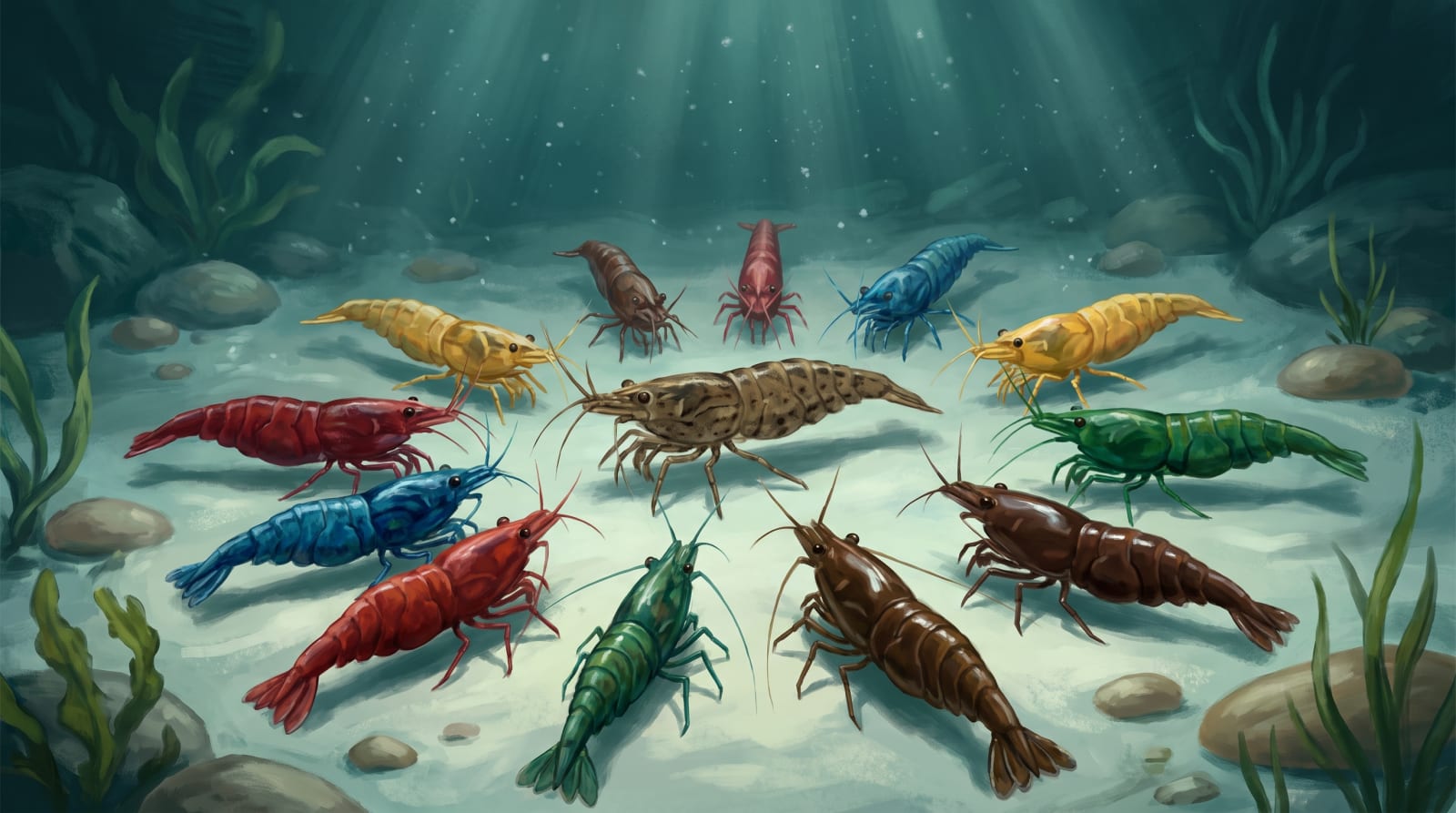
Here is the fact that makes sense of every cherry shrimp you'll ever buy: they are all one species. Red cherries, blue dreams, bloody marys, yellows, greens, the lot — every one is Neocaridina davidi, the same animal wearing a different coat. The colours aren't separate species or hybrids; they're selectively bred lines, each one teased out of the same drab wild ancestor over many shrimp generations. Understand that and the whole hobby's dizzying spread of names falls into a single, simple family tree.
One species, many colours
Wild Neocaridina davidi is not colourful. In the streams of Taiwan and eastern China where it comes from, it's a mottled, translucent brown-green — camouflage, basically, the colour of gravel and leaf litter. A predator glancing into the water shouldn't be able to pick one out, and it can't. That drab, variable brown is what breeders call wild-type, and it's the root of the entire tree.
Every hobby colour is a selected exaggeration of variation that already flickers through wild populations. Now and then a wild brood throws a shrimp with a touch more red, or a bluish cast, or a patch of yellow. In the wild those stand out and get eaten; in a tank, a breeder nets them out and pairs them up. Do that for enough generations, concentrating the trait each time, and drab brown becomes solid red. The colour was never added — it was found, isolated and amplified.
That's the first thing to hold onto about cherry shrimp colour genetics: nothing here is engineered. There's no gene-splicing, no dye, no trick. Every morph on the market is ordinary selective breeding pointed at a naturally occurring variation, which is exactly why anyone with a tank and patience can improve a line at home.
Where the colours came from
The pet trade's colour explosion is recent and traceable. Red came first — the red cherry that gave the hobby its name was fixed from wild-type decades ago, and once keepers proved the wild variation could be locked in, the same method got pointed at every other tint that turned up. Yellow, then a chocolate-brown line, then blues, greens and oranges followed, each one a breeder somewhere spotting an oddity and refusing to let it breed back into the crowd.
Because it's all selection rather than science, the lineages are a bit tangled and not everything is documented. Breeders keep their own records, memories differ, and the same colour has sometimes been reached by more than one route. So the family tree below is the hobby's best working picture, not a lab pedigree — honest about where lines genuinely connect and where the ancestry is educated guesswork. What isn't in doubt is the shape of it: one wild root, a handful of main branches, and named lines hanging off each.
The colour family tree

Read the tree from the wild-type root outward, and the hobby's names stop being a random list.
The red branch is the oldest and best-fixed. From wild-type, breeders concentrated red pigment into the plain red cherry, then kept pushing coverage and depth to produce the graded ladder every keeper knows — Sakura, then Fire Red, then Painted Fire Red at the top. It's one continuous line of selection; the grades are stops along it, not different shrimp, which is why Neocaridina grades reads as a single ladder for red where other colours don't.
The chocolate lineage is the tree's most productive dark branch. Chocolate is a deep, glossy cocoa-brown, and it turns out to be genetically rich: several celebrated lines were bred out of chocolate stock. Bloody Mary is the famous one — a flesh-red, almost translucent-crimson shrimp that comes from the chocolate line rather than the red-cherry line, which is why its red looks and behaves differently from a Fire Red. Black Rose, the deepest black in the hobby, traces here too, and even some greens and blues are credited to chocolate ancestry. If you want to understand the dark end of the family, chocolate is the trunk it grows from.
The blue branch carries the colours that behave least like the reds. Blue Velvet is the lightest, a glassy powder-blue traced back to blue rili breeding; Blue Dream is the deep, opaque navy most shops mean by "blue cherry shrimp"; and Blue Diamond is darker still, a near-black sapphire usually credited to the chocolate and black lines. The blues are understood to arise through a different pigment route from the reds, which is part of why they were harder to fix and why they can be less predictable in a breeding project.
The warm branches — yellow and orange — sit near each other. Yellow was one of the earliest morphs after red, running from a soft lemon up to a solid "Yellow Fire" with a neon back-stripe at the top grade. Orange, sold as Orange Sakura, is a separate line reaching a deep pumpkin at its best.
The green branch is younger and more variable, its two lines — Emerald Green and the darker Green Jade — never fully fixed, which is why green broods still throw brownish and olive shrimplets more freely than a long-settled red.
The rili "branch" is really a pattern, not a colour. Rili shrimp — Red Rili, Carbon Rili and others — show solid pigment at the head and tail with a clear, unpigmented band across the middle. That broken pattern can be laid over more than one colour line, which is why rili sits across the tree rather than at the end of one branch, and why it never quite breeds true.
The pigments underneath
You don't need biochemistry to keep shrimp, but a little explains a lot of the family tree's quirks. Colour in these shrimp lives in chromatophores — pigment-bearing cells in and under the shell — and different colours draw on different pigment systems. The warm colours, reds and oranges and yellows, are broadly one family, tied up with carotenoid pigments the shrimp largely gets from its food, which is part of why a varied diet and dark substrate make a red look its best. The blues work differently and are less well pinned down in the hobby, which fits their reputation for being fussier to fix and quicker to fade under stress.
This is also why grade and colour aren't the same as health. Pigment sits in the shell; it says nothing about the animal underneath. A washed-out cull and a Painted Fire Red graze, moult and live exactly alike — the selective breeding that separates them changed their coats, not their constitutions. Colour is genetics plus environment: the parents set the ceiling, and food, lighting and stable water decide how much of it you actually see.
Why mixed lines fall back to brown
The most important rule in the whole family tree is what happens when branches cross. Because every colour is a selected trait sitting on that same wild-type background, and wild-type is the species' default, mixing two colour lines lets the drab brown re-emerge. Cross a red with a blue and you don't get purple — you get, within a couple of generations, a tank sliding back to muddy wild-type brown as the selected colours separate out and the ancestral camouflage reasserts itself.
Think of the colours as lids held down on a wild-type spring. Selection keeps the lid on; crossing lines lets it go. The offspring of a mixed pairing carry a jumble of colour genes with no consistent target, and each generation the wild pattern shows through more strongly until the tank is brown. This is the single genetic fact behind every warning on this site to keep one line per tank — the mechanism is spelled out in crossbreeding and wild-type reversion, and what it means for a shared tank in mixing Neocaridina colours.
It also explains why high grade is worth guarding. A deep, even line represents years of holding that lid down; one unnoticed cross-colour shrimp starts letting the spring back up. Reversion is patient and it always wins if you stop selecting.
The Snowball exception
One popular "Neocaridina" doesn't sit cleanly on this tree at all, and it's worth knowing. Snowball shrimp — the milky-white line whose eggs look like tiny snowballs — is often not Neocaridina davidi but a close relative, Neocaridina cf. zhangjiajiensis. In the tank it's a distinction without a difference: care, water and temperature are identical to any cherry, so keep it exactly the same way.
Where it matters is breeding. Because Snowball frequently traces to a different species, pairing it with your davidi colour lines muddies the genetics on top of the usual reversion problem, so keep it separate if you want predictable offspring. It's a good reminder that the hobby's tidy labels hide some real biological wrinkles — "white Neocaridina" and "cherry shrimp" may not be quite the same animal under the shell.
What the tree means for keeping shrimp
For most keepers the family tree boils down to two practical truths. First, care never changes across the whole thing: one species means one set of needs, so a chart that works for red cherries works identically for blue diamonds, greens, chocolates and the rest. You can pick a colour purely on looks and budget. Second, colour only holds if the tree's branches stay apart — one line per tank keeps a colour true, and any mixing invites the wild-type root back up through it.
That's the quiet elegance of the thing. A single unremarkable brown shrimp from a Taiwanese stream is the ancestor of every jewel-bright colony in the hobby, and it's still in there, waiting under every line, ready to come back the moment selection stops. Understanding that root is what turns a wall of confusing shrimp names into one readable family.
FAQ
Are all Neocaridina shrimp the same species?
Nearly all of them, yes. Red cherries, blue dreams, bloody marys, yellows, greens and the rest are all Neocaridina davidi — one species in different selectively bred colours, so their care is identical. The main exception is the Snowball line, which often traces to a close relative, Neocaridina cf. zhangjiajiensis. It's kept exactly the same way, but it's technically a different species under the shell.
What is wild-type Neocaridina?
Wild-type is the natural, un-selected form of the species: a mottled, translucent brown-green shrimp built for camouflage in the streams of Taiwan and eastern China. Every hobby colour was bred out of it by concentrating small natural variations. It matters because wild-type is the genetic default — mix two colour lines and their offspring drift back towards this drab brown within a couple of generations.
Why do my cherry shrimp babies keep turning brown?
Almost always because colour lines have been mixed somewhere in the tank's history. Because every colour is a selected trait on a wild-type background, crossing two lines — red with blue, say — lets the ancestral brown re-emerge, and each generation looks muddier than the last. The fix is to keep a single colour line per tank; a browning colony can't be selected back to bright without starting from clean, single-line stock.
Are cherry shrimp colours genetic or from their food?
Mostly genetic. The colour a shrimp can be is set by its parents' genes, fixed over generations of selective breeding — food can't add a colour the shrimp doesn't carry. Diet and environment decide only how well that genetic colour shows: a varied, carotenoid-rich diet, dark substrate and stable water bring reds and oranges to their deepest, while stress and pale surroundings wash them out.
Can you create a new cherry shrimp colour?
Not from nothing — you can only concentrate variation that's already in the population. New hobby lines appear when a breeder spots an unusual shrimp in a brood, isolates it and selectively breeds the trait until it holds true. That's how every existing colour was made. Deliberately crossing established lines, by contrast, tends to produce wild-type brown rather than a bright new colour, because the selected traits separate out.