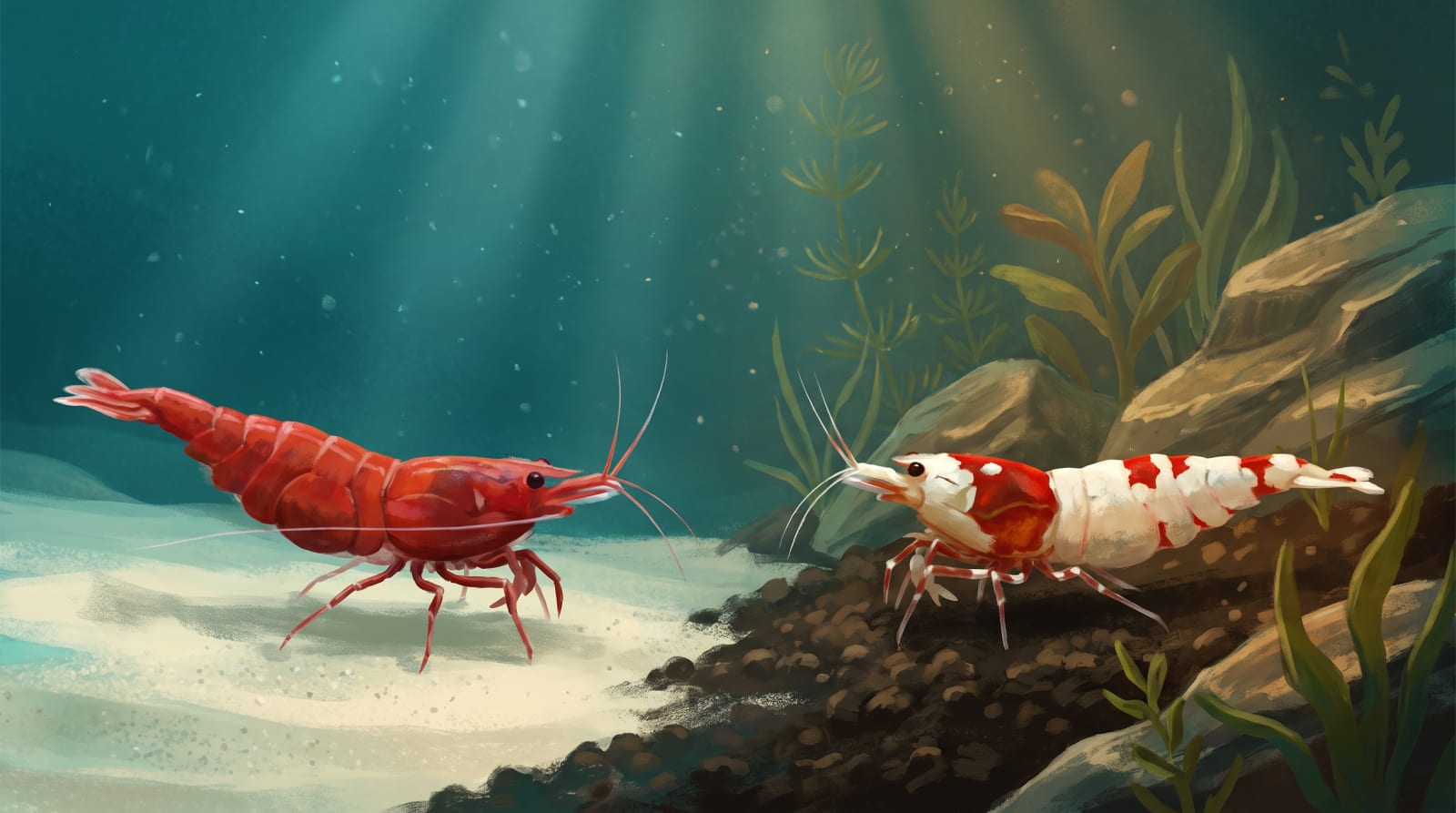
Neocaridina and Caridina are the two great families of dwarf shrimp in the hobby, and nearly every shrimp you'll see for sale belongs to one or the other. Cherry shrimp are Neocaridina; crystal reds and bee shrimp are Caridina. They look similar enough that beginners assume they're kept the same way — and that assumption ends more Caridina colonies than any disease. The honest short answer, for almost everyone starting out in the UK, is Neocaridina. This guide explains why, and when Caridina become the better choice.
The one difference that matters: water
Colour, price and reputation all follow from a single split: these two genera want opposite water. Neocaridina thrive in the hard, neutral-to-alkaline water that comes out of most UK taps. Caridina want soft, acidic water that almost nobody has on tap and that you have to build yourself from reverse osmosis (RO) water and a shrimp-specific mineral salt.
That's the whole story in a table.
| Neocaridina (cherry) | Caridina (crystal/bee) | |
|---|---|---|
| pH | 6.8–7.6 | 5.5–6.5 |
| GH | 6–12 | 4–6 |
| KH | 2–8 | 0–1 |
| TDS | 150–250 | 100–150 |
| Substrate | Inert sand or gravel | Active buffering soil |
| Water source | Dechlorinated tap (hard regions) | RO, remineralised |
| Difficulty | Beginner | Intermediate to advanced |
| UK price | £2–4 standard grade | Considerably higher |
Everything else about the two is broadly shared. Both reach 2.5–3cm, both live 1–2 years, both breed by direct development with no larval stage, and both graze biofilm all day and want the same steady, stable conditions. Temperature overlaps too: both are content at normal UK room temperatures, though Caridina keepers tend to run the cooler end. The parting of ways is chemistry, and it's a wide parting.
Telling them apart at a glance
Colour and pattern give you a rough first guess, though they're never the whole answer. The banded white-and-red or white-and-black "crystal" look is classically Caridina — crystal reds and blacks are the shrimp most people picture. Solid single colours in red, blue, yellow, orange or green are classically Neocaridina. That rule of thumb gets you most of the way, but there are exceptions both directions: some Caridina lines like blue bolts are near-solid, and patterned Neocaridina such as rili shrimp break up the block colour too.
So the pattern is a hint, not proof. The reliable tell is the water the shrimp are being sold in. A seller keeping shrimp over dark active soil in soft, acidic water is almost certainly selling Caridina; one running inert gravel in ordinary hard tap water is keeping Neocaridina. If you're ever unsure which you're looking at, ask the seller what water they keep them in — it tells you both what the shrimp is and what you'll need to house it.
Neocaridina: the hardy all-rounder
Neocaridina davidi is the shrimp we recommend to everyone getting started, and years of breeding them haven't changed that. They tolerate a broad band of conditions as long as those conditions hold steady, they breed with no help from you, and in hard-water parts of the UK they'll live in dechlorinated tap water with nothing added.
Their range is forgiving: pH 6.8–7.6, GH 6–12, KH 2–8, TDS 150–250, anywhere from 18–26°C. The full reasoning behind each of those lines is in our Neocaridina water parameters guide, but the headline is that these are numbers most UK tap water already sits near. If you're in London or the South East your water is hard and generally fine straight from the tap once dechlorinated; our UK tap water guide covers the soft-water regions that need a little mineral added.
They come in every colour the hobby loves — the classic red cherry, blue dreams, yellows, oranges — all the same species wearing different coats, all kept identically. And they're cheap: £2–4 each for standard grades means a starting colony of ten is a modest outlay while you learn. For the complete picture of keeping them, our cherry shrimp care guide is the cornerstone.
Caridina: the connoisseur's shrimp
Caridina are the shrimp people graduate to. Crystal red shrimp (CRS) and crystal blacks are the famous ones, with the various bee and Taiwan bee lines — pandas, king kongs — sitting at the pricey, delicate end. They are, to be blunt, some of the most beautiful freshwater invertebrates you can keep, and they ask a lot more in return.
The care difference is entirely about the water. Caridina need soft, acidic conditions — roughly pH 5.5–6.5, GH 4–6, KH 0–1, TDS 100–150 — which in practice means starting from RO water and remineralising it with a Caridina-specific GH salt, over an active buffering substrate that holds the pH down. Our guide to remineralising RO and rainwater covers the mixing side, and the inert-versus-active substrate question is where the two genera visibly diverge in kit.
In practice, that water becomes a small weekly ritual. You either buy RO from an aquatics shop by the container or run a compact RO unit at home, then remineralise each fresh batch with the GH salt to a target TDS before it ever reaches the tank. It isn't hard once it's habit, but it is a habit — there's no topping up from the tap when the level drops, the way there is on a hard-water cherry tank.
None of that is difficult once you've done it, but it's a routine, not a one-off, and there's less margin for error than Neocaridina give you. Caridina are more sensitive to swings, slower to breed, and the top lines command prices well above cherry shrimp — a real investment to lose to a wobble in your water. That's why we steer beginners to cherries first: learn to keep water stable on a shrimp that forgives mistakes, then step up.
Can you keep them together?
Two questions hide inside this one. Will they interbreed? No — Neocaridina and Caridina are separate genera and don't produce viable offspring, so there's no risk of muddying either line by housing them together. We cover the genetics in crossbreeding and wild-type reversion; the short version is that the hybrid worry people have simply doesn't apply across genera.
Should you keep them together? Almost never — and the reason is the water table above. A tank tuned for Neocaridina is too hard and alkaline for Caridina; a tank tuned for Caridina is too soft and acidic for Neocaridina. You'd have to compromise to a mediocre middle that suits neither, and shrimp punish compromise. Keep each genus in its own tank, dialled in for what it actually wants. If you only have room or budget for one tank, that decision makes itself: pick a genus and commit the tank to it.
Which should you keep?
For a first shrimp tank, keep Neocaridina. They match UK tap water, they cost little, they breed readily, and they forgive the learning curve every new keeper climbs. Start with cherries, get a colony thriving, and you'll have learned to hold water steady on a shrimp that shrugs off small mistakes — the exact skill Caridina demand. If you're planning that first build, our £60 budget shrimp tank shows how cheaply a Neocaridina setup goes together.
Move to Caridina when you genuinely want to — for the crystal patterns, the challenge, the prestige lines — and when you're set up to run RO water as a habit rather than a novelty. Plenty of keepers run both, one genus per tank. There's no rush, and no shame in staying with cherries forever; a well-kept Neocaridina colony is a lovely thing in its own right.
FAQ
What is the difference between Neocaridina and Caridina?
They're two genera of dwarf shrimp that want opposite water. Neocaridina — cherry shrimp and their colour forms — like hard, neutral-to-alkaline water (pH 6.8–7.6, GH 6–12) and live happily in most UK tap water. Caridina — crystal reds and bee shrimp — need soft, acidic water (pH 5.5–6.5, GH 4–6) built from RO. They look alike and share most care, but the chemistry is a hard divide.
Are Caridina harder to keep than Neocaridina?
Yes, mainly because of the water. Caridina need soft, acidic conditions almost nobody has on tap, so you're mixing RO water with a mineral salt and running an active substrate as a routine. They're also less forgiving of swings and slower to breed. Neocaridina, by contrast, tolerate a wide band of conditions and suit UK tap water, which is why beginners should start with them.
Can Neocaridina and Caridina live in the same tank?
They won't interbreed — they're different genera, so there's no hybrid risk — but housing them together is still a poor idea. Each wants opposite water, and a tank set up as a compromise between hard and soft suits neither and stresses both. Keep each genus in its own tank tuned to its needs. If you have only one tank, choose one genus and commit to it.
Is a crystal red shrimp the same as a cherry shrimp?
No. A crystal red shrimp is a Caridina and a cherry shrimp is a Neocaridina — different genera with opposite water needs. Cherries want hard, neutral water and thrive in UK tap; crystal reds want soft, acidic RO water over active substrate. They're a similar size and both are dwarf shrimp, but you can't keep them the same way, and they won't crossbreed.
Which shrimp is best for beginners?
Neocaridina — cherry shrimp — without much argument. They match the hard tap water most of the UK has, cost only £2–4 each, breed on their own, and forgive the mistakes every beginner makes. Caridina are beautiful but ask for RO water, tighter stability and a bigger budget, all of which is easier once you've cut your teeth on a forgiving colony of cherries first.