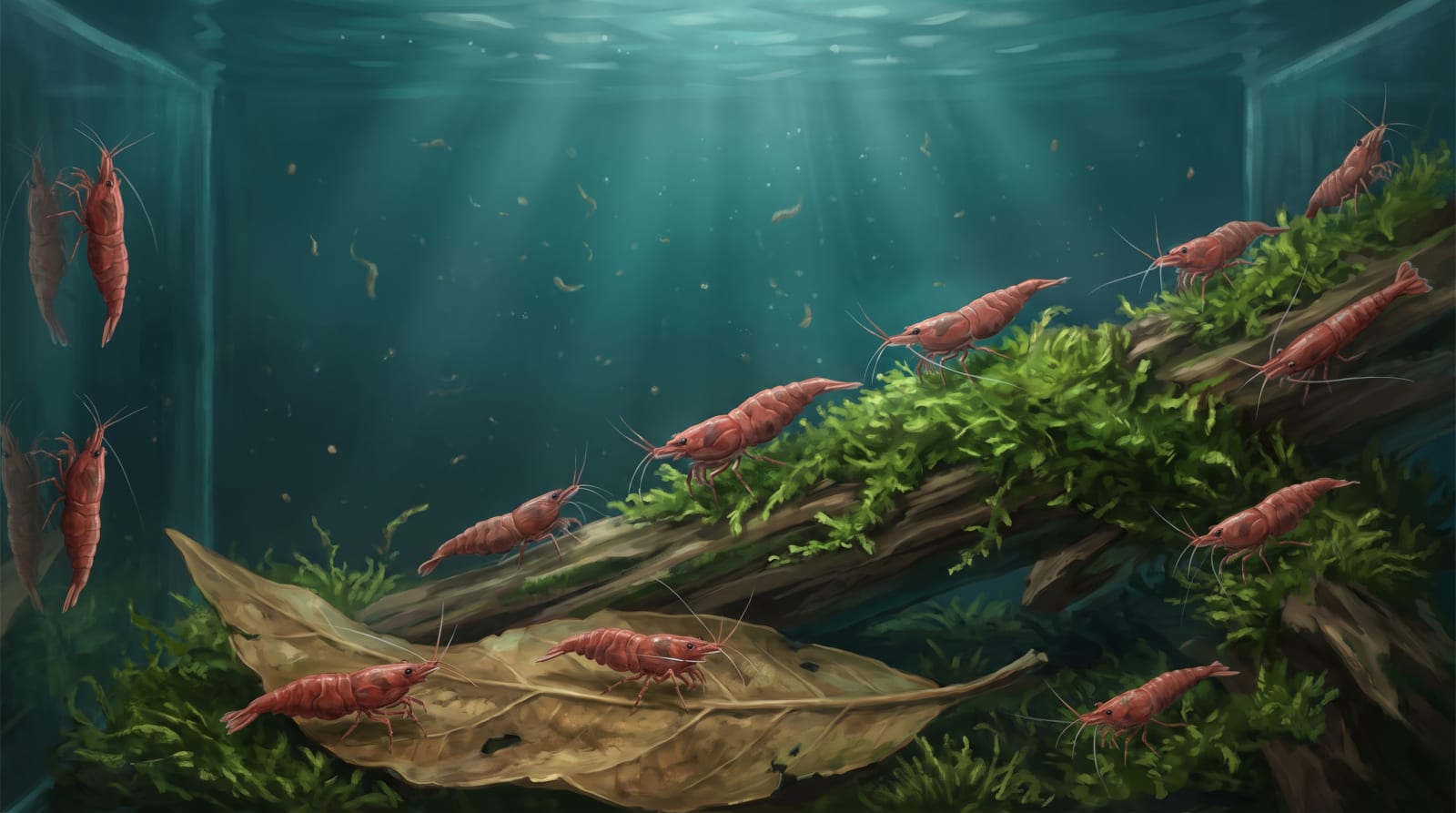
The number most people want is 2 to 5 cherry shrimp per litre for a settled colony, and that's a fair rule of thumb. But it's the answer to a slightly wrong question, because you never stock a shrimp tank to its limit on day one — you start small and let the colony find its own number. This guide gives you the honest version: the stocking band we work to, what different tank sizes actually hold, and why cherry shrimp are the rare aquarium animal you can barely overstock if you feed sensibly.
The short answer: 2 to 5 shrimp per litre
For an established cherry shrimp colony, the widely used guideline is 2–5 shrimp per litre. A 19L tank comfortably supports a colony in the dozens on that basis; a 30L can hold well over a hundred. It's a generous allowance compared with fish, because shrimp are tiny, produce very little waste, and don't need swimming room the way fish do.
Notice it's a range, not a figure. The bottom of the band is a relaxed, lightly stocked tank; the top is a busy, mature colony that's found its ceiling. Where a particular tank settles depends far more on food and stability than on the litre count, which is why we treat 2–5 per litre as a sanity check rather than a target to hit.
Start low, not at the limit
Whatever your tank's eventual capacity, you begin with ten or more shrimp — not with the tank's maximum. Ten is the number we recommend to everyone starting out: a group of ten red cherry shrimp, the classic starting line, all but guarantees both sexes and gives the colony enough genetic breadth to grow without inbreeding trouble. Two or three "to see how it goes" mostly buys you stressed shrimp and no momentum.
From that starting group the colony builds itself. Cherry shrimp breed readily — a female carries 20–30 eggs and can be berried again within days of a moult — so ten shrimp become a proper colony in months. Stocking to the theoretical maximum on day one skips the best part and stresses a young tank that hasn't grown the biofilm to feed them all yet. Let it fill gradually. If the fundamentals are still new to you, our cherry shrimp care guide is the place to begin.
What different tank sizes actually hold
Here's how the 2–5 per litre band plays out across the common UK nano sizes. "Sensible start" is the group we'd buy to begin; "settles around" is the rough colony size a healthy, well-fed tank tends to reach over time.
| Tank size | Sensible start | Settles around |
|---|---|---|
| 10L (the minimum) | 10 shrimp | 20–50 |
| 19–20L (recommended) | 10–15 shrimp | 40–100 |
| 30L | 15–20 shrimp | 60–150 |
| 45L | 20–30 shrimp | 90–225 |
Ten litres is the absolute floor we'd stock, and 19 litres or more is what we actually recommend. It isn't about swimming room — it's that a larger volume holds its temperature and chemistry steadier, and steady is what keeps shrimp alive. A lightly stocked 19L tank is more forgiving than a packed 10L one. If you're choosing a tank, our comparison of the best nano tanks for shrimp in the UK weighs up the common sizes.
Does tank shape matter for stocking?
More than the litre count alone suggests. Shrimp are grazers, not swimmers, so what they use is surface area — the floor, the glass, the plants, the filter — far more than open water. Two tanks of the same volume can hold different colonies if one is a long, low box with a big footprint and the other a tall, narrow column. Given the choice, take footprint over height every time; it gives the colony more to work over and more of the biofilm that actually feeds them.
Planting changes the sum in the same direction. A tank thick with moss and leaves has vastly more grazing surface than a bare one of identical volume, so it sustains a larger colony on the same water. When we talk about a 19L tank holding a hundred shrimp, we're picturing a mature, well-planted 19L tank — not an empty box with the same number on the label. Cover does double duty here, feeding the colony and hiding the shrimplets that keep it growing.
Why the number is softer than it looks
The reason we don't fuss over precise stocking maths is that cherry shrimp colonies self-regulate. Left alone in a stable tank, a colony grows until it reaches the food supply the tank can sustain, then levels off. They breed to the food, not to the litre count. A tank with plenty of biofilm and steady feeding will hold a bigger colony than a sparse one of the same size, and it does so without you managing a single number.
That self-correction is gentle, not dramatic. As a colony gets denser, competition for grazing quietly slows breeding, and the population plateaus rather than crashing. It's one of the things that makes shrimp such forgiving stock — the biology does the stocking management for you. We work through the growth curve properly in how fast do cherry shrimp breed, and the food side of the equation is covered in how often and how much to feed shrimp.
What actually limits stocking
If it isn't swimming space, what does put a ceiling on shrimp numbers? Two things, really.
The first is bioload — the waste the colony produces and the tank has to process. Shrimp are light on this front, but a big colony still adds up, and it's managed the ordinary way: a cycled tank, a sponge filter with plenty of biological surface, and small regular water changes to keep nitrate low. Ammonia and nitrite must read zero and nitrate stay under 20ppm whatever your stocking; our guide to safe ammonia, nitrite and nitrate levels sets out the targets. If those numbers hold, the colony has headroom.
The second is food, which is really the same limit seen from the other side. A dense colony needs more grazing surface and slightly more supplementary feeding than a sparse one. The trap is trying to force a bigger population by feeding heavily — which brings us to the one way you genuinely can get stocking wrong.
Tankmates change the maths
The stocking numbers above assume a species-only tank — just shrimp, and perhaps a few snails. Add fish and the sum changes, because most fish eat baby shrimp. A colony sharing its tank with even peaceful nano fish rarely reaches the densities a shrimp-only tank does, since the shrimplets that would have grown the population get picked off before they mature. The adults may be perfectly safe while the colony quietly fails to grow.
That isn't a reason to avoid a community tank, only to set expectations. If you want the big colonies in the table, keep shrimp on their own with plenty of moss for cover. If you'd rather a mixed display, choose genuinely shrimp-safe companions, accept a smaller and slower colony, and plant heavily so some shrimplets slip through. Our cherry shrimp tank mates guide grades the usual candidates honestly.
Can you overstock a shrimp tank?
Not easily by shrimp numbers alone — but yes, indirectly, through the feeding it tempts you into. Overfeeding is the single biggest killer of shrimp tanks, and it usually starts with a keeper trying to sustain more shrimp than the tank naturally would. Uneaten food fouls the water, spikes nitrate, and triggers planaria and snail blooms; the colony you were trying to grow ends up worse off.
The fix is to trust the self-regulation. Feed for the colony you have, not the one you're hoping for, and let the tank set its own ceiling. If a colony genuinely outgrows its space you'll see it — shrimp everywhere, breeding slowing — and the answer then is to move some on to a second tank or a fellow keeper, not to pile in more food. A tank that's found its natural number is a stable, low-effort tank, which is exactly what you want. If you're planning your first setup around a starting group, our £60 budget shrimp tank build shows how it goes together.
FAQ
How many cherry shrimp can I keep per litre?
For a settled colony, 2–5 shrimp per litre is the standard guideline — so a 19L tank might hold anywhere from around 40 to 100 shrimp once mature. It's a generous allowance because shrimp are tiny and produce little waste. You don't stock to that number on day one, though; you start with ten or more and let the colony breed up to whatever your tank's food supply sustains.
How many shrimp can I put in a 20 litre tank?
Start with ten to fifteen shrimp in a 20L tank and let the colony grow. At the usual 2–5 per litre for a mature colony, a 20L can comfortably settle anywhere from roughly 40 to 100 shrimp over time. You won't need to add more after the initial group — cherry shrimp breed readily, so the colony fills the space itself. A 19–20L tank is our recommended size for a first colony.
How many cherry shrimp should I start with?
Ten or more. A group of ten all but guarantees you have both sexes and gives the colony enough genetic breadth to grow healthily. Starting with two or three saves a few pounds and usually costs you the colony, because you may end up with all one sex or too few to establish momentum. Ten standard cherries is a small outlay for a self-sustaining colony.
Can you have too many shrimp in a tank?
It's hard to overstock a shrimp tank by numbers alone — colonies self-regulate, breeding to the food available and levelling off rather than crashing. The real danger is overfeeding to push the population higher than the tank naturally supports, which fouls the water and does more harm than the shrimp count ever would. Feed for the colony you have and let it find its own ceiling.
Do cherry shrimp overpopulate?
They breed prolifically, but "overpopulate" overstates it. In a stable tank a colony grows until it meets the available food, then plateaus as competition for grazing gently slows breeding — it self-limits rather than exploding indefinitely. If a colony does outgrow its tank, you'll see it and can move some shrimp on. What you shouldn't do is feed harder to sustain an unnaturally dense population.