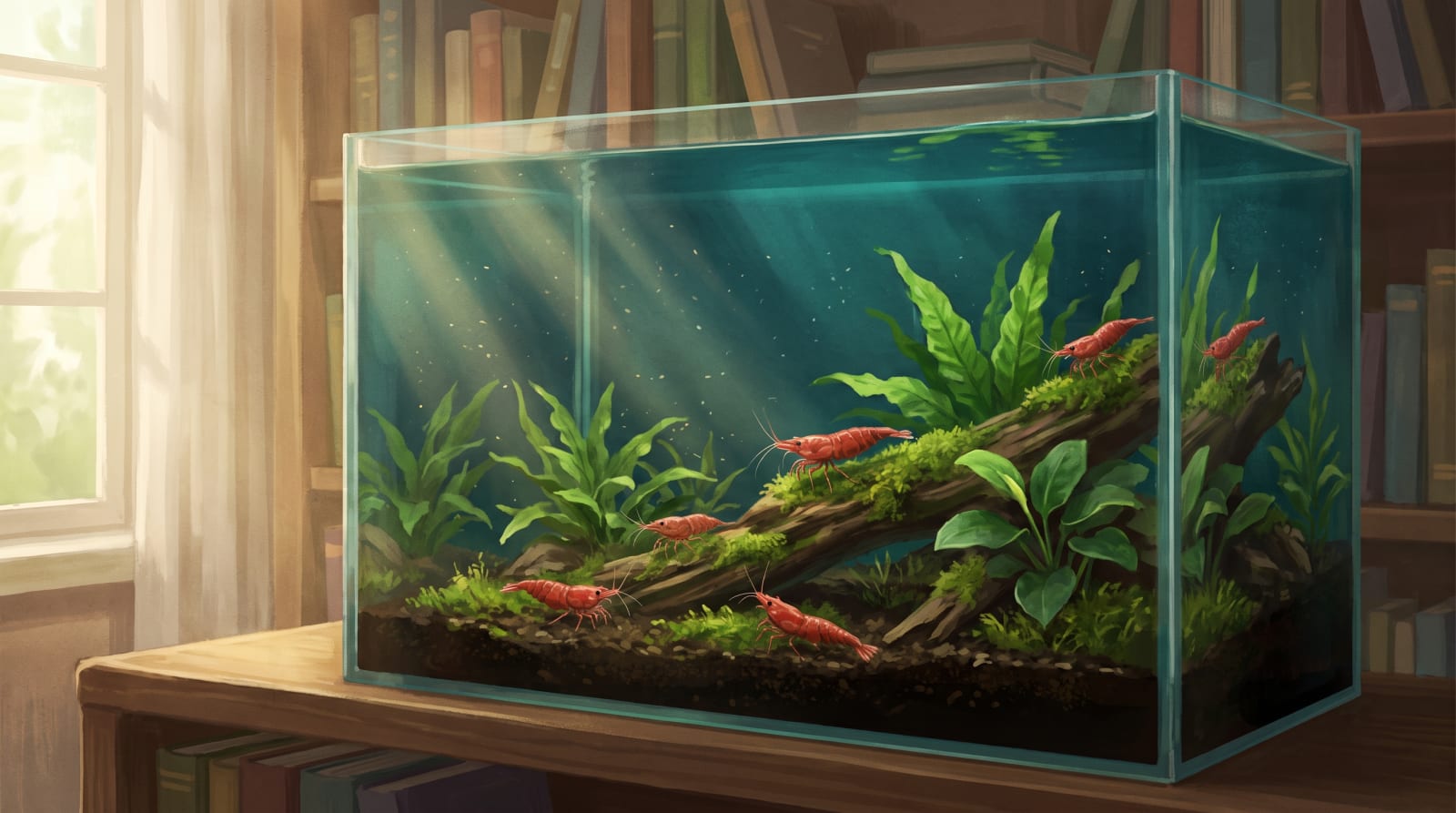
The best nano tank for shrimp isn't a brand — it's a volume and a shape. Ask which specific tank to buy and you'll get ten different answers, all of them fine, because a shrimp doesn't care whose name is etched on the glass. What it cares about is how much water surrounds it and how steadily that water behaves, and both of those come down to size. So this is a comparison of size classes from 5 to 30 litres rather than a badge roundup, ending with the volume most people should actually buy.
Why we compare by size, not brand
Any well-made glass box of the right size will keep shrimp. The differences between the various tanks marketed at nano keepers — the trim, the branding, the shape of the lid — are small next to the difference between a 10L tank and a 25L one. Size is the decision that matters; everything else is trim.
Three things actually count, and none is brand-specific. Total volume sets how fast the water swings. Footprint sets how much floor there is to graze. And whether the tank takes a lid decides a couple of quieter problems we'll get to. That's why we won't hand you a list of models to buy — you don't need one. Spend the effort you'd have spent comparing badges on choosing the right size and a decent lid instead.
The three size classes
The single most useful fact in shrimp keeping is that bigger water is steadier water. A small volume heats up, cools down and shifts chemistry quickly, and shrimp dislike quick. The floor is 10L; below it, stability gets genuinely hard to hold. Above roughly 20L a colony becomes close to self-managing. Here's how the bands compare.
| Size class | How it behaves | Best for |
|---|---|---|
| 5–10L | Swings fastest; least margin for error | Experienced keepers, tight spaces; 10L is the floor |
| 15–20L | The sweet spot — steady yet still compact | First colonies, and most keepers |
| 25–30L | Most forgiving; nearly runs itself | Anyone with the space; growing a big colony |
5–10L: doable, least forgiving
This is where most nano keepers start, and where most avoidable losses happen. In a 5–10L tank the water can shift temperature between morning and evening, a skipped top-up concentrates minerals noticeably, and a single overfeed fouls the lot in a hurry. Ten litres is the absolute minimum we'd set — enough water for a small, stable colony if you stay attentive — and we'd nudge a first-timer above it wherever the space and budget allow. Anything under 10L, the little 5L cubes on the shelf included, can be done, but really only by keepers who already understand what they're managing. It's not a sensible first colony.
15–20L: the sweet spot
If we could put one number on a beginner's shopping list, it would sit here. Our standing recommendation for cherries is 19L or more, and that lands squarely in this band: enough water to ride out the odd mistake, small enough to sit on a desk or sideboard, and cheap to plant and light. A 15–20L tank forgives a late water change, holds its temperature steady through a normal day, and gives a starter group of ten the room to become a proper colony. For most people reading this, this is the answer.
25–30L: most forgiving
More water is more buffer, and a 25–30L tank is about as steady as a shrimp tank gets while still counting as a nano. Parameters barely move day to day, a larger colony has room to spread, and there's slack for a few tankmates or heavier planting if you want them. The only real costs are the footprint on your shelf and a little more water to condition and light. If you've got the space, you won't regret the extra litres.
Footprint beats height
Given two tanks of the same volume, the wider, shallower one is the better shrimp tank nearly every time. Shrimp live on surfaces, not in open water — they graze the floor, the glass, the hardscape and the plants all day. A wide footprint gives more of every one of those: more substrate to work, more room to spread out, less squabbling over the good spots.
A tall, narrow "column" tank of the same litres gives you the opposite — less floor, and a deep body of water that's harder to light down to the bottom and slower to exchange gas at the surface. Wide and low also makes maintenance and viewing easier. So when you're comparing two tanks, read the base dimensions before you look at the height. A long, low footprint is worth more to a shrimp than the same volume stacked upwards.
The details that matter more than the badge
Get a lid. Shrimp aren't the jumpers some fish are, but they climb — up the glass, up airline, up cables — and the odd one will find the carpet if the top is open. More usefully, a lid slows evaporation, and evaporation is what drives TDS creep: as water leaves, the minerals stay behind and the concentration climbs, one of the slow swings you're trying to avoid. A cover glass or fitted lid handles both problems at once.
Open top versus lid, for light and plants. If you run a bright light for a demanding carpet you might want a more open top, managing the evaporation another way. For the low-tech planting most shrimp tanks use, a simple lid is the right call — less top-up, fewer escapees, steadier water.
Glass over acrylic. Glass doesn't scratch the way acrylic does, and it keeps its clarity for years. On a small tank the weight saving of acrylic isn't worth the scuffs.
Rimless or braced is mostly cosmetic — a braced tank is a touch more robust, a rimless one looks cleaner. Neither changes a thing for the shrimp.
What a nano shrimp tank costs
We've kept price out of the size question on purpose, because it isn't really the point — the gap in running cost between a 10L and a 25L is small. A complete first setup, tank and sponge filter and substrate and plants and dechlorinator together, comes in at around £60 done sensibly, and we've costed the whole thing in our £60 UK budget build. The tank itself is only a slice of that total. A larger nano costs a little more to fill and light, but not nearly enough to change the decision — so buy the size you'll still be happy with in a year, not the smallest one that fits the shelf today.
Matching the tank to your plan
How many shrimp a given tank holds is its own question — colonies self-regulate around food and space rather than filling to a fixed number — and the maths is set out in how many shrimp per litre. For getting started, the rule from the cherry shrimp care guide holds: begin with at least ten shrimp, in 10L at the very least and 19L or more ideally.
The rest follows from what you want the tank to be. For a growing colony, size up — the extra water is stability and the extra floor is grazing. For a display with a few shrimp living among plants and other stock, you've more freedom on shape. Either way, the tank is only the shell. The step-by-step setup, the sponge filter inside it, and even whether the room stays warm enough to skip a heater all matter more to your shrimp than which nano you picked. So does the substrate that goes in the bottom — but get the volume right first, and the rest has room to work.
FAQ
What size tank do I need for cherry shrimp?
Ten litres is the practical minimum, and around nineteen litres or more is what we'd recommend. Below 10L the water swings temperature and chemistry too quickly for comfort, especially while you're still learning; at 15–20L a colony becomes forgiving and easy to run. You can keep cherries in a 5L nano, but that's a job for someone who already knows the ropes rather than a sensible first tank.
Can cherry shrimp live in a 5 litre tank?
They can, but it's the hard way to start. A 5L tank holds so little water that temperature and parameters shift quickly, a single overfeed can foul it, and there's almost no margin when something goes wrong. Experienced keepers run lovely 5L tanks; beginners tend to lose colonies in them. If you possibly can, start at 10L and preferably 19L or more — the bigger water does half the work for you.
Is a 20 litre tank a good size for shrimp?
It's arguably the ideal. A 20L tank sits right in the sweet spot: enough water to hold steady through a normal day and forgive the odd late water change, yet small enough to plant, light and site with ease. A starter group of ten has plenty of room to grow into a full colony. If you're choosing one tank for a first cherry shrimp setup, something around this size is the safe, easy answer.
Does the shape of the tank matter for shrimp?
Yes — favour footprint over height. Shrimp graze surfaces rather than swim, so a wide, shallow tank gives more floor, glass and hardscape to work, and it's easier to light and keep oxygenated. A tall, narrow tank of the same volume offers less usable space and a deeper column that's harder to plant and light through. Given two tanks of equal litres, pick the one with the larger base.
Do cherry shrimp need a big tank?
No — they're nano livestock, and a small tank suits them well, provided it isn't too small. The target is stability, not size for its own sake: 10L is the floor, 19L or more is comfortable, and much beyond 30L stops being a nano without adding a great deal for the shrimp. Bigger water is steadier water, so within the nano range, lean larger rather than smaller and you'll have an easier time of it.