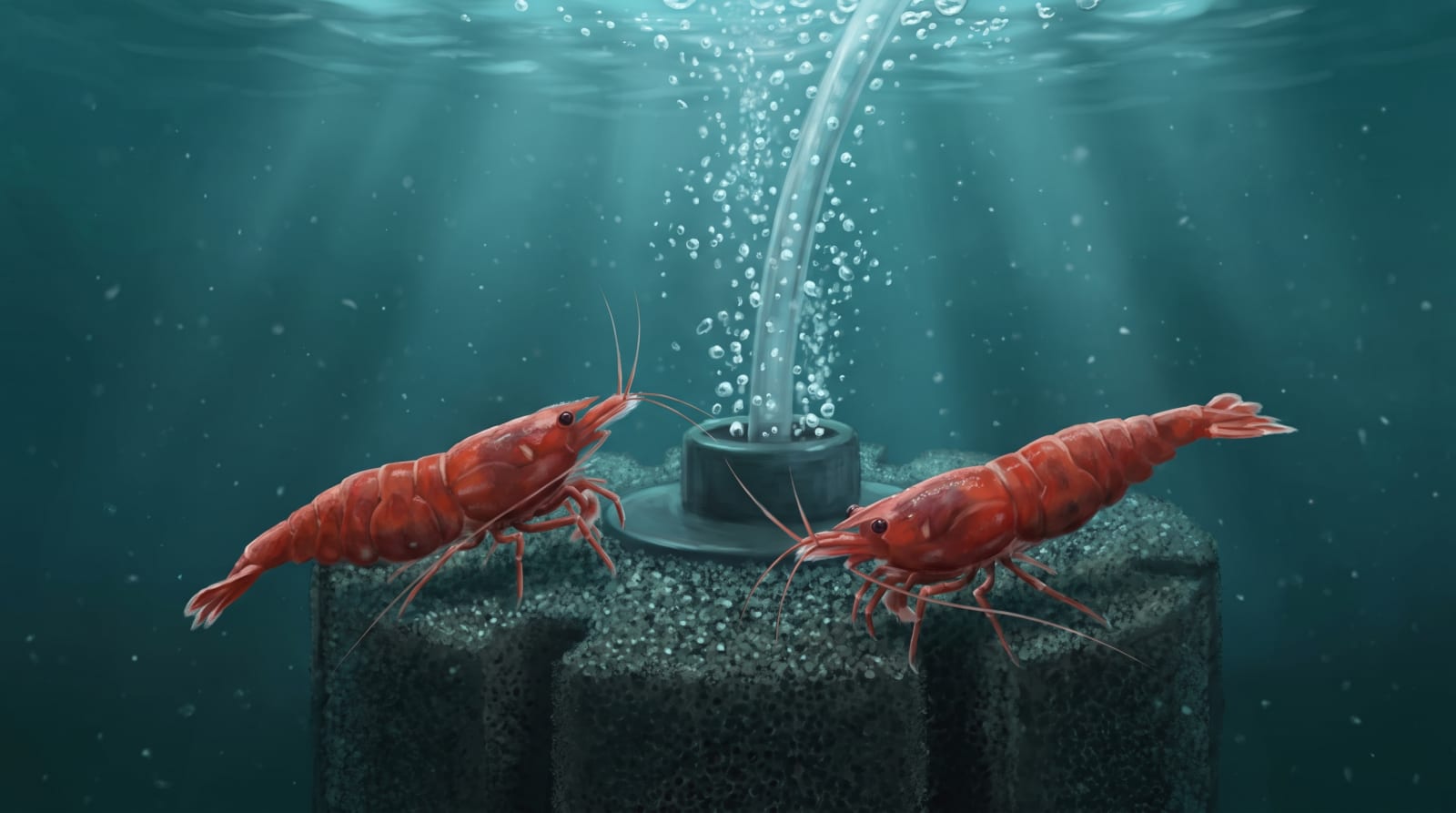
The best filter for a shrimp tank is also one of the cheapest things in the aquatics shop, which makes a pleasant change. Every tank in our breeding room runs an air-driven sponge filter, and years of keeping Neocaridina haven't given us a single reason to switch. This guide covers why sponges suit shrimp so well, how to choose and run one, and an honest look at the alternatives — including the ones that quietly eat your shrimplets.
The short answer: an air-driven sponge filter
Four things make the sponge filter the shrimp-keeping standard, and none of them is nostalgia.
It can't eat shrimplets. There's no intake, no impeller, no slots — just a block of foam that water is drawn through. A newly hatched cherry shrimp is 1–2mm long and goes wherever the current takes it; with a sponge filter, the worst that happens is it lands on the foam and starts grazing.
It feeds the colony. The sponge's surface becomes a permanent lawn of biofilm, which is the primary diet of every shrimp in the tank. Give a mature sponge a few weeks and you'll rarely see it without a shrimp or three working across it. A busy colony of red cherries will graze a sponge the way sheep work a hillside.
The flow is gentle. Shrimp are grazers, not swimmers. They want still corners, gentle turnover and surfaces to walk, and a sponge delivers exactly that — no current strong enough to pin a moulting adult or sweep shrimplets off the glass.
It's cheap and nothing breaks. No cartridges to replace, no impeller to seize, no electrics in the water. A sponge filter is a piece of foam and a tube; ours run for years and the only maintenance is a squeeze in old tank water.
Why shrimp tanks break the usual filter rules
Filter marketing assumes fish: a serious bioload, big appetites and a need for strong mechanical turnover. A shrimp colony is the opposite case. Even a thriving colony produces a fraction of the waste a small shoal of fish does, so raw filtration power is close to irrelevant.
What a shrimp tank actually needs from its filter is three things. First, safety — nothing that catches 1–2mm shrimplets, because an open intake in a breeding tank is a slow-motion cull. Second, biological surface area, since the filter is where the nitrogen cycle lives; the bacteria that keep ammonia and nitrite at zero colonise the foam during the tank's 4–6 week cycle and stay there for the tank's whole life. Third, gentle water movement to carry oxygen and keep dead spots to a minimum.
So the question isn't "which filter is most powerful?" — it's "which filter is safest and grows the most food per pound?" A sponge wins on every count, which is why the answer is so boring and so unanimous among breeders.
How a sponge filter actually works
An air pump sits outside the tank and pushes air down the airline into the base of the filter's uplift tube. The rising bubbles lift water up the tube with them, and that lost water is replaced by water drawn steadily through the sponge walls. That's the whole machine: mechanical and biological filtration in one block of foam, powered by bubbles.
The part nobody tells beginners is that the filter becomes a feature. Within a few weeks of the cycle finishing, the sponge is coated in biofilm — the invisible buffet that shrimp graze all day. For newborns it's even better: a sponge is a safe, food-covered landing pad in a world where almost everything else is a risk. It's a genuine factor in shrimplet survival rates, and one of the reasons breeding tanks and sponge filters go together everywhere you look.
Choosing one: size, foam and the air side
Size. Sponge filters are sold with rated tank volumes on the box. Pick the one that matches your tank or the size above — you can't over-filter with a sponge, and a bigger sponge just means more bacteria and more grazing surface. For the 10L–19L tanks most colonies live in, the smallest and second-smallest models in any range are plenty.
Single or dual sponge. Twin-sponge models let you clean one sponge while the other keeps its bacteria untouched, which is a nice bit of insurance. In smaller tanks a single sponge is fine — you're never cleaning it harshly enough to crash the cycle anyway if you do it right.
Foam grade. Coarse foam clogs more slowly and suits a breeding tank that gets left alone; fine foam polishes the water a little better but needs squeezing more often. Both work. We run coarse on the breeding tanks and have never wished otherwise.
Base. Weighted bases sit on the substrate and stay put. Suction-cup mounts work too, but cups harden and let go after a year or two — worth knowing before the filter floats up mid-holiday.
The air side. You'll need a small air pump, airline, and a non-return valve fitted in the line — non-negotiable, because it stops water siphoning back into the pump when the power goes off. A bleed valve lets you tune the bubble rate down, and dropping an airstone into the uplift tube makes the bubbles finer and the whole thing noticeably quieter. The pump itself is covered properly in do shrimp need an air pump? — short version: buy the quiet one, size it to the filter's rated volume.
The alternatives, honestly rated
| Filter type | Adult shrimp | Shrimplets | Our verdict |
|---|---|---|---|
| Air-driven sponge | Safe | Safe | The standard. Fit and forget |
| Air-driven corner/box | Safe | Safe | Same principle, plus a media chamber |
| Hang-on-back + prefilter sponge | Safe | Mostly safe | Workable, mind the flow |
| Internal power filter | Mostly safe | Poor | Open slots swallow shrimplets |
| Canister | Safe | Poor without a prefilter | Where shrimplets go to vanish |
Air-driven corner and box filters are the sponge's older cousin: a plastic chamber you pack with media, run from the same air pump. Everything good about a sponge applies, and the chamber takes ceramic media or peat if you ever want it. Less grazing surface on the outside, but a perfectly sound choice, especially second-hand.
Hang-on-back (HOB) filters can work on a shrimp tank with two changes. The intake must wear a tight prefilter sponge — that's the difference between a filter and a shrimplet harvester — and the flow wants turning down or baffling, because a nano tank doesn't need a waterfall. Be honest with yourself about the failure mode: prefilters get knocked loose, and the odd shrimplet still ends up living in the filter box. Fine for a display tank, not our choice for a breeding one.
Internal power filters are the ones we'd actively steer you away from. The intake slots on most models are precisely shrimplet-sized, the flow is strong for the tank sizes shrimp live in, and a prefilter sponge fixes the first problem while making the cramped footprint worse. If it's what you own, sleeve the intake and turn it right down; if you're buying new, buy a sponge instead.
Canister filters are superb at what they're for — big, heavily stocked community tanks. On a 19L shrimp tank a canister is overkill bordering on comedy, and on any tank it's the classic answer to "where did all my shrimplets go?" Open a mature canister that's been running unguarded on a shrimp tank and you'll often find a small population living in it. If shrimp share a big community tank with one, a coarse intake sponge is mandatory; the flow they produce is also more than a colony would choose.
If you already own any of these, you don't need to bin it — a prefilter sponge converts most filters into something shrimp-workable. But if you're buying for a shrimp tank from scratch, the step-by-step setup guide assumes a sponge for good reason: it's the cheapest option and the best one, which doesn't happen often.
Running and maintaining a sponge filter
New sponges just need a rinse and a squeeze in clean water to shed manufacturing dust, then they go straight in. Squeeze the sponge a few times underwater as you place it — foam holds air when dry, and an air-filled sponge will bob up and float until it's properly saturated. A back corner near the surface is the classic spot: the rising bubble column agitates the surface, which is where the tank actually exchanges oxygen.
Expect the filter to run near-silently once the bubble rate is tuned; if it rattles or hums, it's the pump or the airline touching something, not the sponge. A pump sat on a folded cloth or foam pad, with the airline routed so it touches nothing that resonates, is effectively inaudible from the sofa.
Maintenance is one job: at water-change time, roughly monthly, squeeze the sponge out in the bucket of tank water you've just removed. Never rinse a mature sponge under the tap — chlorine and chloramine kill the bacterial colony you spent six weeks growing — and never replace the sponge outright unless it's physically falling apart. If you run a twin-sponge model, clean one sponge per month and alternate. The grubby brown look is normal; a good part of that coating is exactly the biofilm your shrimp want. The wider routine lives in our 15-minute weekly maintenance guide.
One breeder's habit worth stealing: run a second small sponge filter in an established tank. It costs nothing to keep going, and it hands you a fully cycled filter on demand — for a quarantine tub, a new build, or an emergency — without a week of waiting.
Troubleshooting: the problems you'll actually meet
The bubbles are too loud. Fit an airstone inside the uplift tube for finer, quieter bubbles, and use a bleed valve to soften the flow. Most "noisy filter" complaints are really a pump vibrating against a hard surface — move it onto something soft before blaming the sponge.
The flow seems too strong for the tank. It almost certainly isn't, but shrimp do prefer calm water, and a nano tank doesn't need a jacuzzi. Bleed off excess air with a valve rather than kinking the line, which strains the pump.
The sponge keeps floating. Trapped air. Hold it underwater and squeeze until the bubbles stop; a weighted base stops the problem recurring.
Flow has visibly dropped. The sponge is clogging — usually a sign of heavy feeding as much as time passing. Squeeze it out in removed tank water and have an honest word with yourself about portion sizes.
Shrimp are sitting on the filter all day. Not a problem — the opposite. A sponge crawling with grazing shrimp is a sponge doing both of its jobs. The time to look closer is when shrimp that normally graze it suddenly won't: filters concentrate whatever is in the water, and shrimp avoiding a favourite surface is worth a water test.
Power cut. The sponge's bacteria will ride out a normal outage without drama. Your non-return valve protects the pump; when power returns, the filter picks up where it left off. After an unusually long one, squeeze the sponge out in tank water in case anything in the middle of the foam has died back.
FAQ
Do cherry shrimp need a filter?
In practice, yes. Shrimp are more sensitive to ammonia and nitrite than most fish, and the filter is where the bacteria that keep both at zero actually live. A sponge filter costs little and removes the risk entirely. Heavily planted filterless tanks can be balanced by experienced keepers, but they run with no safety margin — not something we'd recommend for a first colony.
Can shrimp get sucked into a filter?
Adults, rarely — they're strong enough to walk away from most intakes. Shrimplets, constantly: at 1–2mm they drift wherever water is drawn, so open intake slots on internal and canister filters collect them relentlessly. A tight prefilter sponge over any intake fixes most of it; sponge and air-driven box filters remove the problem altogether.
How often should you clean a sponge filter?
Squeeze it out roughly monthly, in a bucket of water removed during a water change — never under the tap, where chlorine or chloramine would kill the filter bacteria. You're loosening the worst of the gunk, not scrubbing it sterile; a slightly grubby sponge is a healthy, biofilm-coated one. Twin-sponge models let you alternate sides so the cycle is never disturbed.
Do sponge filters need an air pump?
Yes — the sponge is inert without airflow through the uplift tube. Buy a quiet pump rated for your tank size, fit a non-return valve in the airline so water can't siphon back during a power cut, and add a bleed valve if you want to soften the bubble rate. One pump with a splitter will happily run two small filters.
Are hang-on-back filters safe for shrimp?
Workable, with conditions: a tight prefilter sponge on the intake, the flow turned down or baffled, and acceptance that the odd shrimplet will still hitch-hike into the box. For a display tank with some shrimp in it, that's a fair trade. For a breeding colony where every shrimplet counts, we'd still run a sponge.