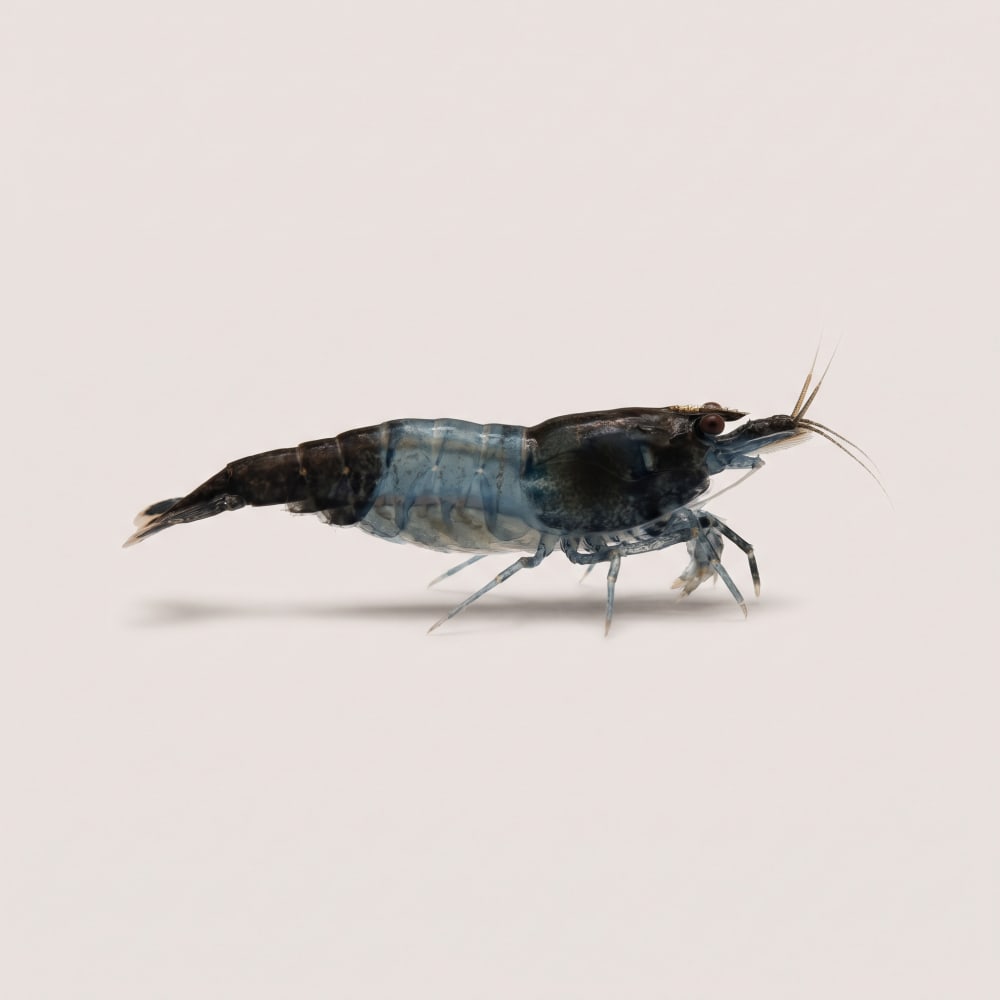
Most Neocaridina lines chase one colour done as completely as possible. The Carbon Rili goes the other way: dense, smoky black over the head and tail, and a midsection of almost nothing — a translucent blue-grey window with the shrimp's workings faintly visible inside. Smoke and glass. On a dark floor the clear middle all but disappears, so the black head and tail seem to float slightly apart as the shrimp walks: the most graphic pattern in the genus, in the least expected palette.
Carbon Rili shrimp at a glance
| Difficulty | Easy |
| Adult size | 2.5–3cm |
| Lifespan | 1–2 years |
| Temperature | 18–26°C |
| pH | 6.8–7.6 |
| GH | 6–12 |
| TDS | 150–250 |
| Breeding | Prolific |
What is a Carbon Rili shrimp?
"Rili" names a pattern, not a colour: solid pigment at the head and tail with a clear, unpigmented midsection. The pattern turned up first in the red lines — the red rili is the original — and the Carbon Rili is its monochrome descendant, wearing black where the red rili wears red. You'll also see it listed as "black rili shrimp"; same animal. Underneath the pattern it's ordinary Neocaridina davidi, with the same easy care as every cherry shrimp.
Where it came from gets told a few different ways. Most accounts have carbons developed out of black and chocolate rili projects, but breeders disagree on the exact route and, as usual with Neocaridina lines, there's no paperwork to settle it. What's not in doubt is the family resemblance: the clear midsection usually isn't colourless but carries a cool blue-grey cast, and breeders often say the hobby's blue lines were originally pulled from the clear middles of rili broods. True or not, put a carbon next to a blue velvet and you can see why the story persists.
Pattern and grading
Solid lines are graded on coverage; rilis are graded on contrast and edges. A top carbon shows three things: black sections that are dense and properly opaque, not smoky grey; a midsection window that's clean and bright, not fogged with stray pigment; and sharp borders between the two — cut lines, not gradients. Balance matters too: roughly matched black at head and tail reads far better than a heavy hood over a bare tail. Lower grades smudge, with grey blacks, murky windows and pigment freckling into the clear zone.
Females carry more pigment and show the pattern at its boldest, males run lighter throughout, and juveniles firm up as they mature, so grade patiently. The general logic is in the Neocaridina grades guide; rilis simply swap coverage for contrast.
Care
A carbon rili is a cherry shrimp in a striking jacket, and the whole cherry shrimp care guide applies as written: a cycled tank from 19L, a sponge filter, stable water inside the ranges in the table above, a varied diet, dechlorinated changes and absolutely no copper. Stability beats perfection on every parameter, and an unheated UK room at 18–21°C is workable — breeding just runs quicker in the low twenties.
UK hard-water areas can run carbons from the dechlorinated tap; soft-water areas should remineralise to GH 6–12, and the UK tap water guide maps where you stand. Dark substrate earns its keep here more than anywhere: it deepens the black and makes the glassy midsection look cut out of the shrimp.
Do Carbon Rili shrimp breed true?
Truer than people expect on colour, looser than people hope on pattern. An unmixed carbon line keeps producing black-pigmented shrimp, but the rili pattern itself varies in every brood: some shrimplets come through near-solid black, some heavily marked, some balanced and crisp, and some almost entirely clear blue-grey. That spread is normal rili genetics, not a fault — and it's also the fun of the line, because grading your own broods actually means something. Keep the balanced, high-contrast shrimp breeding and rehome the rest, and the pattern steadies over generations without ever becoming a certainty. The cycle itself is standard cherry breeding, covered in how to breed cherry shrimp.
The near-solid blacks a carbon line throws will remind you of black rose shrimp, and the two likely share background, but a solid throwback from a rili line isn't graded black rose stock — treat it as a handsome cull. And the standing rule holds: one colour line per tank, because mixing Neocaridina lines drags the offspring back to brownish wild-type within a couple of generations. Mixing Neocaridina colours has the detail.
Buying Carbon Rili shrimp in the UK
Carbons are an uncommon sight in UK shops. The rili lines in general travel breeder-to-keeper, and the monochrome version is the scarcest of them. Loosely patterned carbons run the usual £2–4 per shrimp; well-graded, high-contrast groups run £30–50 per 10, towards the top of that range when the pattern is genuinely crisp across the whole group.
Buying a patterned line, insist on photos showing several animals clearly. One crisp female proves nothing about a colony — you're paying for consistency of contrast and clean edges across the group. Ask the breeder what proportion of their broods make the grade; with rilis it's never all of them, and an honest seller will say so.
Our own carbon line is restocking after the last batch sold through, so join the waitlist on this page and you'll hear first when the next graded groups are ready.
FAQ
What is a carbon rili shrimp?
A Neocaridina davidi colour line wearing the rili pattern in monochrome: smoky black head and tail with a translucent blue-grey midsection. It's the same species as every cherry shrimp — identical care, size and breeding — and it's also sold as "black rili shrimp".
Do carbon rili shrimp breed true?
The black pigment breeds true in an unmixed line; the pattern doesn't fully. Every brood throws a spread from near-solid black through crisp rilis to almost-clear shrimp, and you steer the line by breeding from your balanced, high-contrast animals. Expect to keep selecting for as long as you keep the line.
What is the difference between carbon rili and black rose shrimp?
Black rose is a solid line, graded on complete, even black coverage; carbon rili is a patterned line, graded on the contrast between its black sections and its clear midsection. They likely share ancestry, and carbon broods do throw solid black shrimplets, but a solid throwback from a rili line isn't the same as selected black rose stock.
How much do carbon rili shrimp cost UK?
Loosely patterned carbons run the standard £2–4 per shrimp. Well-graded, high-contrast groups sell at £30–50 per 10, sitting towards the top of that range because so few UK breeders work the line. Judge listings on group photos — you're buying the consistency, not one photogenic female.