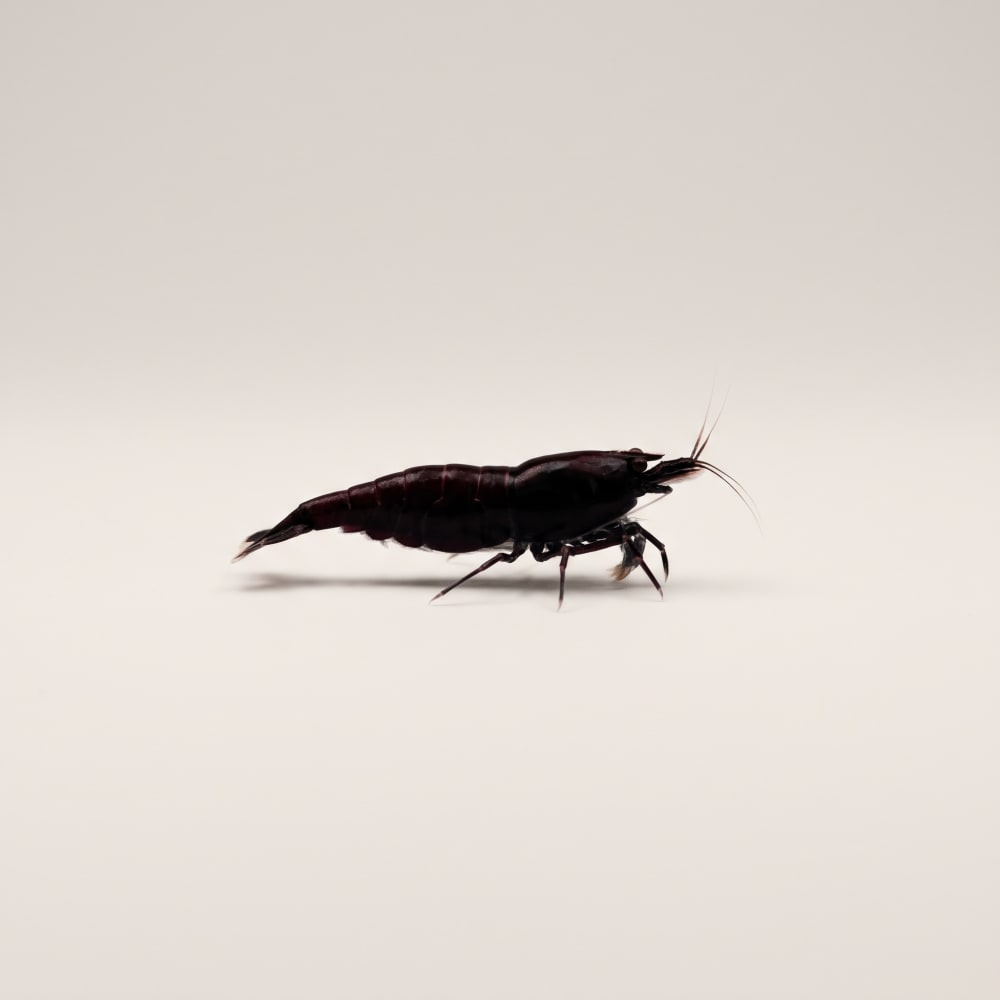
A good Black Rose in a viewing tank looks like a shrimp cut from jet. Put strong light on it and the black gives up a deep maroon undertone, like the last colour in a glass of red wine — and that's the tell of the line, not a flaw in it. Black is the hardest shrimp colour to photograph and the easiest to fall for in person.
Black Rose at a glance
| Difficulty | Easy |
| Adult size | 2.5–3cm |
| Lifespan | 1–2 years |
| Temperature | 18–26°C |
| pH | 6.8–7.6 |
| GH | 6–12 |
| TDS | 150–250 |
| Breeding | Prolific |
What is a black rose shrimp?
Black Rose is the black colour line of Neocaridina davidi — the same easy, prolific species as every cherry shrimp, taken about as far from cherry red as selective breeding can go. Most lines trace back to chocolate and black breeding programmes, brown deepened generation by generation until it reads as true black, though breeders disagree about exactly where chocolate ends and Black Rose begins, and more than one programme claims the founding credit. The maroon undertone in strong light is that heritage showing through, and we treat it as a feature: it's how you know you're looking at deep pigment in the flesh rather than a thin grey coating.
Don't confuse the line with carbon rili, which is black patches over clear panels by design, or blue diamond, which reads near-black across the room but resolves navy under light. A Black Rose should resolve black — or that deep maroon-black — everywhere.
Colour and grading
Grading is depth and coverage. Standard grade shows solid dark colour with thinner, browner patches, usually at the joints and underside. High grade is even, opaque black from nose to tail, with the maroon only appearing when you deliberately light it hard. Females carry the denser colour and males run smaller, slimmer and thinner-shelled, so any honest colony shows a spread — judge a line by its females, not its best male. Our Neocaridina grades guide covers how grading works across every line.
The substrate rule, reversed
Here's the tip we give every Black Rose buyer, learned slowly in our own breeding room: dark lines show best over pale substrate. Every other Neocaridina deepens over dark substrate and washes out over sand, and black shrimp are the one line where that standard advice works against you — over black substrate they simply vanish. Over pale sand or light gravel, a Black Rose colony reads like ink drops on paper. If you're planning a tank around them, plan it pale, plant it green and light it well; it's the reverse of what we'd tell you for any other colour on this site.
Care
Underneath the colour it's a cherry shrimp, and care is standard: the table above has the canonical ranges, our cherry shrimp care guide has the routine, and stability beats perfection on every parameter. A cycled tank of 19L or more, a sponge filter, a weekly dechlorinated water change, a varied diet with a protein component, and no copper-based medications anywhere near the tank. An unheated UK room at 18–21°C is fine; breeding just runs quicker at 22–24°C. Soft-water homes should check the UK tap water guide and remineralise to GH 6–12; hard-water homes are usually fine straight from the treated tap.
Breeding — and the brown babies question
Black Rose breeds true kept as a single line, with one honest caveat: broods regularly throw a few chocolate-brown shrimplets. That's not contamination and not a collapsing line — it's the chocolate background reasserting itself, and every Black Rose breeder sees it. Pull the browns into a separate tank before they mature at 3–5 months if you're keeping the line black, or grow them on; some of ours have made handsome chocolates in their own right.
Selection otherwise runs as it does for every line — deepest, most even black into the breeding tank, the rest rehomed — and the full cycle of berried females, 20–30 eggs and a 14–21 day carry is in how to breed cherry shrimp. And the standing rule: never mix colour lines. Black Rose crossed with any other Neocaridina colour drifts back to wild-type brown within a couple of generations, which is a long way to fall from jet black. Mixing Neocaridina colours explains why.
Buying black rose shrimp in the UK
Standard-grade black Neocaridina cost £2–4 each, and high-grade Black Rose runs £30–50 per 10, with the best black lines sitting toward the top of that range because deep, even black is genuinely harder to breed than it looks. Ask for photos of the seller's actual stock under plain light — black shrimp are flattered by dim photography — and expect the maroon undertone under strong light rather than treating it as a fault. A listing full of shrimp with brown joints and thin panels is standard grade, whatever the title says. Buy ten or more so the colony has genetic room to work with.
We breed Black Rose here and the colony is restocking as we write this — join the waitlist on this page for first refusal when the next batch is graded.
FAQ
Are black rose shrimp really black?
In most light, yes — a good one reads jet black across the room. Under strong, direct light the black resolves into a deep maroon undertone, which is the line's chocolate heritage showing and the mark of real pigment depth. If a shrimp resolves navy instead, you're looking at a blue diamond, not a black rose.
Why did my black rose shrimp have brown babies?
It's normal. Black Rose descends from chocolate breeding lines, and broods routinely include a few chocolate shrimplets even in well-kept colonies. Cull them from the breeding tank if you want the line to stay black. If most of a brood is brownish and you keep other colour lines in the same tank, though, you're seeing wild-type mixing instead — a different problem with a one-tank-per-line solution.
What substrate shows black shrimp best?
Pale substrate — sand or light gravel. It's the reverse of every other Neocaridina line: dark shrimp disappear over dark substrate and stand out beautifully over pale. Add dense green planting and decent light and a Black Rose colony is one of the most striking displays in the hobby.
How much do black rose shrimp cost in the UK?
£2–4 each for standard grade and £30–50 per 10 for high grade, with strong black lines at the top of that range. Very cheap "black" shrimp are usually thin-panelled standard grade or chocolate throwbacks — ask for photos in honest light before you pay.