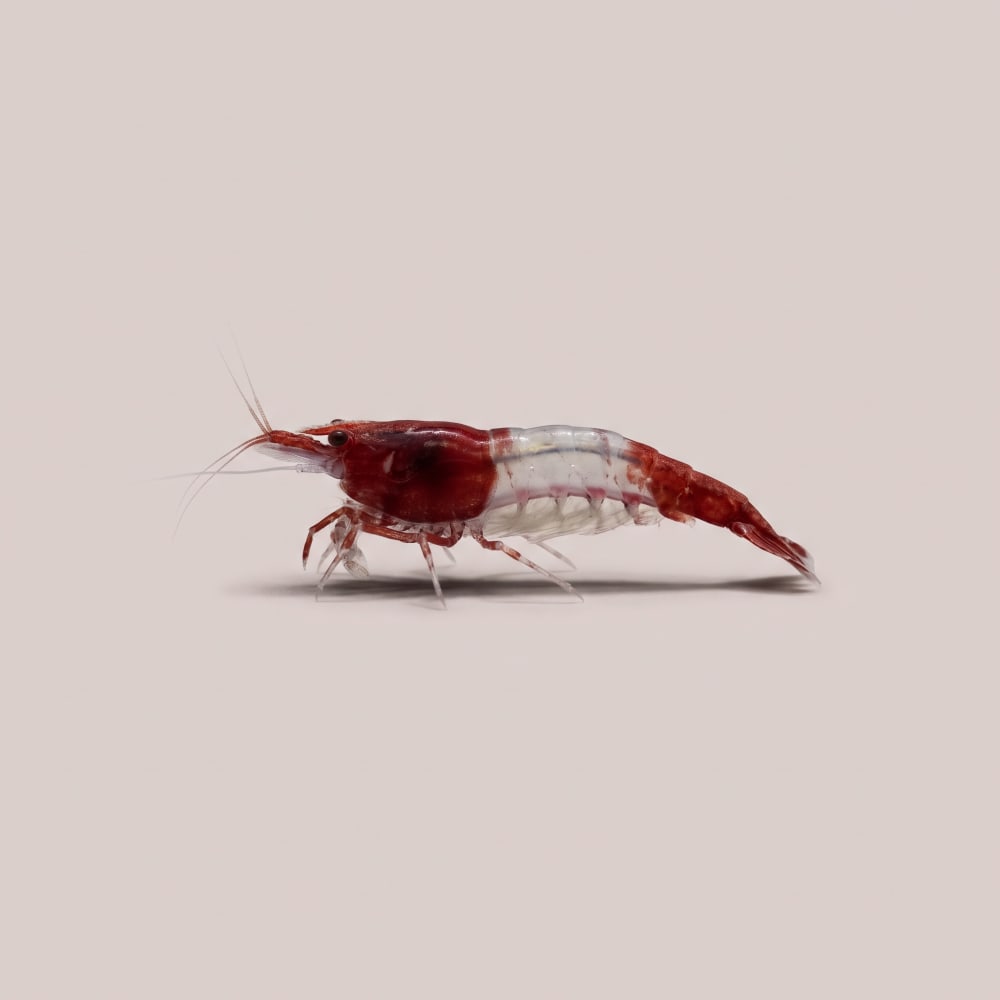
The red rili looks like someone took a red cherry and wiped the middle clean: solid red across the head and tail with a glass-clear midsection between them. It's the pattern shrimp of the Neocaridina world — every one wears the design slightly differently — and underneath it's a cherry shrimp, as easy and prolific as its solid-red ancestor.
Red rili shrimp at a glance
| Difficulty | Easy |
| Adult size | 2.5–3cm |
| Lifespan | 1–2 years |
| Temperature | 18–26°C |
| pH | 6.8–7.6 |
| GH | 6–12 |
| TDS | 150–250 |
| Breeding | Prolific |
What is a red rili shrimp?
A red rili is a colour line of Neocaridina davidi selected for a two-tone pattern: dense red over the head and shoulders, dense red on the tail, and a translucent, glassy midsection carrying almost no pigment at all. The pattern is a selected trait, not a hybrid or a separate species — most accounts credit breeders in Taiwan with pulling the first rilis out of red cherry stock around 2010, though as with most Neocaridina origin stories, the details vary with who's telling it.
The line matters historically as well as visually. Several of today's blue lines are widely said to sit downstream of rili breeding — the Blue Velvet most often — because blue rili variants, with their tinted clear sections, gave breeders the raw material to select toward full-body blue. And if your tastes ever run past red, the rili pattern comes in other colours too, the black-and-glass carbon rili being the one we'd point you at first.
Red rili vs red cherry
Same species, same care, opposite goals.
| Red rili | Red cherry | |
|---|---|---|
| The look | Two-tone: red head and tail, clear middle | Solid red, ideally nose to tail |
| Graded on | Crispness and contrast of the pattern | Completeness of red coverage |
| A top shrimp | Dense red blocks, clean glass, sharp edges | Fully opaque, even red |
| A cull | Muddy, bleeding, smeared pattern | Patchy, translucent red |
The joke in breeding circles is that the two ladders climb in opposite directions: cherry breeders spend generations chasing total coverage while rili breeders spend them protecting a clean gap. Both are just selection, and how grading works across every line is in the Neocaridina grades guide.
Pattern and grading
No two rilis wear the pattern identically — coverage varies shrimp to shrimp, which is half the charm of a colony. Grading is about crispness and contrast rather than a coverage percentage: the red should be dense and saturated where it's red, the midsection clean and glassy where it's clear, and the boundary between the two sharp rather than bleeding. Low grades look smeared; high grades look deliberate, as if the shrimp were assembled from parts.
Broods also range wider than in the solid lines: some shrimplets emerge nearly solid red, some nearly clear, and most land somewhere between. The culls from a rili line are honestly some of the loveliest culls in the hobby — asymmetric, one-off patterns you'd happily keep in a display tank. Females, as in every Neocaridina line, run larger and carry denser colour than the slimmer, paler males.
Care
Standard cherry shrimp care with no adjustments: a cycled tank of 19L or more, a sponge filter, inert substrate, and stable water at 18–26°C, pH 6.8–7.6, GH 6–12, TDS 150–250, with every drop dechlorinated and copper kept well away. An unheated UK room is fine; breeding simply runs slower below 21°C. The full routine is in the cherry shrimp care guide.
The clear midsection rewards a dark tank. Over dark substrate the glassy middle reads as a crisp, deliberate gap; over pale sand the whole shrimp washes out. Most hard-water UK areas can keep rilis straight from the dechlorinated tap, while soft-water regions should check the UK tap water guide and remineralise to GH 6–12 if needed.
Breeding true
Rilis breed true to colour but loosely to pattern. Because the patterning is a selected trait with natural spread, every brood ranges from near-solid to near-clear around a patterned majority, and holding a line's quality means constant, gentle selection: the sharpest, highest-contrast shrimp go into the breeding tank before maturity at 3–5 months, and the rest go to the display. Mechanically it's all standard Neocaridina — 20–30 eggs carried for 14–21 days, shrimplets grazing biofilm from day one — and the process is laid out in how to breed cherry shrimp.
One line per tank, as always. Rilis interbreed freely with every other Neocaridina colour, mixed lines drift back to brownish wild-type shrimp within a couple of generations, and the pattern won't save them. The genetics are in mixing Neocaridina colours.
Buying red rili shrimp in the UK
Standard-grade rilis run the usual £2–4 per shrimp in the UK, with sharply patterned high-grade lines at £30–50 per 10. Buy from photos of the seller's actual colony and judge the group, not the hero shrimp: you want dense red, clean clear sections and reasonable consistency across ten animals, while accepting that rili coverage always varies more than a solid line's. A listing of vaguely patchy red shrimp described as rili is usually low-grade cherry stock wearing a better name. Our own rili line is restocking at the moment, so join the waitlist on this page and we'll email you when the next broods are graded.
FAQ
What makes a shrimp a rili?
The two-tone pattern: solid colour at the head and tail with a clear, glassy midsection between. It's a selected Neocaridina trait rather than a separate species, and it exists in red, carbon (black), orange and blue forms. The crisper the boundary between colour and clear, the better the rili.
Do red rili shrimp breed true?
To colour, yes; to pattern, loosely. Broods contain near-solid reds and near-clear shrimp alongside the patterned majority, and keeping a line sharp means selecting the crispest shrimp forward each generation. That variation is normal — it's how the line works, not a fault in your stock.
What is the difference between red rili and red cherry shrimp?
Same species, opposite targets. A red cherry is graded on how completely red covers the body; a red rili is graded on the pattern — solid red head and tail against a clean, clear middle. Care, size, lifespan and breeding are identical, and most accounts have rilis selected out of red cherry stock in the first place.
How much do rili shrimp cost in the UK?
£2–4 each for standard grades and £30–50 per 10 for high-grade, sharply patterned lines. Judge value on the pattern itself: dense colour, clean glass and crisp edges are what you're paying for. A washed-out or muddy pattern should cost cherry money, not rili money.