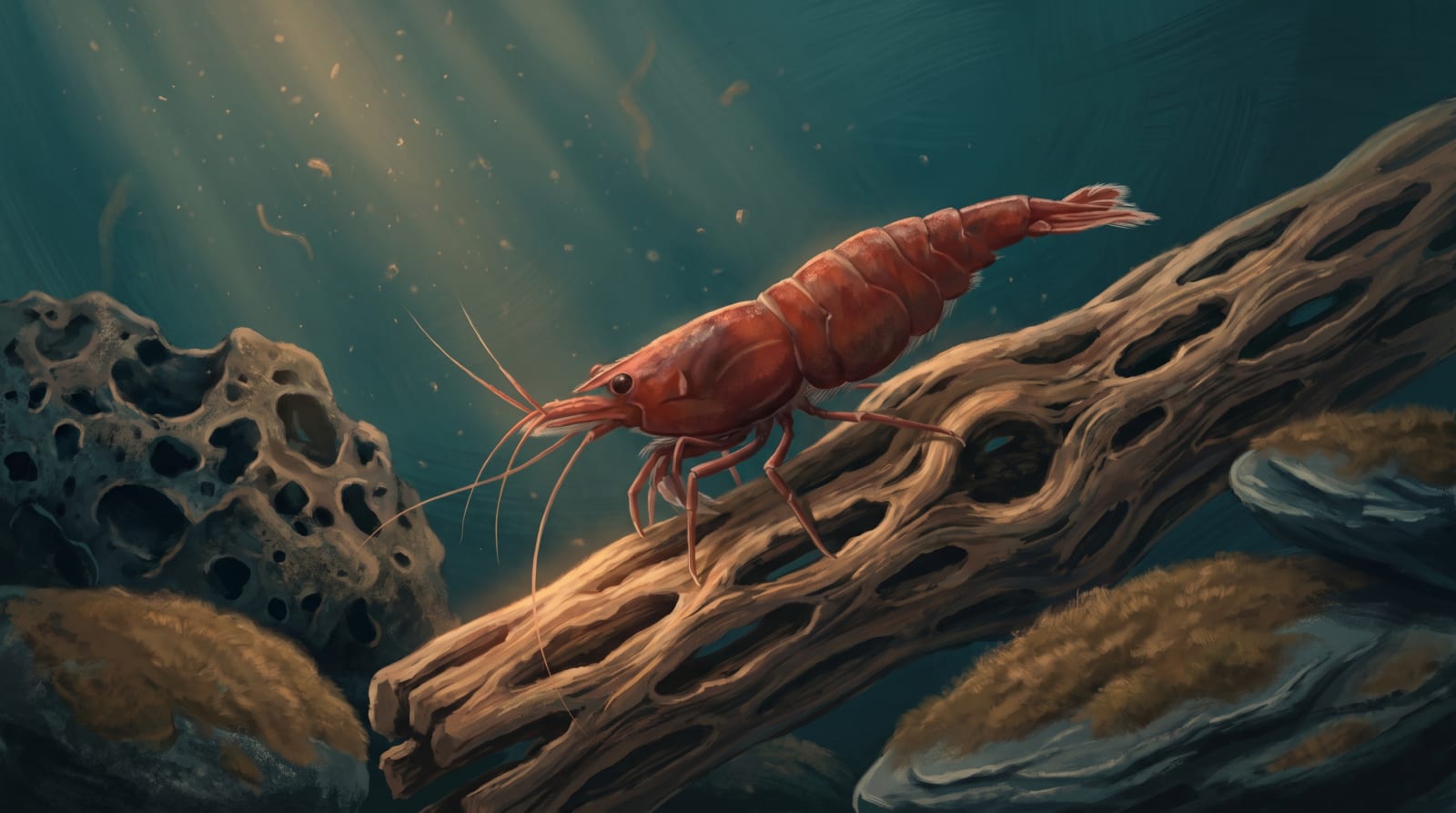
Hardscape is the wood and rock that gives a shrimp tank its shape, and for cherry shrimp it does two jobs long before it does anything decorative: it grows biofilm they graze all day, and it makes the shaded hides they duck into after a moult. The catch is that not every stone and stick is neutral in the water. Some wood gently nudges your chemistry, some rock shoves it, and both can bring problems in with them if you skip the prep. This is how we choose and prepare shrimp-safe wood and rock across our tanks, and how to test a mystery rock before it ever touches the water.
What hardscape is actually for
In a planted display, hardscape is the composition. In a shrimp tank it earns its place as surface area first. Every branch and stone films over with biofilm within a few weeks, and that biofilm is the primary food for the whole colony — shrimplets included, from the day they hatch. The more textured, porous surface you give them, the more grazing lawn the tank grows.
The second job is cover. Shrimp moult every few weeks, and for 24–48 hours afterwards the new shell is soft and the animal is vulnerable, so it hides. A tangle of wood, a stack of slate with gaps, a piece of honeycombed cholla — these are the moulting shelters that keep a nervy shrimp calm and a shrimplet alive. Cover is survival, and hardscape is half of it. The other half is planting, which we cover in the aquascaping ideas for shrimp tanks guide.
So the brief for any piece of hardscape is simple. It should add surface and shelter, it shouldn't drag your water somewhere it doesn't want to go, and it shouldn't smuggle in anything toxic. Wood and rock each fail that brief in their own way, so we'll take them in turn.
Shrimp-safe wood: cholla, spider, oak and beech
Wood is the easy half. Every aquascaping wood we use is safe for cherry shrimp once it's prepared, and shrimp adore all of it.
Cholla is the shrimp keeper's classic, and for good reason. It's the dried skeleton of a cholla cactus — a hollow tube pierced with holes — and as it slowly softens underwater it becomes a honeycomb the colony grazes down to a shell. Shrimplets live inside it. If you buy one piece of wood for a shrimp tank, buy cholla.
Spider wood (also sold as azalea root) is all fine twisting branches, so it throws a lot of surface and a lot of shade into a small tank. It's our default for a nano aquascape. Oak and beech branches — dried, fallen, from a spot you know hasn't been sprayed — do the same job for free if you're willing to gather and prepare them yourself.
All of these are woods, not buffering substrates, so they don't shift your GH or KH. What they do release is tannins: the tea-coloured humic acids that tint the water and, as a mild side effect, nudge pH gently downwards. In a tank with any carbonate buffer to speak of — our KH sits comfortably in the 2–8 range — that drop is usually a fraction of a point and nothing a cherry shrimp notices. In very soft, low-KH water the tint and the dip are both a little stronger. Either way it lands well inside the 6.8–7.6 pH cherries are happy at, and the tannins themselves are a mild positive, releasing compounds that biofilm loves. If you want the water crystal rather than blackwater-tea, more frequent water changes and a little activated carbon pull the colour out without any harm.
Preparing new wood: soak or boil until it sinks
New wood needs preparing for two reasons. Fresh, dry wood floats, and it carries a first flush of tannins and surface gunk you'd rather not dump into a stocked tank all at once.
The fix is to waterlog it. A long soak in a bucket — changing the water when it stains dark, over a week or two — will do it, and so will a spell in a pan of boiling water if you want to hurry a smaller piece along and give it a rough sterilise at the same time. You're done when the wood stays put on the bottom instead of bobbing up. Cholla and thin branches usually sink fast; dense spider wood can be stubborn, and until it sinks on its own you can wedge it under a stone or tie it to a piece of slate.
Two honest notes. First, some pieces never fully stop leaching tannins, and that's fine — it's cosmetic, not a water-quality problem. Second, a few weeks after wood goes in you may see a white, slimy fungal bloom on it. It looks alarming and it's harmless: it's a sugar-feeding biofilm that clears on its own, and the shrimp and any snails will graze most of it off for you. Leave it be. If you're building a whole tank from scratch, the wood goes in early, during the setup and cycling weeks — the full order of operations is in our step-by-step shrimp tank setup.
Rock: inert versus calcium-leaching
Rock is where you have to pay attention, because rock divides cleanly into two camps: stone that sits there doing nothing to your water, and stone that slowly dissolves into it.
Inert rock is the safe camp. Slate, lava rock (the light, porous kind), most granite and quartz, and dragon stone — the beige, pitted "ohko" stone — don't dissolve at normal aquarium pH, so they leave your GH, KH and pH exactly where they were. Lava rock and dragon stone are also gloriously porous, which makes them superb biofilm surfaces and, in dragon stone's case, a warren of little caves shrimplets vanish into. These are the rocks we reach for.
Calcium-leaching rock is the other camp. Limestone, and the popular grey seiryu-type stone, are largely calcium carbonate, and calcium carbonate slowly dissolves into aquarium water. That pushes your GH and KH upward and drags pH up with them. A single small stone in a big tank does this slowly; a full seiryu hardscape does it steadily and forever.
Here's the honest nuance, because "never use limestone" is too blunt. Cherry shrimp actually want a decent GH — 6–12 is our target, and the calcium and magnesium in it are exactly what new shells are built from. So a bit of extra carbonate isn't poison. The problem is control. You can't dose a rock, and a rock that's always pushing your numbers up is the enemy of the one thing that matters most: stability. The reasoning behind every number is laid out in our Neocaridina water parameters guide.
The vinegar test: 30 seconds, any rock
You don't have to guess which camp a rock is in. The test is the one every keeper should know, and it costs you a splash of vinegar.
Take the dry, clean rock and drip a little household vinegar — ordinary acetic acid — onto a hidden spot. Watch closely. If the vinegar fizzes and bubbles where it lands, the rock contains carbonate: it will dissolve into your water and raise GH and KH. If it just sits there doing nothing, the rock is inert and safe. Limestone and seiryu fizz noticeably; slate, lava and dragon stone don't. Test a spot you won't see, because the acid can leave a dull mark, and test the whole rock rather than one corner — some stones are mixed.
The test only tells you about carbonate, so pair it with your eyes for the other risk: metal. Give any found or unfamiliar rock a look for rusty, metallic or brightly stained veins, and leave those ones out. Cherry shrimp are acutely sensitive to copper and other dissolved metals, and a rock with an ore seam in it is not worth the gamble when a piece of plain slate does the same job for nothing.
When leaching rock actually matters: your region decides
Whether a calcium-leaching rock is a real problem or a shrug depends almost entirely on your tap water, which in the UK means it depends on where you live.
If you're in London or the South East, your water is already hard — GH often 12–18 or higher, with plenty of carbonate in it. A modest bit of seiryu or limestone barely registers against that background; your water is buffered hard enough that the rock struggles to move it much. It's not our first choice even then, but it's a low-stakes call.
If you're in a soft-water region — much of Scotland, Wales, Cornwall and the North West, where GH can sit at 2–6 — it's a different story. There, you're already having to add minerals back to reach a shrimp-friendly GH, and an uncontrolled carbonate rock turns that careful job into a moving target. It won't reliably hold your GH where you want it, and worse, it can let your numbers drift and swing as it dissolves at different rates. Swings in GH are directly linked to failed moults and the pale, fatal band keepers call the white ring — the mechanism is spelled out in our guide to failed moults and the GH connection. If you need to raise your GH, do it deliberately with a proper GH+ remineraliser dosed to a TDS target, not by dropping a rock in and hoping. Which camp your postcode falls into is mapped out region by region in our UK tap water for shrimp guide.
What to leave out of a shrimp tank
A short list of things that look like hardscape but don't belong near cherry shrimp.
- Painted, resin or ceramic ornaments unless they're sold as aquarium-safe. Cheap decorations can leach dyes and, occasionally, metals — the same copper worry as a mineral vein.
- Rocks with metallic or rusty veins, as above. If in doubt, leave it out; the shrimp won't miss it.
- Sharp, glassy edges. Not a poisoning risk, but soft newly moulted shrimp can graze themselves on freshly split slate. Knock off any razor edges.
- Sea shells, coral and crushed coral as decoration. These are calcium carbonate too, and they leach exactly like limestone — occasionally used on purpose to raise hardness, but never something to add without meaning to.
- Anything scavenged from a beach or a roadside without cleaning and testing it first. The vinegar test and a good scrub are the minimum.
Chosen well, wood and rock are the cheapest upgrade a shrimp tank gets: more grazing, more cover, more places for the colony to feel safe and breed. If you're using cholla and tangled wood specifically to push shrimplet survival, our guide to breeding décor — tubes, cholla and cover takes that idea further, and the choice between inert and buffering substrate runs on exactly the same logic as the rock decision, covered in inert vs active substrate.
FAQ
Does driftwood lower pH in an aquarium?
Yes, a little. Aquarium woods leach tannins — humic acids that tint the water and gently nudge pH downwards. In a tank with a normal carbonate buffer (KH 2–8) that's usually a fraction of a point, which cherry shrimp don't mind at all, since they're happy across pH 6.8–7.6. The effect is stronger in very soft, low-KH water. It's a mild nudge, not a lever for big pH changes.
Is cholla wood good for shrimp?
It's the classic shrimp wood. Cholla is the hollow, holey skeleton of a cholla cactus, and as it softens underwater it becomes a honeycomb the colony grazes for biofilm and shrimplets shelter inside. It's inert to your GH and KH, releases only mild tannins, and is one of the cheapest, most useful things you can add. Give it a soak or a boil to sink it first.
What rocks are safe for a shrimp tank?
Inert rocks that don't dissolve into the water: slate, lava rock, most granite and quartz, and dragon stone (ohko). These leave your GH, KH and pH untouched. Avoid limestone and grey seiryu-type stone, which are calcium carbonate and slowly raise hardness, and avoid any rock with rusty or metallic veins. The vinegar test settles it — fizzing means carbonate, no fizz means safe.
Is dragon stone safe for shrimp?
Yes. Dragon stone (ohko stone) is inert — it doesn't fizz on the vinegar test and won't shift your water chemistry — and its pitted, cavernous texture is excellent for shrimp, growing biofilm and giving shrimplets endless caves to hide in. Give it a rinse and scrub to clear loose clay from the crevices before it goes in, and it's one of the best hardscape rocks for a shrimp tank.
Do I need to boil wood before putting it in a shrimp tank?
You need to waterlog it, and boiling is the fast way. Fresh wood floats and carries a first flush of tannins and surface debris, so either soak it in a bucket for a week or two, changing the water as it stains, or boil a smaller piece to sink it and rough-sterilise it at once. You're finished when it stays on the bottom on its own. Boiling isn't compulsory — a patient soak works just as well.