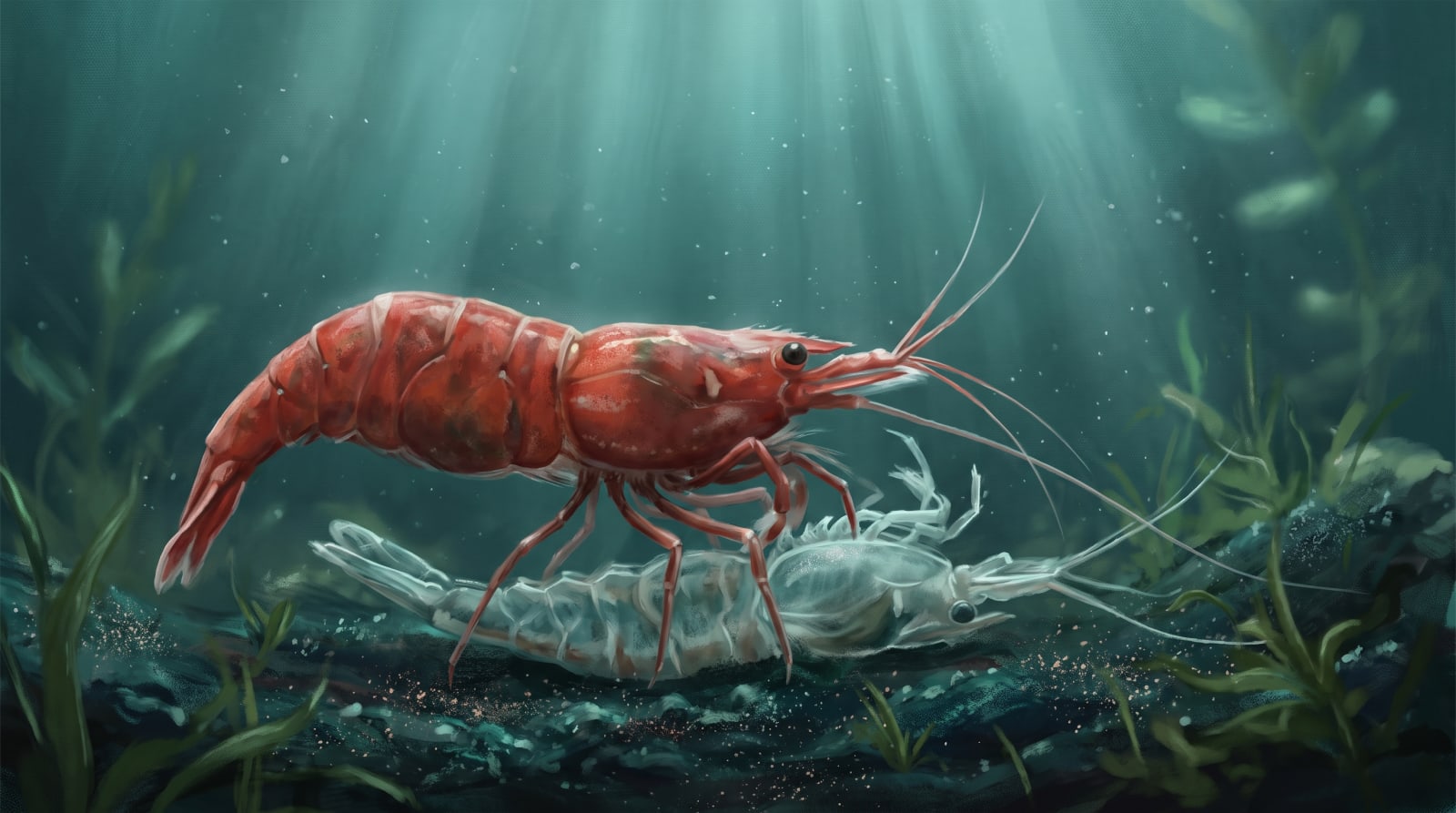
A shrimp that dies halfway out of its old shell, or one you find stuck in a moult it can't finish, has almost always run into the same problem: minerals. Specifically the calcium and magnesium dissolved in your water, the pair a shrimp builds its next shell from and works the moult with. Both show up on a single test — general hardness, or GH — which makes GH the number that quietly governs whether your colony moults cleanly or dies trying. Get it into range and hold it steady, and failed moults go from a regular heartbreak to something you rarely see.
Why moulting is the riskiest thing a shrimp does
Shrimp grow by shedding their skeleton, because they wear it on the outside. Every few weeks a cherry shrimp grows a soft new shell under the old one, splits the old case along a seam behind the head, and flicks itself free in a fraction of a second. Adults do this every three to six weeks; juveniles more often, because they're growing faster and have to keep sizing up their armour to match.
The part that matters for this guide happens in the hours around that flick. A new shell comes out soft and thin, and the shrimp hardens it by pulling minerals — calcium above all — straight out of the water over the next 24 to 48 hours. A moult isn't really a single event, then, so much as a mineral transaction: the shrimp spends a shell, then draws down the water's mineral store to build the replacement. If that store is too thin, or lurches partway through, the transaction fails — and a failed moult is very often a dead shrimp. We've set out the fatal version of it, the white ring of death, separately; this guide is about the mineral chemistry sitting underneath it.
What GH actually is
GH stands for general hardness, and for a shrimp keeper it's simplest to read it as the amount of calcium and magnesium dissolved in your water. Those are the two minerals a shrimp needs most — calcium for the bulk of the shell, magnesium working alongside it — and GH is the single figure that tells you how much of them is on hand. It's usually measured in degrees (dGH) with a liquid test kit, a couple of drops at a time until the colour turns.
It pays to keep GH straight from the other two numbers it gets muddled with. KH, carbonate hardness, buffers pH and stops it swinging; pH is the acidity itself. GH is neither — it's the mineral pantry, and it's the one that feeds a moult. A tank can sit at a perfectly good pH and still leave shrimp short of the calcium they need, which is exactly how careful keepers end up baffled by moulting deaths in water that "tests fine".
For Neocaridina we aim for GH 6–12, and nearer the top of that, 8–12, when a colony is breeding hard and moulting often. That range is the backbone of the wider Neocaridina water parameters we run to.
When GH is too low: soft, incomplete shells
Low GH is the classic cause of failed moults, and it's the one that catches out a big slice of British keepers without them realising. If your water is soft — much of Scotland, Wales, Cornwall and the North West sits at GH 2–6 out of the tap — there simply isn't enough calcium and magnesium in it for a shrimp to build and harden a shell properly.
A shrimp in chronically soft water moults into a shell that stays too soft, or can't part cleanly from the old one, and stalls halfway. You'll see stuck moults, shrimp that die in the act, and in the worst cases the pale separation band of the white ring. Because juveniles moult most often, they tend to be the first to fail when GH drifts low, so a run of losses among your smallest shrimp is a classic low-GH signature and a useful early warning for the whole colony.
The fix isn't a treatment, it's a mineral level. In a soft-water region you remineralise up to GH 6–12 rather than hoping the tap will do it — our guide to remineralising RO and rainwater covers hitting a target reliably. If you're not sure where your area sits, the region-by-region UK tap water guide is the place to start.
When GH is too high — or won't sit still
The opposite problem is real but rarer, and it comes in two forms. Genuinely very high GH — well above 12 — can make moulting harder in its own right, with the new shell forming too thick or too tight for the shrimp to work out of comfortably. In most of the UK you won't reach that from the tap; hard-water regions like London and the South East sit around GH 12–18, which is the high end of workable rather than dangerous, and Neocaridina handle it well straight from the tap once dechlorinated.
The bigger danger by far isn't a high number, it's a moving one. A GH that swings — dropping when you top a hard tank up with a lot of soft RO, or jumping when a remineraliser dose goes in heavy — is worse than a steady GH sitting slightly outside the ideal. Sudden mineral swings can trigger a shrimp into moulting before its new shell is ready, or shift the chemistry partway through a moult so the shell sets wrong. This is why a big, mismatched water change is such a reliable way to produce a dead shrimp the next morning. Stability beats a perfect reading every time; a hard-water colony sitting rock-steady at the top of the range moults better than one being nudged up and down chasing an ideal 8.
Hitting GH 6–12 and keeping it there
The whole job comes down to reaching a sensible GH and then not letting it move. Start by testing — a GH liquid kit is a couple of pounds' worth of drops and the only way to actually know your number rather than guess it. Test your tap or RO source, test your tank, and you'll see straight away which side of the problem you're on.
In a hard-water area the tap does the work, and your job is mainly to avoid diluting it away with too much rainwater or RO and to keep changes gentle. In a soft-water area, mix your change water to a GH 6–12 target with a GH+ remineraliser, dosed to a number rather than by eye, so every batch matches the last. Either way, the golden habit is small, temperature-matched water changes of 10–20% a week rather than big occasional ones — the approach in our water change guide — because a gentle change never moves GH far enough to matter, while a big lurch is precisely the swing that kills a moult.
Does feeding calcium fix it?
When moults start failing, the instinct is to add something — a calcium supplement, a mineral block, a mineral-rich food — and it's usually the wrong lever. A shrimp draws the minerals for its shell mostly from the water, not from its dinner, which is why remineralising a soft tank fixes far more failed moults than anything you drop in as food ever will.
Diet does play a supporting part, mind. A varied diet with a modest protein element supports the whole moulting process, and a shrimp grazing a rich, mature biofilm has more to work with than one scraping a bare new tank — we set that balance out in our guide to protein, plants and the moulting diet. Some keepers add a piece of cuttlebone or a mineral-rich botanical as insurance, and it does no harm; we've kept colonies moulting cleanly for years on nothing but remineralised water held at GH 6–12, so we treat those as extras, not fixes. If moults are failing, your first move is a GH test, not a shopping trip.
Reading a failed moult, and what to do
A failed moult shows up a few ways. Sometimes you catch a shrimp stuck half-out, flicking and curling without breaking free. Sometimes it's the pale band of the white ring across the body. Often it's simply a dead shrimp with a shell still partly attached, or a shed case that came off incomplete. Any of these, once, is bad luck — a single shrimp can just get unlucky. Several across a few weeks is not luck; it's your water telling you the mineral level is wrong, and the answer is a GH test followed by whatever it points to.
Be honest with yourself about the individual, though. By the time a moult has visibly stalled the odds are poor, and handling a stuck shrimp tends to add stress without saving it — the kindest and most useful response is to leave it undisturbed and turn your attention to the water every other shrimp still has to moult in. If failed moults come alongside other losses, work the wider diagnostic checklist for dying shrimp as well, because low GH rarely travels alone. None of this is complicated once the mechanism clicks: minerals build the shell, GH measures the minerals, and a steady GH 6–12 is most of what a clean moult needs — the same unglamorous stability that runs through our whole cherry shrimp care guide.
FAQ
What GH do cherry shrimp need to moult?
Aim for GH 6–12, and nearer 8–12 if the colony is breeding and moulting often. GH is the calcium and magnesium a shrimp builds its shell from, so too little leaves shells soft and moults stuck. Test with a liquid GH kit rather than guessing, and if your tap water is soft — GH 2–6 across much of Scotland, Wales, Cornwall and the North West — remineralise up to range.
Why did my shrimp die while moulting?
Nearly always a mineral problem. If GH is too low, the new shell can't harden or part from the old one and the shrimp stalls halfway, often fatally. The other trigger is a sudden swing — a big, mismatched water change that jolts a moult at the wrong moment. One death can be chance; several means test your GH, hold it at 6–12, and switch to small, gentle water changes.
Do cherry shrimp need calcium to moult?
Yes — calcium is the main mineral in a shrimp's shell, with magnesium alongside it, and the two are measured together as GH. But a shrimp takes that calcium from the water, not mainly from food, so the fix for soft shells is remineralising to GH 6–12, not a calcium food additive. A cuttlebone or mineral botanical does no harm as insurance, but the water is what actually matters.
How often do cherry shrimp moult?
Adult cherry shrimp moult roughly every three to six weeks, and juveniles more often because they're growing faster. For 24 to 48 hours afterwards the new shell is soft, so the shrimp hides while it draws minerals from the water to harden it. If you almost never find shed shells, check the temperature is inside 18–26°C and the tank is fed enough, because cold, underfed shrimp moult and grow slowly.