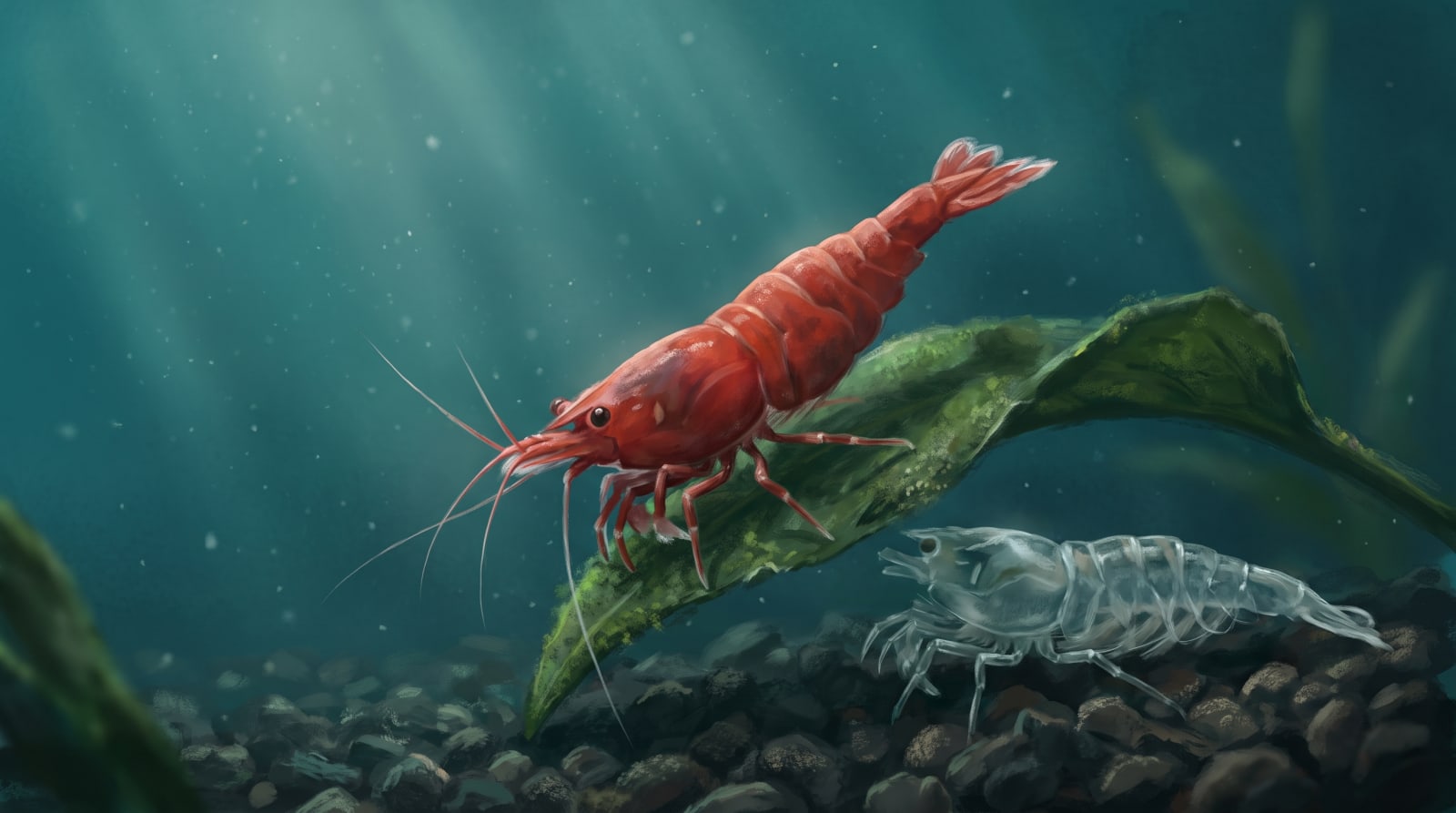
Most feeding mistakes with shrimp aren't about what you offer — they're about the ratio. A cherry shrimp is a grazer that eats a little of everything, mostly plants and biofilm, with a small amount of protein woven in. Tip that balance too far towards protein and you get planaria, foul water and a stressed colony; skip protein entirely and breeding stalls. This guide is about holding the middle, and about the thing that trips up careful keepers: the food dish is not where a shell gets built.
Start with the base: plants, biofilm and algae
The foundation of a shrimp's diet, by a wide margin, is plant matter — living biofilm, soft algae and the aufwuchs film coating every surface in the tank. Shrimp are omnivorous grazers, not carnivores, and as our complete feeding guide lays out, in a mature planted aquarium this base feeds the colony most of the time with no help from you. Get this part right and everything else is a light top-up.
You support the base in two ways. First by growing it — wood, botanicals, leaf litter and moss all pack in grazing surface, and a slightly mature, lived-in tank grows far more food than a scrubbed one. Second by supplementing it a couple of times a week with a plant-leaning staple: an algae- or spirulina-based shrimp food is the natural fit, echoing what they already graze. A weekly piece of blanched vegetable — courgette, spinach, nettle — rounds out the plant side. A soya-husk food such as the Snowflake we make sits here too, plant-based and safe to leave in for slow grazing.
If most of what your colony eats is plant matter and biofilm, you've got the ratio broadly right before protein even enters the picture.
Where protein fits, and how little you need
Protein isn't optional — it's just small. Shrimp need a modest amount for the things plants alone don't cover: egg development in females, growth in juveniles, and rebuilding soft tissue after a moult. A colony fed nothing but veg and algae tends to breed sluggishly, which is the usual sign the protein element is missing.
The dose is the whole trick: roughly once a week, kept small. We give our colonies a small protein feed about weekly and time it around conditioning females for their next round of eggs, because that's when the demand is highest. Sources are simple — a small piece of a protein-rich shrimp food, an occasional bit of bloodworm, or protein-bearing botanicals. It doesn't need to be fancy and it doesn't need to be frequent.
Why so sparing? Because shrimp are built to graze plant surfaces all day, not to eat meat in quantity. Their gut and their tank both handle a trickle of protein far better than a feast. Weekly and small delivers everything the biology asks for without tipping into the problems in the next section.
The moulting diet: water builds the shell, diet supports it
Here's the misunderstanding that costs people shrimp. When moults start failing, the instinct is to reach for a "calcium food" or a mineral supplement, on the logic that a shell is made of minerals so the fix must be dietary. It usually isn't.
A shrimp draws the minerals for its new shell — calcium above all, with magnesium alongside — mostly from the water, not from its dinner. Those two minerals are measured together as GH, general hardness, and holding GH in the 6–12 range is what actually keeps a colony moulting cleanly. Adults moult roughly every three to six weeks, hardening each soft new shell by pulling minerals straight out of the water over the following day or two. If the water's mineral store is too thin, no calcium-enriched pellet will save the moult. The full mechanism is in our guide to failed moults and the GH connection, and the target ranges live in the Neocaridina water parameters reference.
So what does diet do for moulting? It supports the process rather than supplying the shell. A varied diet with that modest protein element helps a shrimp build the new soft tissue underneath, and a colony grazing a rich, established biofilm has more to work with than one scraping a bare tank. Diet is the supporting act; GH is the headline. Put crudely: GH does the shell minerals, and diet does the rest. Some keepers drop in a piece of cuttlebone or a mineral botanical as insurance and it does no harm — but if moults are failing, your first move is a GH test, not a shopping trip.
Too much protein: planaria and water trouble
Protein is the ingredient that punishes overfeeding hardest, and understanding why is most of what keeps a tank healthy.
Protein-rich leftovers foul water faster than anything else you can offer. A meaty morsel that isn't eaten quickly breaks down in the substrate, driving up ammonia in a tank where ammonia and nitrite need to read zero and nitrate stay under 20ppm. Worse, a steady surplus of protein is exactly what pest blooms are built on: a sudden rash of planaria and hydra almost always traces back to too much high-protein food hitting the substrate. Snail populations balloon on the same surplus. None of these are really pest problems — they're feeding problems wearing a costume.
This is why the golden rule is small and weekly. It's also why overfeeding is the single biggest killer of shrimp tanks, and protein is the sharp end of it. If you take one habit from this guide, make it this: when in doubt, offer less protein, not more.
A balanced week in our breeding room
Put the pieces together and a week looks like this — plant-heavy, protein-light, biofilm always underneath:
- The base, always on: biofilm, algae and botanicals grazing away around the clock, feeding the colony between everything below.
- Two or three staple feeds: small pinches of an algae- or spirulina-based food across the week, each gone within two to three hours.
- One vegetable feed: a slice of blanched courgette or a spinach leaf, out within a few hours, twelve at the outside.
- One small protein feed: a little bloodworm or a protein-rich food, kept deliberately modest.
- Skip days without guilt: if food gets ignored, the biofilm is keeping up — skip the next feed. A missed feed in a mature tank costs nothing.
That's a diet weighted heavily towards plants and biofilm, with protein as a weekly accent. In our most mature tanks we drop the staple to twice a week and the colony never notices, because the base is doing the work.
When the balance tips: reading the tank
Your tank tells you when the ratio is wrong, if you know the signals.
Too much protein shows up as cloudy water after feeds, a planaria or hydra outbreak, a sudden snail explosion, or leftovers still sitting in the substrate the next morning. The fix is a reset: stop feeding for a few days, do a couple of small water changes, physically remove the leftovers, and restart at half the protein you were giving.
Too little protein is quieter and slower. Females that never seem to carry eggs, juveniles that grow slowly, a colony that just isn't multiplying the way a healthy one should. If your water is in range and the colony still won't breed, a slightly more generous weekly protein feed is worth trying before you go looking for exotic causes.
The healthy middle looks like this: active all-day grazing, clear water, females regularly carrying 20–30 eggs, shrimplets appearing without fuss, and food that vanishes fast when you offer it. Get the plant base right, keep protein small and weekly, and hold your GH steady at 6–12 — do those three things and the diet side of shrimp keeping is genuinely solved.
FAQ
Do cherry shrimp need protein in their diet?
Yes, but only a little. Protein supports egg production in females, growth in juveniles and tissue repair after moulting, none of which a purely plant diet fully covers. A colony fed only veg and algae tends to breed slowly. The dose is the key: a small protein feed about once a week is plenty, because shrimp are grazers built for plant matter, not meat in quantity.
What should I feed cherry shrimp for healthy moulting?
Focus on the water first — a shrimp builds its shell mainly from the calcium and magnesium in the water, measured as GH, so holding GH at 6–12 matters more than any food. Diet plays a supporting role: a varied plant-and-biofilm base with a small weekly protein feed helps build the new tissue. Calcium foods and mineral blocks do no harm but won't fix soft shells in soft water.
Can you feed shrimp too much protein?
Very easily, and it's a common way tanks go wrong. Excess protein rots fast in the substrate, spiking ammonia and feeding planaria, hydra and snail blooms. Shrimp are grazers, not carnivores, so they handle a small weekly amount far better than frequent meaty feeds. If you're seeing pests or cloudy water after feeding, cut the protein right back — it's almost always the cause.
What is the best diet balance for cherry shrimp?
Heavily weighted towards plants and biofilm, with protein as a small weekly accent. In practice: a mature tank grazing biofilm all day, two or three light algae- or spirulina-based staple feeds a week, one blanched vegetable feed, and one small protein feed. Skip a feed whenever food is ignored. That plant-leaning ratio keeps water clean, pests away and breeding steady.
Does diet affect shrimp moulting?
Indirectly. The minerals a shell is made from come mostly from the water, not food, so GH held at 6–12 is what governs clean moulting. Diet supports the process — a varied diet with modest protein helps build the soft tissue under the new shell, and rich biofilm gives a shrimp more to work with. But if moults are failing, test your GH first rather than changing the menu.