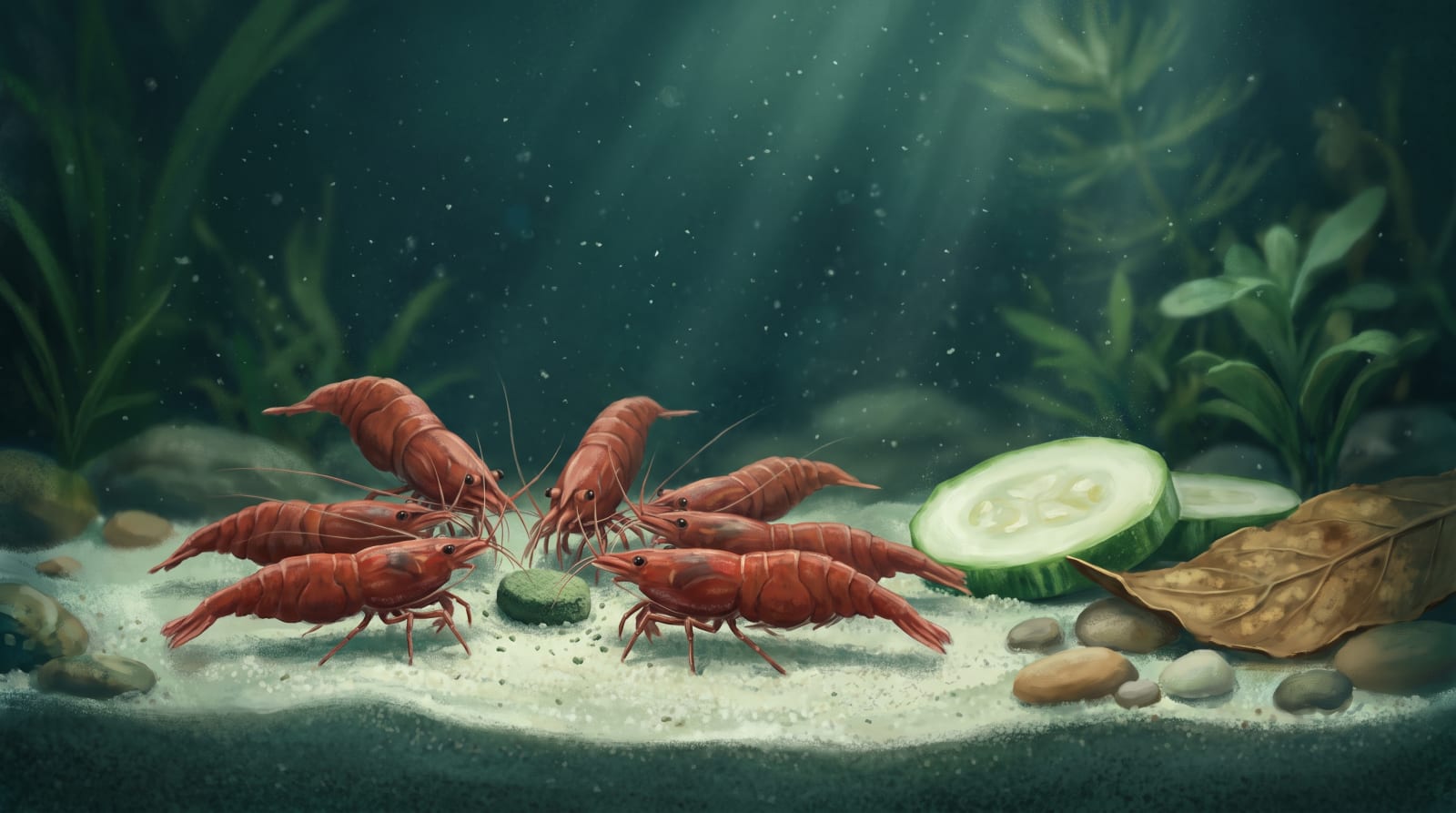
Every "best shrimp food" list we've ever read is a row of product photos, and within a year half the products have been reformulated, renamed or discontinued. So this roundup works the way we actually buy food for our own breeding room: by type. Get the right mix of shrimp food types and almost any honest product within each type will do its job; get the mix wrong and the most expensive tub in the shop won't fix it.
Why we judge types, not brands
Three reasons, all learned the slow way.
First, recipes drift. Brands change formulas without changing packaging, so a recommendation ages badly even when it was right. The ingredient list on the back tells you more than the name on the front ever will.
Second, most shrimp foods are closer siblings than the marketing suggests. Once you've read enough labels you find the same handful of bases — algae and spirulina, vegetable meals, a protein source, a binder — arranged in different proportions. The proportion is the product. Name the type and you've named the job it does.
Third, honesty: we make and sell a food ourselves, so ranking named competitors would put us in a position we don't want to be in. Types keep us straight. Where our own product fits, we'll say so plainly — once — and you can weigh our bias yourself.
One framing rule before the list, because it changes how you shop: everything you buy is a supplement. The primary diet of cherry shrimp is biofilm, grazed off every surface around the clock, and a mature tank does most of the feeding for you. We supplement 2–3 times a week, and that's the ceiling, not the floor. A tub of anything lasts months when you feed properly, so buy small and buy fresh.
The shrimp food types at a glance
| Type | The job it does | How often | Can it stay in? |
|---|---|---|---|
| Algae/spirulina staple | Balanced baseline feed | Within the 2–3 weekly feeds | 2–3 hours |
| Algae wafers | Staple in slab form, longer graze | Occasional staple swap | A few hours |
| Snowflake | Leave-in grazing, holiday cover | Whenever | Until gone |
| Botanicals | Grow biofilm in the tank | One in at all times | Weeks |
| Protein treat | Egg production, moult recovery | Roughly weekly, small | 2–3 hours |
| Powdered shrimplet food | First foods in young tanks | Sparingly | Settles as dust |
| Blanched veg | Plant matter, long graze | About weekly | 12 hours maximum |
Algae and spirulina staples
If you buy one tub, buy this one. An algae- or spirulina-based staple is the balanced baseline of the whole rota: mostly plant matter, modest protein, formulated to sink and hold together while a colony picks it apart. It's the closest packaged approximation of what a grazer actually wants, which is why it anchors two of our three weekly feeds.
Reading the label is the whole skill. You want a named algae — spirulina, chlorella, kelp — at or near the top of the ingredient list, not buried under generic cereal fillers. You want pellets or granules small enough to spread between several shrimp, because one big pellet gets sat on by the boldest female while the rest wait. And you want it to sink; cherry shrimp will not chase food at the surface.
Portion is where staples go wrong. Feed what the colony clears in 2–3 hours, no more, and skip the feed entirely if the last one was ignored. Overfeeding is the number one killer of shrimp, and a staple tub that lasts less than a few months for one tank is being over-used. The warning signs and the recovery plan are in overfeeding: signs, dangers and recovery.
Algae wafers
Algae wafers are the same idea as the staple in slab form, sold for plecos and bottom feeders but perfectly good shrimp food — and often the only suitable thing on the shelf in a small shop. The dense disc takes a colony hours to work through, which makes wafers the best value staple per gram and a good watch-the-colony feed for a weekend morning.
The catch is dose. A whole wafer is a feast for a large colony and a disaster in a ten-shrimp tank, where most of it will rot. Snap wafers into fragments and feed a piece at a time. If a wafer regularly sits past the few-hour mark, you're feeding wafer-sized portions to a fragment-sized colony.
Snowflake: the food you can leave in
Snowflake food is made from soya bean husks, and it breaks the normal rules in a genuinely useful way: it doesn't rot in water. Instead, a white fungal fuzz grows over it as it sits, and that mycelium is itself first-class shrimp grazing. Food that farms more food. Because it can't foul the tank, it's the one thing you can drop in and walk away from — which makes it the standard answer for holidays, and a quiet workhorse in shrimplet tanks, where the fuzz gives tiny mouths something to work on all day.
It won't replace the staple: it's a narrow food, and the point of the rota is variety. But it's the type we lean on hardest after the staple itself. We feed enough of it that we ended up producing our own — the Snowflake in our shop is the same batch our breeding room runs on, and when it's listed out of stock, the waitlist gets the restock email before anyone else.
Botanicals: catappa leaves and alder cones
Botanicals are the type most new keepers skip, because they don't look like food. A catappa (Indian almond) leaf or a couple of alder cones dropped in the tank soften slowly, grow a coat of biofilm, and become a grazing station that works every hour of every day for weeks. Watch a colony process a catappa leaf down to its skeleton and you'll never run a tank without one again. The mild tannins they release have gently antimicrobial properties as a bonus.
There's always at least one leaf in every tank we run. It's the cheapest food on this list per week of feeding, and it's also the safest: there is no dose to get wrong.
Protein treats
Cherry shrimp are grazers, but females building eggs need protein, and a freshly moulted shrimp eats its own shed shell for the same reason. We feed a small piece of bloodworm roughly weekly — frozen-and-thawed, one small piece for the tank, gone within the hour when the colony's in form.
Respect this type. Meaty food fouls water faster than anything else you can offer, and a protein surplus is the classic trigger for planaria and hydra outbreaks — pests that arrive with overfeeding and leave with it too. Weekly and small is the whole protocol. If you keep no fish and the freezer seems excessive, a staple with slightly higher protein content, fed as one of the weekly feeds, covers the same ground.
Powdered shrimplet foods
Powdered food is the specialist of the list: micron-fine particles that drift and settle across every surface, putting food where shrimplets actually live. Shrimplets graze biofilm from day one and don't travel to a feeding dish, so in a young tank that hasn't built its biofilm yet, a tiny pinch of powder papers over the gap.
In a mature, planted tank you can skip the type entirely — the tank already does this job. And go carefully: powder is invisible once dosed, impossible to remove, and very easy to overfeed. A pinch means a pinch. Where it fits in raising a brood, and what we actually dust into our own shrimplet tanks, is covered in feeding shrimplets.
Blanched vegetables: the free staple
The best-value shrimp food in the UK is in your fridge. Courgette and spinach, sliced thin, dipped in boiling water for 30–60 seconds, cooled and weighed down, give the colony a long plant-matter graze that no packet quite matches. Nettle, picked from somewhere you're certain is unsprayed, is the free wild option and shrimp love it.
Two rules keep veg safe. Rinse everything well first — pesticide residue is lethal to shrimp, and supermarket veg has usually met some. And take out whatever's left within hours; 12 hours is the absolute limit before leftovers start working against your water. The full method, and the honest ranking of which vegetables earn a place, is in blanched vegetables for shrimp.
What we actually run in the breeding room
The whole system, so you can see the types working together. Our colonies get 2–3 feeds a week: an algae-based staple as most of them, blanched veg about weekly, and a small protein feed roughly weekly, timed around conditioning females. A catappa leaf sits in every tank permanently. Snowflake covers gaps — busy weeks, holidays, shrimplet tanks. That's the entire rota, and a colony fed this way still gets most of its diet from the tank itself.
If you're starting from zero: buy a spirulina staple and a bag of catappa leaves, use your own veg, and you're 90% of the way there for the price of a pint. Add snowflake when you first go away for a weekend, and powder only if you're raising broods in a young tank. What each feed does inside the shrimp — and what to feed cherry shrimp at each life stage — is the subject of the full feeding guide, and how often to offer it is covered in how often and how much to feed.
How to judge any tub without a brand name
Six checks, in the shop, whatever the label says:
- A named algae or vegetable leads the ingredient list. "Cereals" and "derivatives" leading means filler.
- It sinks. Floating food is fish food, whatever the picture on the front shows.
- Small units or breakable form. Portion control is the actual skill of shrimp feeding.
- Modest protein for staples. Grazer first; the weekly treat covers the rest.
- A small tub. Fed 2–3 times a week, even a small tub outlasts its freshness if you're not careful. Store it dry and sealed.
- No miracle claims. Food feeds shrimp. It doesn't "boost colour in days" — good diet, water and genetics do that slowly. A deep-red line like bloody mary stays deep on variety and stability, not on a magic pellet.
A product that passes all six is a good buy in whatever type you're shopping for. That's the entire secret of the roundup: the type does the job, and the label tells the truth.
FAQ
What is the best food for cherry shrimp?
An algae- or spirulina-based staple, fed 2–3 times a week in portions the colony clears within 2–3 hours, on top of the biofilm a mature tank grows naturally. Around that baseline, add blanched veg and a botanical leaf for grazing, a small weekly protein feed for breeding females, and snowflake as a safe leave-in. Variety across types beats any single "best" product.
Are algae wafers good for shrimp?
Yes — algae wafers are a perfectly good staple for cherry shrimp, and often the most accessible one in UK shops. The only real risk is portion size: a whole wafer overwhelms a small colony and rots. Break wafers into fragments, feed one piece at a time, and remove anything still sitting there after a few hours.
What is snowflake shrimp food?
Snowflake is a food made from soya bean husks. Its trick is that it doesn't decompose and foul the water; instead a white mycelium grows over it, which shrimp and shrimplets graze. That makes it the one food you can safely leave in the tank until it's gone — ideal for holidays and for shrimplet tanks that benefit from constant grazing.
Can cherry shrimp eat fish food?
They'll eat it enthusiastically — shrimp are scavengers and clear whatever the fish miss. As the main diet, though, most fish foods run too high in protein for a grazer, and flake breaks down fast enough to foul water. Fine as an occasional feed or in a community tank by accident; a plant-led shrimp staple is the better everyday choice.
How often should I feed cherry shrimp?
Two to three supplemental feeds a week in an established tank, with portions gone in 2–3 hours — blanched veg stretching to 12 hours at most. Skipped feeds are healthy: the tank's biofilm keeps feeding the colony between meals. New tanks with little biofilm need feeding slightly more often; overfed tanks fail far more often than underfed ones.