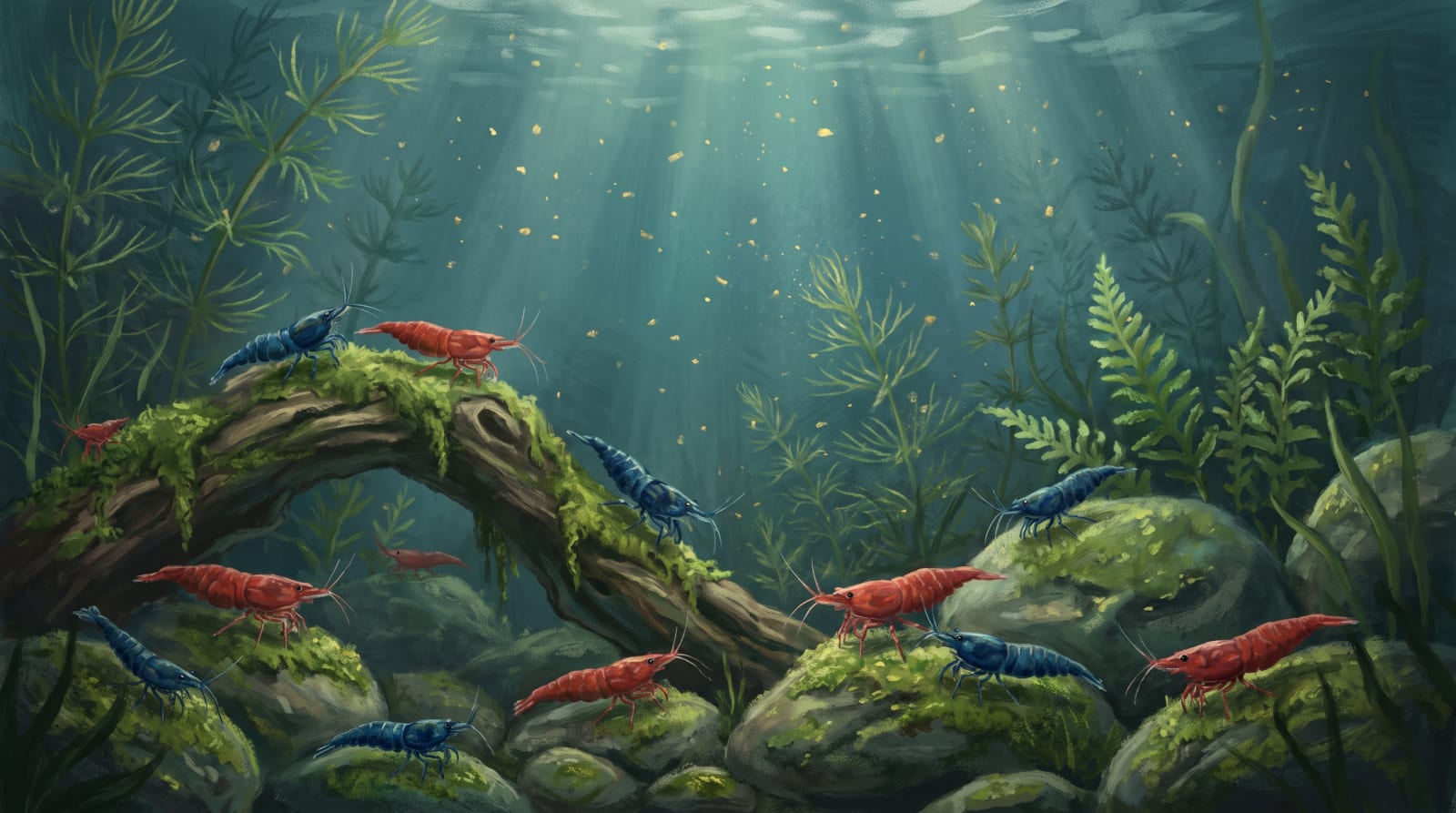
Most aquascaping advice is written for fish tanks, with shrimp bolted on as the clean-up crew. Shrimp read a tank differently: every surface is a feeding station, every shadow is a nursery, and the layout you choose decides how many shrimplets reach adulthood. Here are five aquascaping ideas for shrimp tanks that have earned their place in our breeding room.
What makes a shrimp scape different from a fish scape
A fish scape is composed for the person looking at it. A shrimp scape has to work for the animal first. The two goals overlap more than you might think, but the priorities flip.
A shrimp tank layout has three functional jobs:
- Grazing surface area. Biofilm, algae and aufwuchs growing on surfaces are a cherry shrimp's primary food. More texture means more food, restocking itself around the clock.
- Shrimplet cover. Shrimplets graze biofilm from day one, but they do it hidden. Dense cover is the difference between a colony that grows and one that never seems to.
- Line-of-sight breaks. Structure that interrupts sightlines makes shrimp bolder. A colony with places to duck behind spends more time out in the open, grazing where you can watch it.
Then there is the fourth element: the shrimp themselves. An adult cherry is 2.5–3cm of saturated colour, and in this kind of tank it is the ornament. Everything else is staging, which is why substrate colour gets its own section further down.
Every layout below follows the same working principle: dense cover zones, an open grazing floor, and line-of-sight breaks between the two. And one reassurance before you buy a single pot. Shrimp do not eat healthy plants; they graze the film off leaf surfaces, so nothing you plant is at risk.
A quick word on the vessel itself. A shrimp tank is a nano aquascape almost by definition: 10 litres at minimum, 19 litres or more if you can, cycled for four to six weeks or longer before anyone moves in. The hardware side lives in our shrimp tank setup guide; this article is about what goes inside the glass.
The five layouts at a glance
| Layout | Tech level | Effort | Best for |
|---|---|---|---|
| The Moss Garden | Near zero | Low | First shrimp tank, breeding |
| The Epiphyte Forest | Low | Low | Long-lived, rescape-proof tanks |
| The Iwagumi-ish Minimal | Medium to high | High | The clean look, with trade-offs |
| The Jungle Bottom | Low | Medium | Maximum shrimplet survival |
| The Botanical Blackwater-lite | Near zero | Low | Biofilm production, natural feel |
All five run happily on a sponge filter and modest lighting unless we say otherwise.
1. The Moss Garden
Ask us for one shrimp tank idea and this is the answer. Moss mounds across the floor, a moss wall or a moss-covered stone at the back, and very little else. Most of the tanks in our breeding room are some version of it, because moss aquascaping is as forgiving as this hobby gets.
Moss is the single best shrimplet cover available, and every strand doubles as grazing surface. Tie clumps to small stones or offcuts of wood, space the mounds so bare substrate runs between them, and let it grow in. Trimmings get tied down elsewhere, so the scape spreads itself for free.
What you need:
- A 19L+ tank (10L works, but more water is more stable)
- A sponge filter
- Dark, inert substrate
- As much java moss as the budget allows
- A few small stones or wood pieces to tie it to
Why it works for shrimp: cover and food in one material, with nothing to go wrong. No CO2, no high light, and in most UK homes no heater either. An unheated room sitting at 18–21°C is fine for Neocaridina; they simply breed more slowly at the cool end.
2. The Epiphyte Forest
One good branching piece of driftwood, planted like a tree. Anubias, java fern and bucephalandra are epiphytes, meaning they attach to wood and rock rather than rooting in the substrate. Tie them on with cotton thread, or use a gel superglue (cyanoacrylate) as most of the hobby does — it's aquarium-standard and shrimp-safe once cured. Whatever you do, never bury the rhizome.
Because epiphytes feed from the water column, the substrate underneath can stay plain and inert, and the whole scape survives a rescape: lift the wood out and the forest comes with it. Park a piece of cholla wood at the base of the arch. It is a biofilm magnet, and shrimplets shelter inside it.
What you need:
- One branching driftwood centrepiece
- Anubias, java fern and bucephalandra (more options in our best plants for shrimp tanks)
- Cotton thread or gel superglue
- A piece of cholla wood
- Dark inert substrate and a sponge filter
Why it works for shrimp: grazing surfaces at every height, shade and sightline breaks under the branches, and tough slow growers that suit the modest light shrimp tanks usually run. The tannins the wood releases are a bonus, not a problem.
3. The Iwagumi-ish Minimal
The stone-and-carpet look from competition aquascaping, adapted for shrimp. We will be straight with you: this is the most work of the five, and we only suggest it if you want the aesthetic badly enough to earn it.
There are two catches. The first is the carpet. Carpets are absolutely possible in a shrimp tank, but they demand more light and more fertiliser than anything else on this page, and often CO2 as well. Injected CO2 works with Neocaridina provided the pH swing stays gentle. Liquid carbon products are the common shortcut, and opinion in the hobby genuinely varies on them; at overdose they can harm shrimp, so if you use one, dose conservatively. Fertilisers themselves are not the villain people fear: quality aquarium ferts at normal dose are shrimp-safe, trace copper included. Overdosing is where the risk lives.
The second catch is the stone. Classic iwagumi stone is seiryu, and seiryu-type limestone slowly raises GH, KH and pH. Neocaridina usually tolerate the drift (it matters far more for Caridina), but you should know it is happening. Keep GH inside 6–12 and check your real numbers against our Neocaridina water parameters guide, or sidestep the issue with an inert stone.
A true iwagumi also offers shrimplets nowhere to hide. So cheat: tuck a seam of moss into the stone crevices. The judges are not coming.
What you need:
- One family of stone (seiryu, used knowingly, or an inert alternative)
- A small-leaved carpet such as Monte Carlo (Micranthemum tweediei)
- Stronger lighting and a regular fertiliser routine
- Optional CO2 with a gentle ramp
- Patience while the carpet knits together
Why it works for shrimp, when it works: a huge open grazing floor and colour against clean lines. The moss seam covers the nursery problem; skip it and very few shrimplets will survive the minimalism.
4. The Jungle Bottom
Our breeding-first layout. Instead of building height, pack the floor. Moss mounds run into low epiphytes tied to small stones, with one open patch of substrate at the front kept clear for feeding and watching. Then cap the tank with floating plants.
Floaters do two jobs at once: overhead cover that makes the whole colony bolder, and trailing roots that host biofilm right where young shrimp cruise. Between the floor growth and the root curtain, berried females simply disappear, and the first you see of the next generation is shrimplets grazing out on the open patch.
What you need:
- A 19L+ tank and a sponge filter
- Dark inert substrate
- A lot of moss, plus anubias or bucephalandra tied low
- Floating plants
- A starter colony of 10+ shrimp
Start with ten or more so the colony has real momentum. Standard cherries run £2–4 each in the UK, and high-grade lines are more like £30–50 for ten, so a jungle full of ordinary cherries is cheap to stock. Why it works for shrimp: this is the dense-cover-plus-open-floor principle pushed to its breeding extreme, and it is the layout we would pick if the only goal were numbers.
5. The Botanical Blackwater-lite
Less an aquascape than a biofilm engine. Dark substrate, one decent piece of driftwood, then botanicals: catappa (Indian almond) leaves, alder cones and cholla wood, with moss or a single anubias so it reads as a scape rather than a pile of leaves.
The tannins from the wood and the leaves tint the water amber, and that is a feature. Catappa carries mild antimicrobial tannins, and as the leaves soften they grow biofilm that the colony grazes around the clock. Replace them as the shrimp skeletonise them.
What you need:
- Catappa leaves and alder cones
- A piece of driftwood and a piece of cholla
- Dark inert substrate
- Moss or an epiphyte or two as accents
- A sponge filter and modest light
Why it works for shrimp: constant biofilm production feeds adults and shrimplets alike, the leaf litter and cholla double as shelter, and it is the nearest thing in the hobby to the surfaces this species evolved to graze. The tea-stained look divides opinion; we happen to love it, and shrimp colours glow against amber water.
Substrate and colour: make the shrimp the feature
An adult cherry is a moving block of colour, and the floor underneath decides how hard that colour hits. Shrimp adapt their colouration somewhat to their background. Over a dark substrate, a good red cherry looks lit from inside; the same shrimp over pale sand washes out. Blues and oranges behave the same way.
For Neocaridina, an inert substrate is all you need. No buffering soils, no substrate fertilisers, no expense. Pick something dark and let the livestock be the design feature.
Hardscape safety: wood, rock and what never goes in
Most driftwood is shrimp-safe, and the tannins it leaches are a benefit rather than something to scrub away. Cholla wood is the shrimp keeper's cheat code: fast biofilm on the outside, shrimplet shelter on the inside.
Rock needs one more thought. Seiryu-type limestone raises GH, KH and pH — usually tolerable for Neocaridina, a real problem for Caridina — so use it knowingly or choose an inert stone instead. The absolute rule is simpler: nothing metallic, nothing painted, ever. The full rundown is in our guide to shrimp-safe wood and rock.
Planting for shrimplets
Whatever layout you choose, two additions raise shrimplet survival more than anything else: moss and floating plants. Shrimplets graze biofilm from day one and do their growing inside cover, so moss gives them food and shelter in the same spot, while floater roots hang a second nursery from the surface.
Our moss guide for shrimp tanks covers attachment and trimming, and raising shrimplets covers everything else about keeping the next generation alive.
New plants: the quiet colony killer
Pesticide residue on farm-grown plants is a major cause of mystery shrimp wipeouts. A plant that is perfectly safe in a fish tank can quietly take out a shrimp colony, and you will be left blaming your water.
Rinse every new plant thoroughly, quarantine or dip where you can, and buy tissue-culture pots when the option exists: sealed, sterile and the safe choice. The full method is in our plant dips and pesticides guide.
Maintaining a shrimp scape
Shrimp maintenance is deliberately boring. Small regular water changes beat big irregular ones: 10–20% weekly, temperature-matched, dechlorinated, and added slowly, either dripped in or poured gently down the glass. Stability beats perfect numbers, and a scape full of grazing surfaces is doing half the cleaning for you.
There is one habit to unlearn from fishkeeping: never deep-vacuum the substrate over an established colony. You will strip grazing film and suck up shrimplets you did not know you had. If debris builds, hover the vac over the open floor only, leave the cover zones alone, and trim moss before it swallows the open patch. That is the whole job.
FAQ
Do shrimp like heavily planted tanks?
Yes. More plants means more surface area, and surfaces are where shrimp food grows; they do not eat healthy plants, only the film on them. Keep one open patch of floor for feeding and viewing, then plant the rest as densely as you like.
What is the best moss for shrimp tanks?
Java moss is the workhorse: cheap, very hard to kill and happy in almost any conditions. Mosses in general are the single best shrimplet cover there is, so the fancier species all do the same job and you can choose on looks and budget.
Do shrimp need a lot of hardscape?
No. Hardscape earns its place as grazing real estate and line-of-sight breaks, not as a requirement, and a single branch or a couple of stones is plenty in a nano tank. If you only add one piece, make it cholla wood. Never use anything metallic or painted.
Can you keep shrimp in an iwagumi tank?
Yes, with both eyes open. Seiryu-type stone raises GH, KH and pH, which Neocaridina usually tolerate but you should track, and a carpet means more light, regular fertiliser and often CO2 run with a gentle pH swing. Hide a seam of moss between the stones or shrimplet survival will be poor.
Is driftwood good for shrimp?
Genuinely good, not just safe. Wood grows the biofilm shrimp live on, and the tannins it releases are beneficial. Cholla wood is the best single piece for a shrimp tank: a biofilm magnet on the outside and shrimplet shelter within.