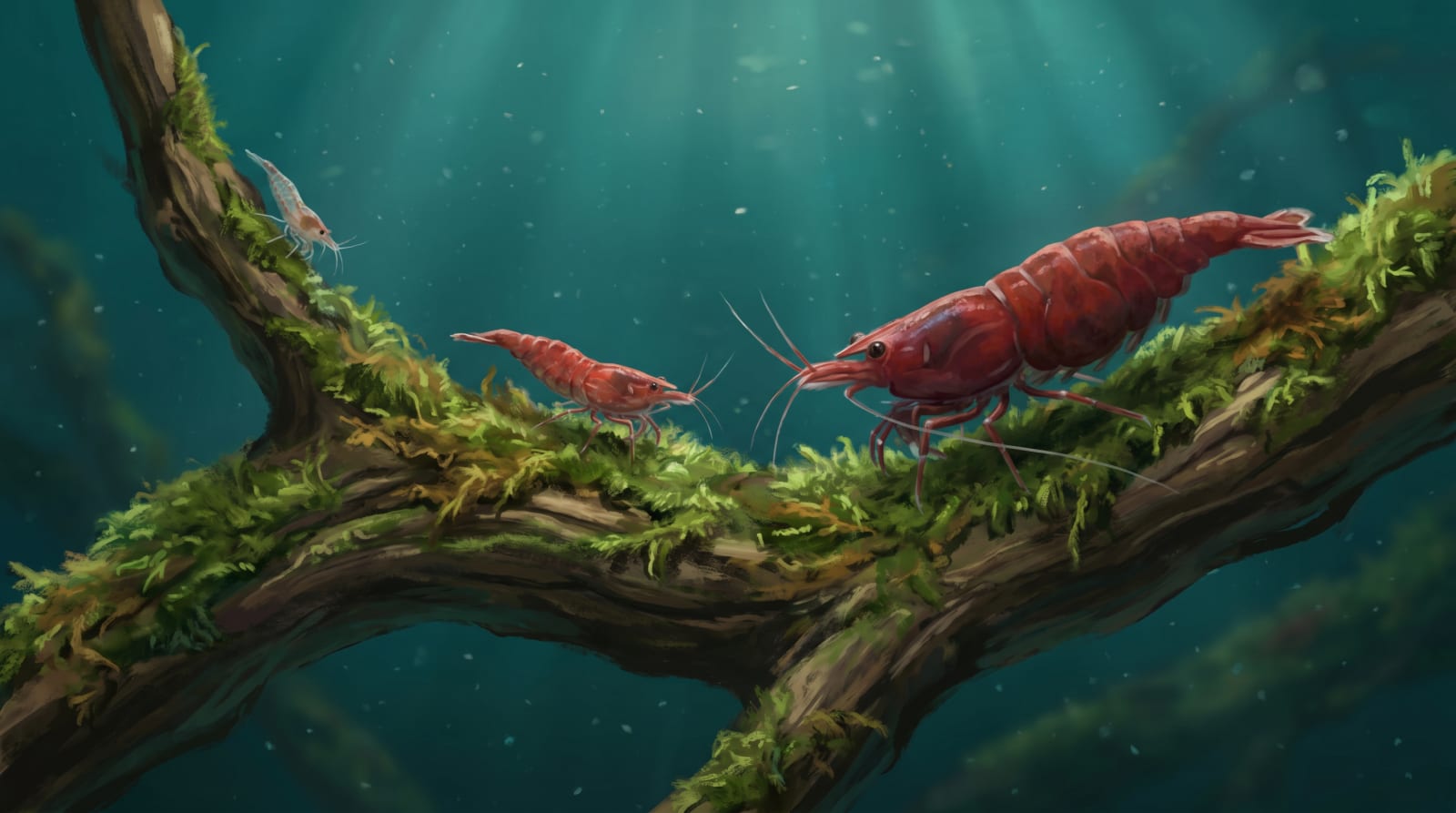
Cherry shrimp live one to two years, pack a full life into that short span, and change more between hatching and adulthood than almost any tank animal you'll keep. They arrive as fully formed miniatures, grow only by shedding their shells, and reach breeding age in a matter of months. This guide walks through every stage — how long each lasts, what it looks like, and what quietly lengthens or shortens the whole run.
How long do cherry shrimp live?
The honest answer is one to two years, and where a given shrimp lands in that range comes down to genetics, temperature and how steady you keep the tank. Two years is a good innings for a cherry shrimp; a well-kept colony will have individuals reach it, while a stressed or hard-run tank sees more of its shrimp closer to the twelve-month mark.
It's worth resetting expectations early, because "how long do cherry shrimp live" is often really asking whether a death was premature. For an animal with a one-to-two-year ceiling, the occasional loss in an established colony is ordinary ageing, not a failure on your part. What matters is the pattern: steady, occasional losses are the clock ticking; a cluster of deaths in a single week is something in the water. Our full cherry shrimp care guide covers the day-to-day that keeps a colony at the top of that range.
What lengthens and shortens a shrimp's life
Temperature is the biggest lever. Cherry shrimp are comfortable across 18–26°C, but warmth speeds their whole metabolism: at the breeding end of 21–24°C they grow faster, breed harder and, many keepers reckon, burn through their lives a little quicker. Cooler tanks run slower on every count. We hold our breeding tanks at 22–23°C as a deliberate trade — faster colonies, accepting we're not optimising for the longevity of any one shrimp. A cooler display tank may see slightly longer-lived individuals; nobody should sell you exact figures on that, because the honest evidence is keeper experience, not a stopwatch.
Stability is the second lever, and the one you control most. Every sharp swing in temperature, TDS or GH is a stress event, and stress events add up over a life. A tank held steady — parameters in range, not chased around with additives — simply wears its shrimp out more slowly. The reasoning behind each number is in our Neocaridina water parameters guide.
Genetics set the ceiling you're working under. Heavily line-bred, ultra-high-grade shrimp are often a shade less robust than hardy standard-grade stock — a fair trade some keepers make for colour. Starting with healthy, active shrimp from a decent source buys you vigour that no amount of aftercare can add back later.
The growth stages, from egg to adult
Cherry shrimp develop directly, and that single fact is the key to their whole life cycle: there's no free-swimming larval stage, no separate plankton food, no fiddly phase to engineer. What hatches is a shrimp in miniature, and from there it's simply a matter of growth.

Egg. A female carries her eggs herself, fanning them under her tail — "berried" is the word — for 14 to 21 days, faster at the warm end of the range. Toward the end you can see tiny dark eye spots through each egg. There's no separate incubation to manage; the mother is the incubator, and she'll carry 20 to 30 eggs at a time. What happens on her swimmerets is covered in our guide to cherry shrimp eggs.
Newly hatched shrimplet. They hatch as 1–2mm replicas of the adults and start grazing biofilm from their first day. They don't travel far to find food, so a mature tank with biofilm on every surface is what carries them through — which is exactly why an older, slightly grubby tank raises more young than a spotless new one. Getting more of them through this stage is the whole subject of raising shrimplets.
Juvenile. Over the following weeks the shrimplets grow steadily, moulting often because growth only happens when they shed the old shell. Colour begins to come in but stays patchy and pale; a juvenile red cherry looks nothing like the deep red cherry it will become. Sexing is close to impossible at this stage — don't read too much into a young shrimp's shape yet.
Adult. By three to five months they're sexually mature and close to full size, and the difference between the sexes turns obvious: females larger and deeper in colour, males smaller, slimmer and paler. From here the shrimp spends the bulk of its one-to-two-year life as a breeding adult, moulting every three to six weeks and, if it's a female, berrying again within days of many of those moults.
How big do cherry shrimp get?
Adult cherry shrimp reach 2.5–3cm from nose to tail, with a clear split between the sexes: females are the larger, rounder, more deeply coloured ones, males noticeably smaller, slimmer and paler. If you're comparing two shrimp and one is visibly bigger and richer in colour, that's your female.
They reach that size the only way a shrimp can — by moulting. Each new shell is built from minerals in the water, chiefly the calcium and magnesium measured as GH, so growth and shell quality are linked: a shrimp in mineral-poor water grows slowly and moults badly. Keep GH in the 6–12 range and steady, and size takes care of itself. When moults start failing, GH is the first thing to check, as we explain in failed moults and the GH connection.
What ageing looks like in a shrimp
Cherry shrimp don't make a drama of getting old. An ageing shrimp tends to slow down, graze a little less and may lose some of the intensity of its colour, but there's rarely a dramatic decline you can point to. Because the range is only one to two years, natural death is quiet and gradual, and it's easy to miss a single old shrimp passing in a busy tank.
The trap is reading old age into every death — or the reverse, writing off a preventable die-off as "just their time". The tell is number and timing. A lone shrimp gone in an otherwise thriving colony, no other symptoms, is almost certainly age. Two or three in a few days, or shrimp dying mid-moult with a pale ring behind the head, is not old age — that's the water talking, and it's worth testing before you assume anything.
Why a colony outlives any single shrimp
Here's the reframe that makes the short lifespan stop mattering. In a working colony the generations overlap so completely that the tank as a whole never ages, even as individuals reach the end of their one to two years. Females breed roughly every five to six weeks, a colony can double every two to three months in good conditions, and there are always eggs, shrimplets and juveniles coming up behind the adults.
The practical upshot is that you stop counting individuals and start thinking in colony terms. You won't clock a single shrimp reaching old age and passing; you'll notice the colony holding steady or growing, which is the real measure of a healthy tank. The maths behind that renewal — how ten starters become a self-sustaining population — is worked through in how fast cherry shrimp breed, and the mechanics of encouraging it in our breeding guide.
FAQ
How long do cherry shrimp live?
One to two years. Where an individual lands in that range depends on genetics, temperature and stability: warmer, harder-run tanks tend to see shrimp closer to a year, cooler and steadier ones closer to two. In a breeding colony it stops mattering much, because overlapping generations keep the tank populated long after any single shrimp has aged out.
How big do cherry shrimp get?
Adults reach 2.5–3cm from nose to tail. Females grow larger, rounder and more deeply coloured; males stay smaller, slimmer and paler. They reach full size by around three to five months, the same point they become sexually mature, and get there by moulting — each shed shell allowing a small step up in size, built from the minerals in your water.
How fast do cherry shrimp grow?
Quickly. They hatch as 1–2mm miniatures and reach breeding size by three to five months, moulting frequently as juveniles because growth only happens when the old shell comes off. Warmth speeds it up and mineral-rich, stable water supports it; cold or soft water slows growth and can cause failed moults. There's no larval stage to nurse — they graze and grow from day one.
Do cherry shrimp die after breeding?
No. Unlike some animals, cherry shrimp breed repeatedly across their adult life rather than dying after a single brood. A female can carry a new clutch within days of a moult and go on to raise many broods over her one to two years. If a berried female dies, look for a water-quality or stability problem, not the pregnancy itself.
Can you tell how old a cherry shrimp is?
Not precisely. Size is the rough guide — a full 2.5–3cm shrimp with deep, settled colour is an adult past three to five months, while smaller, patchily coloured shrimp are juveniles. Beyond that there's no reliable ageing tell; very old shrimp sometimes look a little less vivid or move less, but pale colour has many causes and isn't a clock.