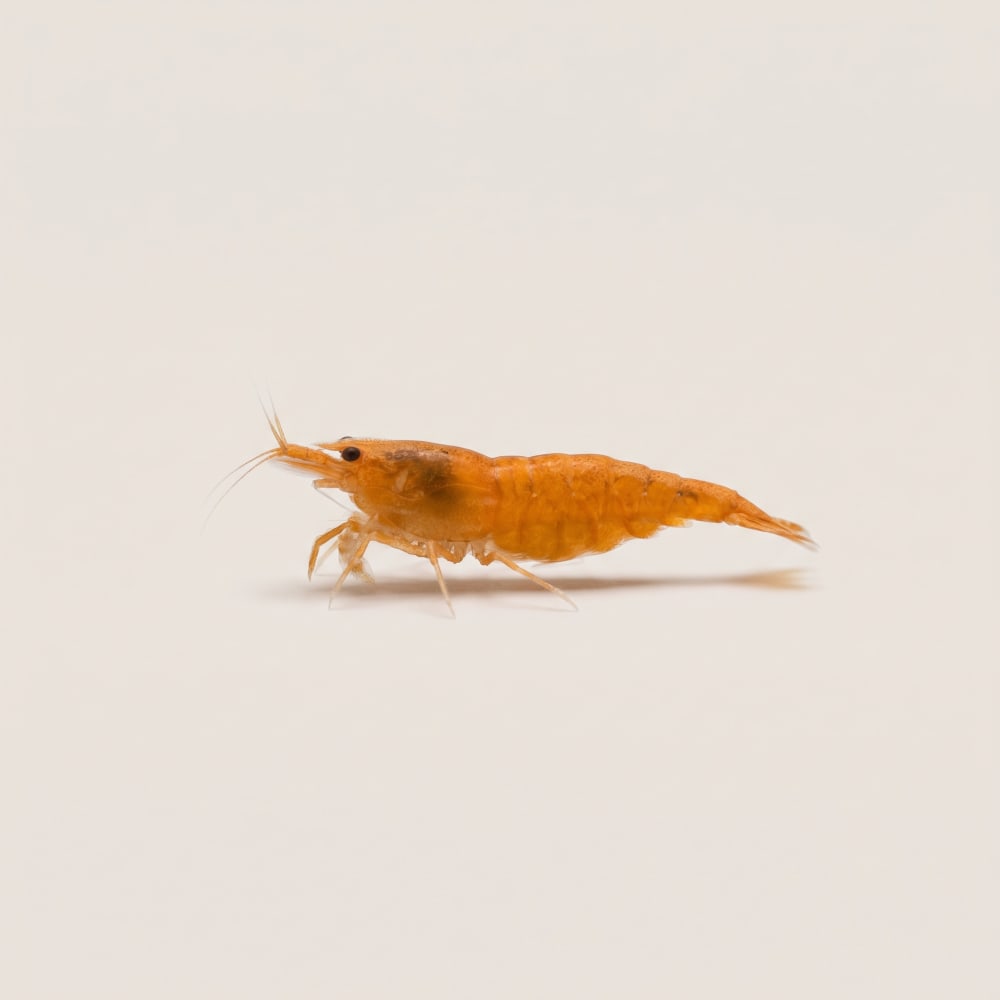
Ask us for one line to start with and the answer is usually this one. Orange Sakura is the warm, pumpkin-orange colour line of the cherry shrimp — an ember glow over dark substrate — and of everything on our racks it's the closest thing to indestructible we keep. It also owns the most confusing name in the hobby, because "sakura" means something entirely different on the red side of the ladder. We'll untangle that below.
Orange Sakura at a glance
| Difficulty | Easy |
| Adult size | 2.5–3cm |
| Lifespan | 1–2 years |
| Temperature | 18–26°C |
| pH | 6.8–7.6 |
| GH | 6–12 |
| TDS | 150–250 |
| Breeding | Prolific |
What is an orange sakura shrimp?
Orange Sakura is a colour line of Neocaridina davidi — the same species as the red cherry shrimp, selectively bred for a deep, warm orange instead of red. Everything that makes a cherry shrimp the best beginner shrimp in the hobby applies here unchanged: hardy, peaceful, prolific and perfectly happy in an unheated UK room.
Where the orange first came from is one of the hobby's quietly disputed stories. Most accounts have it selected out of wild-type stock rather than pulled off the red grading ladder, but breeders' versions differ and, for a keeper, it changes nothing. What we can say from our own racks is that the line is robust even by Neocaridina standards: our orange colonies are consistently the first to bounce back from a house move, a July heatwave, a missed feed. If we had to hand one line to a complete beginner, it would be this or a standard red.
"Sakura" means two different things
Here's the trap. On this page, Sakura is the orange line's name. On the red side of the hobby, Sakura is a grade — the middle rung of the ladder that runs Cull → Cherry → Sakura → Fire Red → Painted Fire Red, where each step up means more complete red coverage on the shell. So a "sakura shrimp" in one listing is a mid-grade red cherry, and in another it's this pumpkin-orange line, and neither seller is technically wrong.
The fix is simple: judge the photo, not the name. If a listing says "sakura" and the shrimp is red, you're looking at a graded red cherry — our Neocaridina grades guide explains exactly what that grade buys you. If it says "orange sakura", or the shrimp in the photo is orange, it's this line. When we sell them we write "orange sakura" in full for precisely this reason, and we'd encourage every seller to do the same.
Colour and grading
Orange Sakuras are graded the way most non-red lines are: on depth and evenness rather than a named ladder. Standard grade shows good orange with translucent patches, usually on the legs and underside. High grade is a solid, even pumpkin-orange from nose to tail, and you'll sometimes see the very deepest stock listed as "orange fire". Females are larger and carry the deeper, more opaque colour; males run smaller, slimmer and paler, which is normal for the species and not a fault in the line.
Environment does the rest. Over dark substrate the orange sits noticeably richer, over pale sand it washes out, and a colony on a varied, algae-heavy diet holds colour better than a sparsely fed one. Juveniles deepen as they mature, so don't judge young stock too early.
Care
Care is standard Neocaridina, which is to say easy: the canonical ranges are in the table above and the full routine is in our cherry shrimp care guide. A cycled tank of 19L or more, a sponge filter, stable water — stability mattering more than any individual number — and a dechlorinated water change each week. An unheated room at 18–21°C is fine; they simply breed faster at 22–24°C.
Most hard-water UK areas can keep them straight from the treated tap, while soft-water areas should remineralise to GH 6–12 first — our UK tap water guide tells you which side of that line your postcode sits on. The usual Neocaridina rules apply in full: no copper-based medications, and rinse or quarantine any plant that might carry pesticides.
Do orange shrimp breed true?
Yes — kept as a single line, orange breeds orange, generation after generation. Broods still vary, some shrimplets deeper and some paler, and improving a colony is nothing more complicated than moving your best orange into the breeding tank and rehoming the rest. The full cycle is in how to breed cherry shrimp: 20–30 eggs, carried for 14–21 days, shrimplets grazing biofilm from day one and maturing at 3–5 months.
The rule that actually matters: one colour line per tank. Orange Sakura will interbreed freely with any other Neocaridina — reds, blues, yellow fires — and mixed offspring drift back to brownish wild-type within a couple of generations. Orange next to yellow is a lovely pairing on a rack; in the same tank it's how both lines end. Mixing Neocaridina colours covers the genetics.
Buying orange sakura shrimp in the UK
Standard-grade orange shrimp cost £2–4 each in the UK, and solid high-grade Orange Sakura runs £30–50 per 10. Check the name against the photo — remember that "sakura" on its own may mean a mid-grade red — and look for even orange across the whole group in the seller's own photos, not one show female fronting the listing. Buy ten or more rather than a handful: cherry shrimp live as a colony, and ten gives you the genetic spread to keep a line strong. Slight translucence in juveniles is normal; young adults with their breeding life ahead of them are the better buy anyway.
Our own Orange Sakura colony is restocking at the moment — join the waitlist on this page and we'll email you when the next broods are graded and ready.
FAQ
Is a sakura shrimp orange or red?
Either, annoyingly. "Sakura" is used two ways in the hobby: as the name of this orange Neocaridina line, and as a grade of red cherry shrimp — the middle rung of the ladder that runs Cull → Cherry → Sakura → Fire Red → Painted Fire Red. A red "sakura" is a mid-grade red cherry; an "orange sakura" is this line. Always judge by the photo, not the name.
Are orange sakura shrimp easy to keep?
Yes — in our experience they're one of the hardiest cherry shrimp lines going. Standard Neocaridina care applies: 18–26°C, pH 6.8–7.6, GH 6–12 and stable, cycled water. It's a line we happily hand to complete beginners.
Do orange shrimp breed true?
Kept unmixed, yes. Orange paired with orange gives orange offspring, with normal grade variation in every brood. Mix them with any other Neocaridina colour and the offspring head back towards wild-type brown within a couple of generations, so keep one line per tank.
How much do orange sakura shrimp cost UK?
Around £2–4 each for standard grade and £30–50 per 10 for high grade. Orange sits at the affordable, available end of the hobby — it's a common line, which is part of its charm — so treat prices far above that range with scepticism unless the photos justify them.