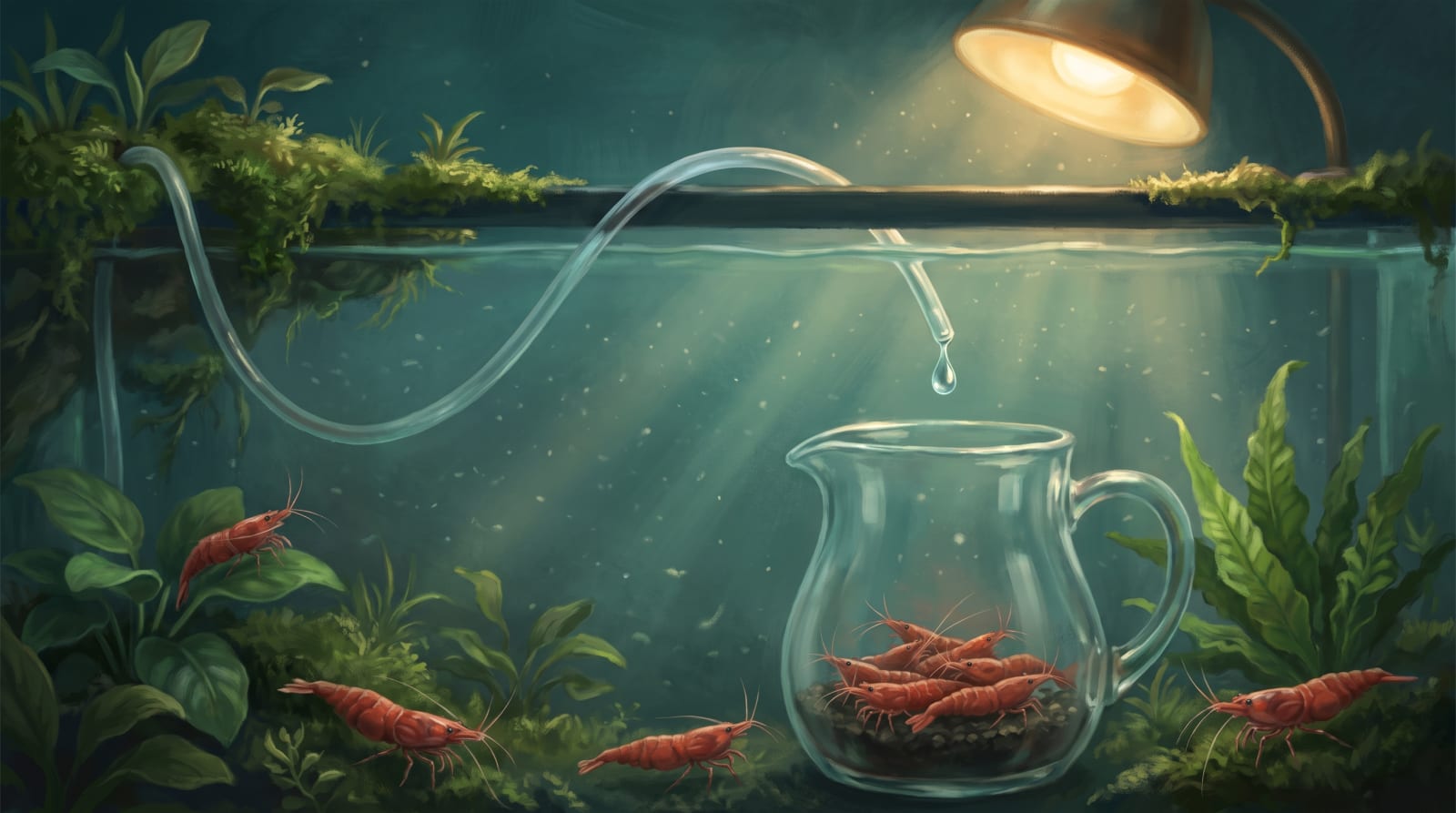
More new shrimp die in their first week than at any other point in their lives, and most of those deaths are decided in the first two hours — in the gap between the water they travelled in and the water they're being asked to live in. Drip acclimation closes that gap slowly enough for the shrimp to keep up. It costs a metre of airline tubing, a jug and an hour or two of patience, and it's the single habit that separates keepers who "have bad luck with shrimp" from keepers who don't.
Why shrimp need drip acclimation
Cherry shrimp are hardy about almost everything except sudden change. Their bodies constantly regulate internal fluids against the mineral content of the water around them, so when that water changes abruptly — a different TDS, a different GH, a different temperature — the shrimp has to re-balance faster than its physiology allows. The stress of a big, fast swing can even shock a shrimp into moulting before it's ready, and a bad moult at the worst moment is how you get the failure mode every keeper dreads, the white ring of death.
The gap is usually bigger than buyers expect. Your seller might run TDS at one end of the 150–250 range while your tap sits at the other; a shop in a soft-water town posts to a hard-water city; and the shipping water itself has drifted overnight — cooling in transit and accumulating waste. Pouring a shrimp straight from that bag into your tank asks it to absorb every one of those differences in one second. Dripping asks it to absorb them over two hours instead. Same destination, survivable pace. (If TDS is a new number to you, the early-warning number explains it — a cheap TDS pen is also how you measure exactly how big a gap your new shrimp are crossing.)
What you need
No kit list in this hobby is shorter:
- A container — a clean jug, bowl or food-safe tub, never soap-washed, big enough to hold the bag water three times over
- Airline tubing — a metre or two of standard aquarium airline
- A flow control — a loose knot tied in the tubing does it; a clip or tap-style valve is a luxury
- A net — for the transfer at the end
- A spot below the tank — gravity runs the whole operation
That's it. Nothing here needs buying from anywhere special, and the same kit does every future batch and gentle water changes besides.
The drip method, step by step
This is how every bag of shrimp that enters our fishroom is handled, whether it's ten standard cherries or a group of high-grade blue dreams.
- Float the closed bag in the tank for 15 minutes. This levels temperature — the fastest-acting parameter and the one shipping disturbs most. Keep tank lights off; a floating bag in a bright tank is a stressed bag.
- Empty the bag — shrimp and all their water — into the container. Sit it on the floor or a chair below the tank. Tip gently down the side rather than pouring from height.
- Start the siphon. Suck the tank end of the airline briefly (or dip-fill the tube), then let it run into the container. Tie your loose knot and tighten it until the flow settles at 1–2 drips per second.
- Let it run for 1–2 hours, until the volume in the container has doubled to tripled. The water your shrimp are sitting in is now mostly your tank's water, arrived at drip pace.
- Net the shrimp across into the tank. The container water — shipping water, waste and all — goes down the drain. Never pour it into your tank; you'd be undoing the entire exercise and importing whatever the bag was carrying.

Three small refinements from a lot of repetitions. Drape a towel or lid loosely over the container — new shrimp flick and climb, and a jug is easy to escape. Check the drip rate after ten minutes, because knots relax and flow drifts. And park the container somewhere it can't be knocked, kicked or investigated by anything on four legs.
How long to drip acclimate — and when to go slower
The honest answer to "drip acclimation how long" is: 1–2 hours, measured by volume rather than the clock. Doubling the container's starting volume is the minimum that counts as done; tripling it is better, and it's where we stop.
Inside that window, let the gap set the pace. Shrimp from a seller whose water broadly matches yours can run at the brisk end. Shrimp crossing a big divide — soft-water stock arriving into hard London tap, or the reverse — earn the slow end, a full tripling at a lazy drip. If you don't know the seller's numbers, assume the gap is big; that's also your reminder to buy from sellers who tell you, which is half the argument of where to buy cherry shrimp.
Don't stretch the job past a couple of hours, though. An open container holds a small volume of cooling, unfiltered water, and somewhere past that point the acclimation is causing more stress than it's removing. Slow means two hours, not an afternoon.
No airline? The quarter-cup method
Acclimating shrimp without a drip line works on exactly the same principle, just in steps: add roughly a quarter-cup of tank water to the container every 10 minutes, until the volume has doubled to tripled — the same 1–2 hours, arriving in small increments rather than drips. Then net across as usual.
It's slightly bumpier for the shrimp than a true drip, but it's the same gradual dilution and vastly better than floating a bag for twenty minutes and tipping it in. It's also the sensible answer the day a bag arrives and you discover your airline has walked. We'd still buy the tubing for next time; it costs less than a coffee and does the job better.
Five ways to undo a good drip
All of these are real, none hypothetical — we've either done them or been asked to diagnose them.
- Pouring the container water in at the end. The entire method exists to keep that water out of your tank. Net the shrimp across; everything else goes down the drain.
- Skipping the temperature float. Starting the drip on a cold, unfloated bag means the shrimp re-warm at whatever pace the room dictates. The 15 minutes in the tank is part of the method, not a preamble to it.
- Acclimating under bright light. Stress compounds. Tank lights off, container out of direct sun, towel loosely over the top.
- Walking away for the duration. Knots relax and drip rates drift — a drip that quietly becomes a trickle finishes the job in twenty minutes instead of two hours. Glance at the flow every so often.
- Topping the tank up afterwards with unconditioned tap water. Chloramine doesn't care how carefully you dripped. Every drop of new water gets dechlorinated, on arrival day and every day after.
The first 48 hours: what normal looks like
Freshly acclimated shrimp look underwhelming, and knowing that in advance saves a lot of unnecessary worry. Expect them to be washed out, pale and hiding for a day or two — transport stress drains colour, and it returns as they settle. Expect no grazing at first, then tentative picking, then normal behaviour somewhere inside the first couple of days. Leave the lights off for the rest of arrival day and resist the urge to poke around looking for them.
Don't feed on day one; a cycled, established tank is already serving the biofilm they actually want, and uneaten food is the last thing new water chemistry needs. And don't chase a shrimp that's vanished — it's in the moss, hardening off or calming down, exactly where it should be.
New shrimp died after acclimating: what actually happened
Sometimes you do everything above and still lose shrimp, and the drip gets the blame. Usually it's one of four other suspects.
The tank wasn't ready. An uncycled tank kills new shrimp regardless of how gently they arrived — ammonia and nitrite must be zero, full stop. If the tank is younger than a month or two, test before you blame the method, and read cycling a tank for shrimp before replacing anything.
The gap was too big for the time given. A one-hour drip across a huge parameter divide is still a shock, just a slower one. Deaths spread over the first week, moulting problems and lethargy point this way.
The shrimp arrived compromised. Stock that was weak, old or badly packed before it reached you dies in week one whatever you do. That's a seller problem, not an acclimation problem — what healthy shrimp look like covers spotting it before you pay, and how shrimp are shipped covers what a well-packed box looks like.
Something else in the water. Chlorine from an unconditioned top-up, copper, pesticide residue from a new plant: the killers that have nothing to do with arrival day. One death in a new group is attrition; a continuing pattern means testing, and why are my shrimp dying is the diagnostic to work through.
The method's job is to remove the one killer that's entirely in your control on day one. The rest is buying well and keeping the water honest — and if you'd like to start with shrimp that come with their water numbers attached, our own colony is rebuilding at the moment, and the waitlist gets first word when the next broods are graded and ready to ship.
FAQ
How long should you drip acclimate shrimp?
One to two hours, at 1–2 drips per second, until the water in the container has doubled to tripled in volume. Use the fast end when the seller's water is close to yours and the slow end when it differs or is unknown. Past a couple of hours the open container starts working against you — slower isn't safer indefinitely.
Do you have to drip acclimate cherry shrimp?
Strictly no — cherries are hardy, and some keepers float the bag and tip them in with apparent success. But the deaths that method causes arrive quietly, spread across the first week, and get blamed on "bad stock". An hour of dripping removes the biggest controllable risk on arrival day, so we drip every bag that enters our fishroom without exception.
How do you acclimate shrimp without an airline?
Use the quarter-cup method: shrimp and bag water go into a container, then add about a quarter-cup of tank water every 10 minutes until the volume has doubled to tripled — the same 1–2 hours as a drip, in steps. Net the shrimp across and bin the container water. It's marginally less gentle than a true drip but close, and far better than not acclimating.
Should you feed shrimp after acclimating?
Not on the first day. New arrivals barely eat, an established tank already offers the biofilm they'll graze when ready, and uneaten food only loads the water. Start light feeding once you see normal grazing behaviour — usually within the first couple of days — and expect full appetite as colour returns.
Why did my shrimp die after acclimating?
Work through four suspects in order: an uncycled tank (test ammonia and nitrite — must be zero), a water gap too big for the acclimation given (check your TDS and GH against the seller's), stock that was compromised before arrival (weak, badly packed or elderly shrimp), or an unrelated toxin like chlorine, copper or plant pesticide. One death is attrition; a pattern is a diagnosis waiting.