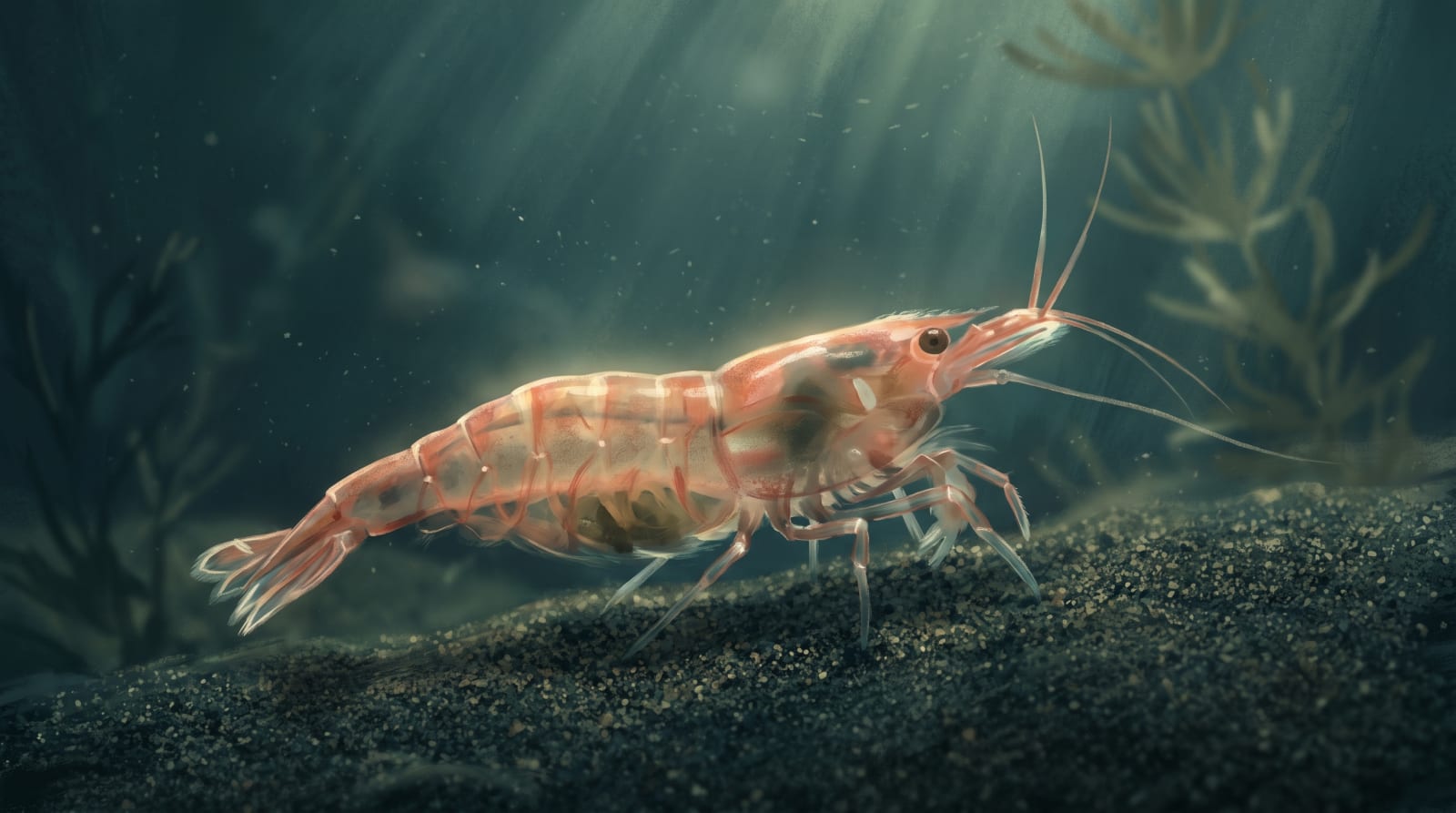
This is the serious one, and it's kinder to be honest up front than to sell you a cure that doesn't exist. When a cherry shrimp's body turns opaque and milky from the inside — most often in the tail — you are usually looking at muscular necrosis or an internal bacterial infection, and for that individual shrimp the outlook is poor. There is no reliable invert-safe treatment that will reverse it. What you can do is read it correctly, contain it, and protect the rest of the colony, and that's what this guide is for.
What opaque, milky tissue means
A healthy cherry shrimp's flesh is translucent. You can see the gut line running through it and, in a clear-bodied shrimp, a good deal of the internal structure. Muscular necrosis and internal bacterial infection both break that clarity: a patch of the muscle turns opaque, milky, chalky white or sometimes faintly pinkish, visible through the shell like a smear of white inside glass. It commonly starts in the tail or the abdominal segments and spreads forward over days.
The word necrosis simply means tissue death — the muscle in that segment is dying and losing its translucency. It can be set off by a bacterial infection in the body, or by acute stress that damages the tissue directly: a sudden large temperature or TDS swing, an oxygen crash, a serious ammonia hit. Very often, in a home tank, you can't tell which, and the practical truth is that it rarely changes what you do about it. Whether the trigger was a bug or a shock, the visible sign and the response are the same.
Necrosis, or the white ring of death?
The single most common mix-up is between this and the white ring of death, and getting it right matters because one is treatable-adjacent and the other isn't.
The white ring is a pale band that appears at the neck joint, behind the head, where the shell has separated for a moult the shrimp then can't complete. It's a shell event — external, at one specific line — and it's a moulting and mineral problem, covered in moulting problems and the white ring of death. Muscular necrosis is internal muscle going opaque, usually starting at the far end in the tail and creeping forward, with no clean band and no stuck moult. If the whitening is a tidy ring at the neck, read the white-ring guide. If it's a spreading milky patch in the tail, you're in the right place.
It's also worth separating from the external parasites in the same silo. Vorticella and scutariella sit on the outside of the shell and clear with a salt dip. Necrosis is inside the muscle, and no salt dip touches it — a distinction we come back to below.
Why there's no cure worth chasing
Anyone who promises you a bottle that reverses muscular necrosis in a shrimp is guessing, and often selling. There are a few hard reasons the affected shrimp usually can't be saved.
Once muscle tissue has gone necrotic, it doesn't come back to life; at best a very small, localised patch occasionally stops spreading and the shrimp lives on with a marked segment, but that's the exception, not something to plan around. Internal bacterial infections are worse still: the antibiotics that might, in theory, address them are difficult to use safely in a shrimp tank, unreliable against an established internal infection, and prone to crashing the biological filter you depend on — trading one dead shrimp for a tankful of ammonia. There is no shrimp-safe medication that dependably clears an internal infection at home. Treat the diagnosis as: this individual is probably lost, and the job now is everything else in the tank.
What to actually do: containment
Because you can't cure the shrimp, the whole game is containment. Three moves.
First, isolate or accept the loss. If you have a spare cycled tank or a simple observation container, moving the affected shrimp out removes any small risk it poses to the others and lets you keep an eye on it. If you don't, that's fine — the shrimp isn't a major infection risk to a healthy colony in good water, and forcing a stressed, dying shrimp through a net-and-transfer is a fair thing to skip.
Second, and this is the one that matters most, don't let the colony eat the body. Cherry shrimp are scavengers and will strip a dead tankmate quickly; with a bacterial death, letting them feed on the corpse is the clearest way to pass a bacterial load around. Watch for the shrimp actually dying, remove the body promptly, and don't leave it in overnight "to be sure". A shrimp that's genuinely dead rather than moulting has usually gone a dull pink and opaque — our post-mortem and diagnostic notes in why are my cherry shrimp dying help tell a body from a shed shell.
Third, fix the stressor. Necrosis and bacterial trouble almost always ride in on a weakened colony, and the thing that weakened it is nearly always the water or a swing in it.
Fixing the stressor is the real work
A single shrimp with a milky tail can be bad luck — an injury, a localised infection, an old animal near the end of its 1–2 year life. More than one, or a steady trickle, is the tank talking to you, and the message is almost always environmental.
Test properly: ammonia and nitrite should be zero, nitrate under 20ppm, and TDS, GH and temperature steady rather than perfect. The thesis that runs through our Neocaridina water parameters guide applies hardest here — stability beats perfect numbers, and it's sudden swings, not a slightly off reading, that batter a colony into the state where necrosis and infection take hold. If you find a problem, correct it gently, with small temperature-matched water changes rather than a big corrective flush that adds a second shock on top of the first. Cut feeding back while things settle, since decaying excess food is both a water-quality drag and a bacterial food source. Get the tank genuinely stable and the rest of the colony usually stays fine, even after you've lost one.
One shrimp, or several?
Reading the count is the most useful diagnostic you have. One opaque-tailed shrimp, with the rest grazing normally and holding their colour, points to an individual problem — injury, age, a one-off infection — and the response is simply to isolate or remove it and carry on watching. Several going milky over a short span points to a shared cause, and that's a water and stability investigation, not a shrimp-by-shrimp one. The split between one-off and colony-wide is the backbone of our whole approach to losses, and it's worth internalising: acute, all-at-once trouble is environmental until proven otherwise, while slow, one-at-a-time attrition is more often age and chronic conditions.
No copper, no miracle bottle
The rule that governs the entire health silo governs this too: never dose copper. Reaching for a broad "anti-bacterial" or "anti-parasite" fish medication in a panic is how a keeper turns the loss of one shrimp into the loss of the tank, because so many of those products are copper-based or otherwise lethal to invertebrates. There is no bottle to reach for here. Our guide to shrimp-safe medications and what never to dose lays out what's genuinely safe and what isn't, and for muscular necrosis and internal infection the honest answer is that the treatment is containment and prevention, not medication. That's not defeatism — it's the approach that actually protects the colony.
FAQ
Why is my shrimp turning white inside?
Opaque, milky flesh inside an otherwise clear shrimp — usually starting in the tail and spreading — is typically muscular necrosis or an internal bacterial infection. The muscle tissue is dying and losing its translucency. It's most often triggered by a bacterial infection or by acute stress like a sudden temperature or TDS swing, low oxygen, or an ammonia spike. It's different from the white ring of death, which is a band at the neck from a failed moult.
Can you cure muscular necrosis in shrimp?
Realistically, no. Once muscle tissue has gone necrotic it doesn't recover, and there's no reliable invert-safe medication that reverses it at home. Occasionally a tiny localised patch stops spreading and the shrimp lives on marked, but that's the exception. The productive response isn't to treat the affected shrimp — it's to contain the problem and fix the underlying stressor so the rest of the colony stays healthy.
What causes bacterial infections in shrimp?
Almost always a stressed or weakened colony in unstable conditions. Poor water quality, sudden swings in temperature or TDS, low oxygen, overfeeding and the decaying waste it leaves behind all lower a shrimp's resistance and let opportunistic bacteria take hold. A robust colony in stable, well-cycled water rarely develops internal infections, which is why prevention is about stability and hygiene rather than any medication.
Is muscular necrosis contagious to other shrimp?
Not in the way an external parasite is. It's usually driven by a shared stressor — bad water or a swing that hit the whole tank — rather than passing directly from shrimp to shrimp, so fixing the environment protects the others. The one real transmission risk is a bacterial death: don't let the colony eat the body, as scavenging a corpse can spread a bacterial load. Remove any body promptly.
My shrimp's tail is milky or cloudy — what should I do?
First decide whether it's one shrimp or several. For a single milky-tailed shrimp with a healthy colony around it, isolate or remove it, don't let the others eat it if it dies, and keep watching — it's often bad luck. For several at once, treat it as a water and stability problem: test everything, stabilise the tank with small gentle changes, and cut feeding. There's no salt dip or bottle that fixes internal necrosis.